
Introduction
You get a 5% raise. Your paycheck grows. You feel ahead.
Then you fill up your gas tank, pay rent, and buy groceries — and something feels off. The numbers don't add up. Your income went up, but somehow you have less.
That's not a budgeting problem. That's the nominal vs. real income gap playing out in real time.
This distinction goes far beyond personal finance. Investors, economists, and high-income earners who ignore it risk a slow, invisible erosion of their wealth — earning more dollars while actually affording less. BLS data confirms this happened on a massive scale: real average hourly earnings fell 3.6% in the year ending June 2022, even as nominal wages climbed.
This guide covers what nominal and real income mean, how to calculate the gap between them, and — more critically for high earners — what it means when inflation outpaces your raises year after year.
Key Takeaways
- Nominal income is your raw dollar earnings — your paycheck, before any inflation adjustment
- Real income reflects what those dollars actually buy, adjusted for inflation
- A rising paycheck does not guarantee rising purchasing power — inflation can wipe out those gains without a single pay cut
- The formula: Real Income = (Nominal Income ÷ Price Index) × 100
- For investors, nominal returns can mask negative real returns — especially during high-inflation periods
Nominal vs Real Income: At a Glance
| Nominal Income | Real Income | |
|---|---|---|
| Definition | Raw dollar earnings, unadjusted | Earnings adjusted for inflation |
| Inflation Adjustment | None | Accounts for CPI or price index |
| Measurement Tool | Current dollars | Base-year dollars |
| Reflects Purchasing Power | No | Yes |
| Primary Use | Payroll, contracts, tax reporting | Economic analysis, investment evaluation |
| Variability | Fixed unless pay changes | Fluctuates with inflation even if pay stays constant |
Nominal income is the number on your pay stub. Real income is what that number actually buys — and for anyone managing a high tax burden or evaluating long-term returns, the gap between the two is where wealth is won or lost.
What Is Nominal Income?
Nominal income is the total amount you earn in a given period — wages, salary, investment distributions, or business revenue — expressed in current dollar terms, with no adjustment for inflation.
It's the most visible form of income measurement. It appears on W-2s, 1099s, employment contracts, and pay stubs. When someone evaluates a job offer or a raise, nominal income is almost always the first number they look at.
What Drives Nominal Income
Several factors move nominal income up or down:
- Minimum wage floors set by government policy
- Employer compensation structures and salary bands
- Market demand for specific skills or roles
- Business performance and revenue growth
- Asset yield rates for investment income
Nominal income can rise even when purchasing power doesn't. A 4% raise is straightforward to calculate: $80,000 becomes $83,200. No additional variables required. But whether that $83,200 actually buys more than last year's $80,000 — that's a different question entirely.
Use Cases for Nominal Income
Nominal income is the right metric for:
- Payroll processing and salary negotiations
- Loan applications and debt-to-income ratios
- Tax calculations and legal contracts
- Any context requiring a fixed, agreed-upon dollar figure
For investors, nominal income shows up as the stated yield or distribution from an asset — for example, the dollar amount distributed per period from an energy partnership. That figure is the starting point for evaluating returns. Whether those dollars retain their purchasing power is where real income enters the picture.
What Is Real Income?
Real income is nominal income adjusted for inflation (or deflation). It answers not "how many dollars did you earn?" but "how much can those dollars actually buy?"
The Formula
As defined by the Dallas Fed, the standard calculation is:
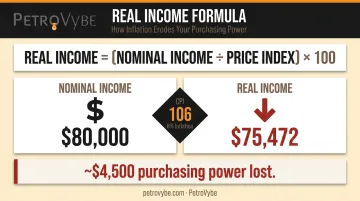
Real Income = (Nominal Income ÷ Price Index) × 100
The Price Index — typically the Consumer Price Index (CPI) — represents the general level of prices relative to a base year (1982–84 = 100 for CPI-U).
Example: If nominal income is $80,000 and the CPI reflects a 6% increase from the base year (index = 106), real income ≈ $75,472. The individual's actual purchasing power is roughly $4,500 lower than their paycheck suggests — even though the number on their W2 didn't change.
What Moves Real Income
Real income shifts when any of these change:
- CPI or PCE inflation rates — the primary driver
- Energy and food price shocks — in 2021, the energy index rose 29.3% and gasoline rose 49.6%, directly squeezing household purchasing power
- Wage growth relative to price growth — if wages rise 4% but prices rise 6%, real income falls 2%
- Monetary policy decisions that affect the money supply and price levels
CPI vs. PCE: Which Index to Use
| CPI | PCE | |
|---|---|---|
| Formula | Modified Laspeyres | Fisher-Ideal |
| Weights | Household survey data | Business survey data |
| Scope | Out-of-pocket urban household spending | Spending by and on behalf of all households |
| Substitution | More fixed | Allows for behavioral changes |
The choice of index affects the measured real income result. CPI is more commonly used for worker purchasing-power comparisons; PCE is the Federal Reserve's preferred measure for broader policy analysis.
Why Real Income Is the Honest Measure
Economists, policymakers, and investors rely on real income — not nominal — because it reflects what earnings actually buy. The IMF explicitly describes real income as a proxy for standard of living. For investors, this distinction is especially consequential: a return that trails inflation isn't growth — it's a loss dressed up in dollar signs.
Nominal vs Real Income: Which One Should You Actually Track?
Once you understand what each metric measures, the practical question becomes: which one should you be watching? The short answer is both — but for different purposes.
When Each Metric Matters
Use nominal income for:
- Day-to-day budgeting against fixed expenses (rent, loan payments)
- Salary negotiations and employment contracts
- Tax filing and legal reporting requirements
- Loan applications and credit decisions
Use real income for:
- Evaluating whether a raise actually improves your standard of living
- Assessing multi-year changes in purchasing power
- Determining whether investment returns are genuinely positive
- Comparing income across different time periods
The High-Earner Trap
Many high-income professionals receive consistent nominal income growth — salary increases, investment distributions, business revenue gains — without recognizing that inflation is steadily eroding the purchasing power of those gains.
BLS data for the year ended December 2022 illustrates this precisely: private-industry wages rose 5.1% nominally while falling 1.2% in constant dollars over the same period. Employees got raises — their real income still declined.
The Compounding Danger for Investors
For investors, nominal returns that look strong in absolute terms can represent negative real returns when inflation is factored in. A 4% nominal annual return in a 6% inflation environment is effectively a -2% real return.
This dynamic played out clearly in 2022: the CFA Institute reported that real returns for both equities and bonds entered negative territory across most major markets, as inflation consumed nominal gains. The pattern isn't new. NBER research documents that real safe-asset returns were "well below zero" throughout the 1970s inflation crisis as well — a reminder that the gap between nominal and real can persist for years.

The Decision Framework
| Situation | Use This Metric |
|---|---|
| Fixed monthly obligations | Nominal income |
| Evaluating a job offer vs. cost-of-living | Real income |
| Short-term cash flow planning | Nominal income |
| Long-term wealth preservation | Real income |
| Investment performance assessment | Real income (after-tax, after-inflation) |
When Nominal Income Rises But Real Income Falls: A Scenario Worth Understanding
Consider a high-income professional earning $200,000 annually who receives a 3% raise two years running. In nominal terms, income has grown to roughly $212,000. But if inflation ran at 5–7% annually — as it did during 2021–2022, when CPI-U peaked at 9.1% year-over-year in June 2022 — real income actually declined. The paycheck grew; what it buys didn't.
The Double Erosion Problem for Investors
Nominal investment income faces erosion from two directions, not one:
- Taxes on nominal gains — the IRS taxes the full nominal return, regardless of whether real purchasing power actually grew
- Inflation on what remains — after taxes, the after-tax dollars buy less than the original investment dollars did
NBER research documents this mechanism: taxes on nominal rather than real gains can significantly lower real after-tax yields as inflation rises. For high-income W-2 earners and capital gains recipients, this compounding effect is pronounced — higher earnings push income into higher brackets, and inflation erodes what's left after taxes.
What This Means for Investment Strategy
Investment vehicles that generate returns well above the inflation rate — with tax efficiency built in — aren't a bonus feature for high earners. They're the baseline requirement for preserving real wealth.
PetroVybe's natural gas development investment is structured specifically with this dynamic in mind. The company targets a ~26% IRR over a 10-year horizon, designed to generate returns that substantially outpace inflation. Equally important, PetroVybe's Intangible Drilling Cost (IDC) deductions — which in 2025 delivered a **94% tax deduction against active income** for partners, including W-2 earnings and capital gains — directly address the tax erosion side of the equation. On a $100,000 investment, that translates to $60,000–$80,000 in deductions applicable against ordinary income.

Learn more about how PetroVybe ONE is structured to deliver real, after-tax returns at petrovybe.com/one.
Frequently Asked Questions
What is nominal income vs real income?
Nominal income is the raw dollar amount you earn — your salary or investment return — without any adjustment for inflation. Real income adjusts that figure for price changes to show actual purchasing power. The gap between the two can widen by thousands of dollars during high-inflation periods.
How do you calculate real income from nominal income?
Use the formula: Real Income = (Nominal Income ÷ Price Index) × 100. For example, if your nominal income is $80,000 and the CPI is 106 (reflecting 6% inflation), your real income is approximately $75,472 — about $4,500 less in actual purchasing power.
Can your real income fall even if your salary goes up?
Yes. If inflation exceeds your rate of income growth, real income declines even when your nominal paycheck increases. This happened to millions of workers in 2022, when wage growth of ~5% was outpaced by inflation running above 8%.
What causes the gap between nominal and real income?
Inflation is the primary driver. When the general price level rises faster than earnings, purchasing power falls. Common triggers include supply shocks (energy, food), monetary policy changes that expand the money supply, and commodity price spikes like the 2021 energy surge.
Why does real income matter more for long-term wealth building?
Nominal income only shows how many dollars you earn. Real income reveals whether those dollars are actually increasing your standard of living — and without that adjustment, nominal figures give a misleading picture of financial progress over time.
What is the difference between nominal and real returns for investors?
Nominal return is the gross yield or distribution stated by an investment. Real return accounts for inflation's erosion of that yield. To build genuine wealth, an investment's after-tax returns must outpace the current inflation rate — otherwise the real gain is smaller than the nominal figure suggests.