Introduction
Imagine two business decisions: spending $50,000 on a year's worth of office supplies, or spending $50,000 on a piece of machinery that generates revenue for the next decade. The first purchase vanishes from your books within months. The second sits on your balance sheet for years, depreciating gradually while producing income the entire time.
That contrast is why fixed assets matter to more than accountants. For investors evaluating a company's earning power, depreciation schedules, and tax position, fixed assets are often where the real story lives.
This article covers what fixed assets are, the major categories with real-world examples, and how they're recorded and depreciated under GAAP — with particular attention to what those mechanics mean for investors putting capital into long-duration, tangible assets.
Key Takeaways
- Fixed assets are long-term tangible properties used to generate income, reported on the balance sheet as PP&E (Property, Plant & Equipment)
- Common types include land, buildings, machinery, vehicles, and industry-specific assets like producing wells and pipelines
- Depreciation method choice directly affects taxable income; in oil and gas, IDC deductions can front-load significant first-year tax savings
- Fixed asset purchases and disposals appear under investing activities on the cash flow statement, not operating activities
- Accredited investors can access tangible, long-duration oil and gas assets with substantial first-year tax deductions against active income
What Are Fixed Assets?
ASC 360-10-05-3 defines PP&E as "long-lived tangible assets used to create and distribute an entity's products and services." Three characteristics define them:
- Tangible form — they have physical existence
- Operational use — held for use in business operations, not for resale
- Long-term benefit — expected to contribute to future cash flows beyond one accounting period
Fixed Assets vs. Current Assets
Current assets — cash, inventory, accounts receivable — are expected to convert to cash within the normal operating cycle. Fixed assets are noncurrent by design. They're illiquid, depreciating slowly while generating income over time.
Land is classified as a fixed asset but is never depreciated. Finite-lived land improvements (paving, landscaping, drainage) are recorded separately and do depreciate.
What Fixed Assets Are NOT
Knowing what qualifies also means knowing what doesn't. Several things commonly mistaken for fixed assets fall outside the definition:
- Personal vehicles used for commuting
- Household appliances or consumer durables
- Intangible assets like patents, trademarks, or goodwill — these are noncurrent but amortized, not depreciated
Types of Fixed Assets
Different industries rely on entirely different asset bases. A retail chain's most critical fixed assets are its stores. An airline's are its aircraft. An oil and gas developer's are its producing wells and production infrastructure.
Property Assets
Land, buildings, factories, and warehouses are the most foundational fixed assets across industries. While land itself carries no depreciation, structures built on it are depreciated over their estimated useful lives. Under GAAP, nonresidential commercial buildings are typically depreciated over 39 years using the straight-line method for tax purposes.
A manufacturing company might own the building its assembly line occupies. A logistics firm might own warehouses across multiple states. In each case, the structure is recorded at cost and expensed over its useful life.
Equipment and Machinery
This category covers:
- Industrial machinery and assembly equipment
- Vehicles and transportation fleets
- Office furniture and computer hardware
- Specialized tools and production equipment
Equipment generally depreciates faster than property. Computers and vehicles lose value quickly due to obsolescence and wear, making accelerated depreciation methods particularly appropriate for this class. For IRS purposes, computers and peripherals carry a 5-year GDS recovery period, and automobiles a 5-year GDS period as well.

Infrastructure and Industry-Specific Assets
Capital-intensive industries maintain fixed asset bases that dwarf most other sectors:
- Airlines — aircraft and engines, classified within property and equipment in SEC filings
- Manufacturers — production machinery, tooling, and assembly equipment
- Oil and gas — drilling rigs, producing wells, production equipment, gathering pipelines, and processing facilities
For upstream oil and gas specifically, wells and related development facilities are recorded under oil-and-gas properties, subject to either successful-efforts or full-cost accounting rules. The IRS classifies well-drilling assets under asset class 13.1 with a 5-year GDS recovery period, while petroleum E&P assets fall under class 13.2 with a 7-year GDS recovery period.
PetroVybe's South Texas development projects illustrate how these classifications apply in practice. The PetroVybe ONE program in Lavaca County operates under asset class 13.1 — multi-well natural gas development infrastructure with proved reserves independently valued at $48 million (PV-09) by a licensed third-party engineering firm. Accredited investors who take a direct position hold an interest in these recorded assets from the point of development, when cost basis is established and IDC deductions become available.
How Fixed Assets Are Recorded in Accounting
Initial Recording and Cost Basis
When a fixed asset is purchased, the company debits the PP&E account and credits cash (or accounts payable). The recorded cost isn't just the sticker price — ASC 360-10-30-1 specifies that cost includes all amounts necessarily incurred to bring the asset to the condition and location required for its intended use. That means:
- Purchase price
- Shipping and delivery costs
- Installation and testing fees
- Any site preparation required
Depreciation begins when the asset is available for intended use — not necessarily when it's first used.
Where Fixed Assets Appear on Financial Statements
| Financial Statement | Where Fixed Assets Show Up |
|---|---|
| Balance Sheet | Net PP&E (gross cost minus accumulated depreciation) |
| Income Statement | Depreciation expense flows through each period |
| Cash Flow Statement | Purchases and disposals appear under investing activities |
That last point catches many readers off guard. Buying a $2 million piece of machinery doesn't hit operating cash flow — it's classified as a capital outflow under investing activities (ASC 230-10-45-13(c)). Proceeds from selling a fixed asset follow the same logic: they're investing inflows, not operating ones.
The Fixed Asset Lifecycle
Every fixed asset passes through four stages:
- Acquisition : Recorded at cost, including all costs to ready the asset for use
- Depreciation : Cost systematically expensed over the asset's useful life
- Revaluation or Impairment : If market value drops below net book value, an impairment write-down may be required
- Disposal : The original cost and accumulated depreciation are removed from the books; any gain or loss is recorded
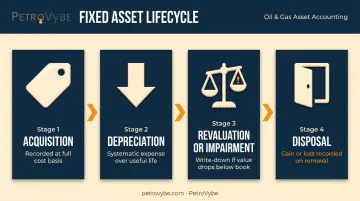
On disposal, if proceeds exceed the asset's net book value, the company records a gain. If proceeds fall short, it records a loss. Large disposal gains or losses can distort reported earnings, which is why analysts strip them out when evaluating underlying business performance.
That same focus on stripping out noise explains why analysts also rely on efficiency ratios to assess the asset base itself.
The Fixed Asset Turnover Ratio
The fixed asset turnover ratio (net sales divided by average net fixed assets) measures how efficiently a company converts its asset base into revenue. A higher ratio signals stronger capital deployment; a lower one often points to overcapitalization relative to output. Industry structure, asset age, and depreciation policy all affect where a given company lands, so cross-sector comparisons require context.
Depreciation Methods for Fixed Assets
Every depreciation calculation rests on three inputs:
- Cost basis — what was paid to acquire and ready the asset
- Salvage value — estimated residual value at end of useful life
- Useful life — how many years or units of production the asset is expected to contribute
GAAP requires companies to consistently apply their chosen method and disclose it. The method should match the pattern in which the asset's economic benefits are consumed.
Straight-Line Depreciation
The simplest and most common method. The same dollar amount is expensed every year.
Formula: (Cost − Salvage Value) ÷ Useful Life
Example: A $100,000 piece of equipment with a $10,000 salvage value and 10-year useful life generates $9,000 in annual depreciation expense.
Best suited for assets that deliver consistent value over time — buildings, furniture, and other long-lived assets that don't become obsolete quickly.
Accelerated Depreciation Methods
When assets lose value faster in early years, accelerated methods are more appropriate:
Double Declining Balance (DDB): Applies twice the straight-line rate to the beginning carrying amount each year. A 10-year asset would depreciate at 20% annually (instead of 10%), front-loading expense in years one through three. The asset cannot be depreciated below salvage value.
Sum-of-the-Years'-Digits (SYD): A middle-ground accelerated method that calculates depreciation as: depreciable base × (remaining life ÷ sum of original years of life). Slightly less aggressive than DDB.
Units of Production: Ties depreciation to actual output rather than time. Depreciation = (depreciable base ÷ total estimated capacity) × current-period output. This is especially relevant for oil and gas wells, where production declines over the asset's operating life — PwC confirms that upstream DD&A is typically calculated on a units-of-production basis because output best reflects how the asset's benefits are consumed.
Tax Implications of Depreciation
Depreciation also reduces taxable income directly — and for the right asset class, that reduction can be immediate. Two current provisions are particularly powerful:
| Provision | Key Limit | Effective Date |
|---|---|---|
| Section 179 | $2.56M maximum deduction; phaseout begins at $4.09M in qualifying property placed in service | Tax years beginning in 2026 |
| Section 168(k) Bonus Depreciation | Permanent 100% additional first-year depreciation | Qualifying property acquired and placed in service after January 19, 2025 |
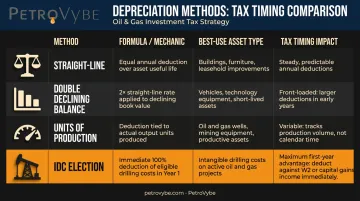
For oil and gas, the tax benefit goes further. Intangible Drilling Costs (IDCs) cover wages, fuel, geological services, engineering, drilling, and hydraulic fracturing. These costs can be elected as current expenses under IRC 263(c) and Treasury Regulation 1.612-4, rather than capitalized and depreciated over years.
That election can compress the tax recovery timeline from years to a single filing period — a structural advantage that standard fixed asset depreciation cannot match.
Why Fixed Asset Investment Matters to Investors
Understanding a company's fixed asset base reveals three things: its long-term earnings capacity, its capital discipline, and its tax efficiency. A business with well-managed assets can generate durable income while building balance sheet value over time.
The Oil and Gas Tax Advantage
For accredited investors, oil and gas fixed assets carry a tax treatment that most asset classes can't match. Under IRC 469(c)(3), a working interest held directly or through an entity that does not limit the holder's liability is excluded from passive activity treatment — meaning qualifying IDC deductions can potentially offset active income, including W2 earnings and capital gains, rather than being confined to passive income.
IRS Publication 925 applies adjusted-basis limits, at-risk rules, and other limitations in sequence, so individual tax outcomes depend on ownership structure, filing facts, and consultation with a qualified tax advisor. The structural advantage is real. Congress carved out the working interest exception specifically because it recognized oil and gas development as a productive, job-creating activity that deserves preferential tax treatment.
PetroVybe's Direct Asset Position
PetroVybe structures its development positions so that accredited investors hold a direct limited partnership equity interest in the underlying physical assets through PetroVybe Partners LP, a Regulation D 506(c) private placement. The underlying assets include producing wells, production infrastructure, and proved reserves. This is not a stock, ETF, or fund. It's an equity stake in the PP&E itself.
The PetroVybe ONE program in Lavaca County, Texas operates on a dual strategy:
- PROTECT — Acquire legacy production assets and execute targeted workovers to maintain and improve efficiency of existing wells
- SCALE — Continuously reinvest operating cash flow to drill new wells, replacing natural production decline with fresh productive capacity
Partners receive K-1 documentation reflecting their direct equity position, including IDC deductions exclusively available to equity participants in drilling operations — not to holders of derivative instruments.
In practice, PetroVybe partners have achieved first-year tax deductions of 91–94% against active income across recent years, combining IDC deductions with depletion allowances and other oil and gas tax benefits.
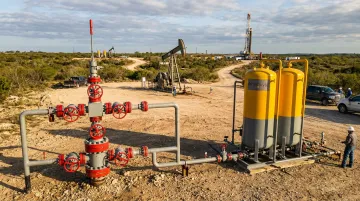
The fixed asset base underlying the project covers wells across multiple Texas counties and carries a $48 million proved reserves valuation (PV-09) determined by a licensed third-party engineering firm. Unlike book value, PV-09 measures forward-looking cash flows — giving investors an independently validated picture of what the physical assets are actually worth in production terms.
Frequently Asked Questions
What are common examples of fixed assets?
The most recognizable categories include land and buildings, vehicles and machinery, office equipment and computers, and industry-specific infrastructure such as producing oil and gas wells, gathering pipelines, drilling rigs, and production equipment. Any tangible asset held for operational use with a benefit period beyond one year qualifies.
How do you account for fixed assets?
Fixed assets are initially recorded on the balance sheet at cost — debit PP&E, credit cash or accounts payable. The asset is then depreciated over its useful life, with annual depreciation expense flowing through the income statement. Upon disposal, the original cost and accumulated depreciation are removed, and any gain or loss is recognized.
What is the difference between fixed assets and current assets?
Current assets are expected to convert to cash within the normal operating cycle — inventory, receivables, and cash itself. Fixed assets are noncurrent, held for more than one period, and used to generate income rather than sold in the ordinary course of business. Land is a fixed asset that carries no depreciation because it doesn't wear out.
How does depreciation reduce taxable income?
Depreciation allows businesses to deduct a portion of a fixed asset's cost each year as an operating expense, reducing net taxable income. In oil and gas, IDC deductions can allow a large first-year write-off against active income, pushing the tax benefit well beyond what standard depreciation on other asset classes delivers.
Are oil and gas wells considered fixed assets?
Yes. Producing wells, drilling equipment, pipelines, and processing infrastructure are all treated as PP&E. Upstream oil and gas properties follow either successful-efforts or full-cost accounting, with depletion calculated on a units-of-production basis tied to proved reserves.
What is the fixed asset turnover ratio?
The fixed asset turnover ratio measures how efficiently a company generates revenue from its fixed assets, calculated as net sales divided by average net fixed assets. A higher ratio signals more effective capital use, though comparisons are most meaningful within the same industry since asset intensity varies significantly across sectors.