

This guide answers the questions that matter most: what a net worth tax is, how it differs from taxes you already pay, the current US status, and what legal steps high earners can take right now to reduce their tax burden.
Key Takeaways
- A net worth tax (also called a wealth tax) is an annual levy on total assets minus liabilities — not on income earned
- The US has no federal net worth tax as of 2025; several proposals exist but none have been enacted
- A net worth tax differs from income, capital gains, and property taxes — those tax flows or specific assets, not accumulated wealth
- Most OECD countries that adopted net worth taxes have since repealed them
- Legal deductions like Intangible Drilling Costs can meaningfully reduce the income tax burden high earners face today
What Is a Net Worth Tax and How Does It Work?
A net worth tax — also called a wealth tax or capital tax — is an annual levy on an individual's or household's total assets minus total liabilities. Unlike income tax, which taxes what you earn, a net worth tax targets accumulated wealth: the stock of what you own, not the flow of what you receive.
What Counts as "Net Worth" for Tax Purposes?
The tax base typically includes:
- Financial assets — bank accounts, stocks, bonds, mutual funds, retirement accounts
- Non-financial assets — real estate, luxury goods, business interests, artwork, trusts
- Minus liabilities — mortgages, business debts, personal loans
So a household with $60M in assets and $10M in debts would have a taxable net worth of $50M.
A Concrete Example
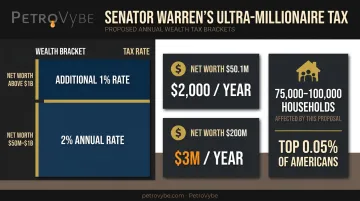
Senator Warren's Ultra-Millionaire Tax proposal illustrates how this works in practice. The proposal applies a 2% annual rate on net worth between $50M and $1B, plus an additional 1% above $1B.
Under that structure, a family with $50.1M in net worth has $100,000 of taxable wealth — producing a $2,000 annual tax bill. A household at $200M would owe roughly $3M per year. Anyone below the $50M threshold owes nothing.
Warren's 2024 release estimated the tax would affect roughly 100,000 households — approximately the top 0.05% of Americans. The Peter G. Peterson Foundation put the number at 75,000 households (0.06%).
These numbers also clear up two misconceptions that surface in nearly every policy debate about wealth taxes.
Two Common Misconceptions
A net worth tax does not replace income tax. Most proposals layer on top of existing income taxes — meaning high earners would still owe income tax on what they earn, plus the annual wealth levy on what they hold.
Nor would most Americans owe anything under it. The proposed exemption thresholds ($50M+) are designed to target only the ultra-wealthy, leaving the overwhelming majority of households — including many high-income earners — outside the scope.
Does the US Have a Federal Net Worth Tax?
No. As confirmed by the Congressional Research Service, the United States does not have a federal wealth tax as of 2025. Multiple proposals have been introduced — including Warren's Ultra-Millionaire Tax — but none have been enacted into law.
The Constitutional Barrier
Whether Congress even could pass a federal net worth tax without a constitutional amendment remains genuinely unsettled. Article I of the Constitution requires that "direct taxes" be apportioned by state population — a requirement that would create serious structural problems for a uniform wealth tax.
Legal scholars are divided on two competing positions:
- Amendment required: A wealth tax needs a constitutional amendment — similar to the 16th Amendment that enabled income taxes
- Excise tax workaround: It could be structured as an excise tax to sidestep the apportionment requirement entirely
The Supreme Court's 2024 decision in Moore v. United States addressed an income tax question, not a wealth tax — so the constitutional question remains open.
State-Level Exceptions Worth Knowing
Georgia imposes a corporate net worth tax on corporations doing business in the state, calculated using the prior year's ending balance sheet. The graduated schedule runs from $0 (for net worth at or below $100,000) to $5,000 (above $22M). This applies to Georgia corporations and LLCs taxed as corporations — not to single-member LLCs or individuals.
Texas went the opposite direction: in November 2023, voters approved a constitutional amendment (Proposition 3) explicitly prohibiting the state legislature from ever imposing a net worth or wealth tax on individuals or families — making it one of the strongest state-level protections for wealth holders in the country.
Don't Confuse NIIT With a Wealth Tax
The Net Investment Income Tax (NIIT) is frequently misidentified as a form of wealth tax. It isn't. The NIIT is a 3.8% federal tax on investment income — dividends, capital gains, rental income, and similar flows — for taxpayers whose modified AGI exceeds:
- $200,000 (single filers)
- $250,000 (married filing jointly)
- $125,000 (married filing separately)
The NIIT taxes investment income, not accumulated wealth. In other words, a household sitting on $50M in assets but earning little income in a given year would owe nothing under NIIT. That's a structurally different tax base.
Net Worth Tax vs. Other Taxes: Key Differences
High earners often ask how a net worth tax compares to taxes they're already paying. The distinction is the tax base.
| Tax | What It Taxes | Who It Affects |
|---|---|---|
| Net worth tax | Total assets minus liabilities (annual) | Ultra-wealthy households (if enacted) |
| Income tax | Wages, salaries, business income | All earners above standard deduction |
| Capital gains tax | Profits on asset sales | Investors who sell appreciated assets |
| Property tax | Real estate value (state/local) | Property owners |
| NIIT | Investment income above MAGI threshold | Investors earning $200K+ (single) |

None of these are a net worth tax. Each targets a specific flow or a specific asset class — not the full stock of accumulated wealth.
Why This Distinction Matters for Planning
For high earners today, the more pressing question is a practical one: how do you reduce the income taxes you're already paying?
A federal net worth tax doesn't exist. Income taxes do, and at the top marginal rate of 37% for ordinary income above $626,350 (single) or $751,600 (married filing jointly) in 2025, they represent a substantial and immediate burden. That's the tax reality high earners need to plan around — not a hypothetical wealth levy that has never passed Congress.
Arguments For and Against a Net Worth Tax
The Case For
- Wealth concentration: Federal Reserve data show the top 10% of households held approximately $118.26T of the $174.01T in total household wealth as of Q1 2026 — roughly 67.96% of all wealth
- Revenue potential: Proponents argue it would raise significant federal revenue from a narrow population
- Tax system progressivity: Investment income is often taxed at lower rates than wages, creating effective rate disparities that a wealth tax could address
The Case Against
- Valuation difficulty: How do you tax a stake in a private business, a piece of art, or an illiquid real estate portfolio? Subjective valuations create disputes and enforcement nightmares
- Capital flight: Wealthy individuals may move assets offshore or relocate to avoid the tax — reducing the revenue actually collected
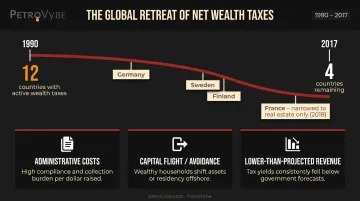
- International track record: The OECD's analysis of net wealth taxes found 12 OECD countries had active wealth taxes in 1990; by 2017, only four remained — with administrative costs, avoidance, and lower-than-projected revenues driving repeal after repeal. Germany, Sweden, and Finland abolished their wealth taxes entirely; France narrowed its to real estate only in 2018
The debate is real, and the history is instructive. Whether a net worth tax ever takes effect in the US depends on political will and whether lawmakers can solve the practical problems that sank it elsewhere — but high-net-worth individuals would be wise to understand both sides before that question is answered.
How Accredited Investors Can Legally Reduce Their Tax Burden Today
Here's the practical reality: a federal net worth tax is a policy debate. The income tax burden on high earners is not.
A single filer earning $1,000,000 in ordinary income in 2025 faces an estimated federal income tax of approximately $321,470 (roughly a 32% effective rate after applying the standard deduction and marginal brackets). That's before accounting for NIIT on investment income. For married filers, the effective rate is approximately 28.3%, or about $282,963.
That's an immediate, real problem — and legal solutions exist.
Intangible Drilling Costs: A Little-Known Tax Deduction
Few deductions match the raw impact of Intangible Drilling Costs (IDC) for high earners — a benefit that flows directly from oil and gas development investments.
Under IRC Section 263(c), taxpayers may elect to deduct IDCs — expenditures for wages, fuel, supplies, and other costs incurred in drilling and preparing wells for production — in the year they're made. These aren't depreciated over time. They're deducted immediately.
What makes IDCs particularly valuable for high earners:
- Offsets W-2 wages, capital gains, and other active income — oil and gas working interests are specifically exempted from passive income restrictions under IRC Section 469(c)(3), unlike most investment deductions
- Delivers deductions in Year 1 via K-1, not spread across years of depreciation
- Allows investors to take the full IDC deduction upfront or spread it equally over 5 tax years
PetroVybe: An Example of IDC Deductions in Practice
PetroVybe is a Texas-based oil and natural gas development company that structures direct investment positions for accredited investors through a limited partnership (PetroVybe Partners LP). The LP passes IDC deductions through to partners annually via K-1.
Documented partner results:
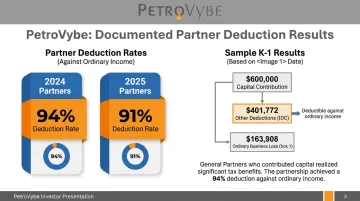
- 2024 partners: 94% tax deduction against active ordinary income
- 2025 partners: 91% tax deduction against active income
- Verified investor Nizar A. eliminated a $30,000 tax liability completely through the deduction structure
- A sample K-1 shows a partner with a $600,000 capital contribution receiving $401,772 in other deductions — approximately 67% from that line item alone, with totals reaching the 91–94% range across all deductions
PetroVybe focuses on natural gas liquids (NGL) development in South Texas and the Gulf Coast Basin, with operations spanning Lavaca County and beyond. The company carries a $48MM proved reserves valuation (PV-09) from a licensed third-party engineering firm.
Its Chief Geophysicist, Michael Stamatedes, brings a 75.2% career well success rate over 48 years — nearly double the industry average of below 40%.
Key investment parameters:
| Minimum Investment | $100,000 |
| Target 10-Year MOIC | 2.2–5.8x |
| Eligibility | Accredited investors only |
| Income Threshold | $200,000+ individual / $300,000+ joint |
| Net Worth Threshold | $1M+ excluding primary residence |
All projections are forward-looking and subject to variables. Consult your CPA or tax attorney before investing.
Frequently Asked Questions
Do you pay taxes on your net worth?
In the US, there is currently no federal tax on net worth or accumulated wealth. Americans are taxed on income earned, capital gains realized, and certain investment income — not on the total value of assets held.
How much federal tax do you pay on $1,000,000?
A single filer earning $1,000,000 in ordinary income in 2025 owes approximately $321,470 in federal income tax (roughly 32% effective rate, after the standard deduction). Married filing jointly comes to approximately $282,963 (28.3% effective rate). Additional taxes like NIIT may apply on investment income portions.
Does the US have a net worth tax?
No federal net worth or wealth tax exists as of 2025. Proposals have been introduced but not enacted. Texas has constitutionally banned one at the state level. Georgia levies a corporate net worth tax on businesses doing business in the state (not on individuals).
What is the difference between a net worth tax and a wealth tax?
The terms are generally interchangeable and both refer to a tax on total assets minus liabilities. "Net worth tax" sometimes refers specifically to corporate versions like Georgia's, while "wealth tax" more commonly describes individual-level proposals like Warren's Ultra-Millionaire Tax.
Which states have a net worth tax?
Georgia is the primary state with an active corporate net worth tax, applicable to corporations doing business in the state. Texas explicitly prohibits one via constitutional amendment. No state currently imposes a personal net worth tax on individuals.
Is a federal wealth tax constitutional in the US?
Constitutionality remains genuinely debated. The Constitution requires direct taxes to be apportioned by state population — a significant barrier that leads some scholars to argue an amendment would be needed, while others contend it could be structured as an excise tax to sidestep that requirement. No Supreme Court ruling has definitively resolved the question.