This article breaks down what carried interest is, how the distribution waterfall determines when GPs get paid, and why the tax treatment has survived decades of legislative challenges. It also explains what carried interest means for accredited investors evaluating private fund structures versus direct investment alternatives.
Key Takeaways
- Carried interest is the GP's share of fund profits — typically 20% — earned only after investors receive their capital back plus a preferred return
- Assets held more than three years qualify for long-term capital gains rates (up to 23.8% including NIIT), versus a top ordinary income rate of 37%
- The 2017 Tax Cuts and Jobs Act extended the minimum holding period from one to three years under IRC Section 1061
- LPs don't share in carried interest's tax advantage — their returns are taxed based on the character of underlying fund income, making fund structure matter more than most investors realize
- Direct oil and gas investments take a different approach: IDC deductions accredited investors can use against active income, including W-2 wages
What Is Carried Interest in Private Equity?
Carried interest is the performance-based share of profits paid to the general partner (GP) of a private investment fund. Unlike a salary or flat fee, carried interest is contingent compensation — the GP earns it only after the fund clears a pre-agreed return threshold, meaning investors profit before the manager does.
The LP/GP Fund Structure
Private equity funds operate on a two-party model:
- Limited partners (LPs) — institutional investors, family offices, and accredited individuals who contribute capital
- General partner (GP) — the fund manager who sources deals, manages investments, and executes exits
The GP typically contributes little or no capital but receives carried interest as their primary upside. According to PitchBook and Preqin's historical fund terms data, 20% is the standard carry rate, appearing at approximately 84% of sampled funds. This is the "20" in the well-known "2 and 20" fee structure — the "2" being the annual management fee.
Carried Interest vs. Management Fee
These two fees serve entirely different purposes:
| Fee | Rate | Timing | Purpose |
|---|---|---|---|
| Management fee | ~2% of AUM annually | Regardless of performance | Covers GP operating costs |
| Carried interest | ~20% of profits | Only above the hurdle rate | Performance incentive |
The management fee covers GP salaries, overhead, and deal sourcing costs regardless of fund performance. Carried interest is where GPs make real money — but only if the fund delivers. A manager collecting a 2% fee on a $500M fund earns $10M annually whether returns are strong or flat; carried interest, by design, eliminates that misalignment.
How Carried Interest Is Calculated
Carried interest isn't paid on gross fund returns. It flows through a structured sequence called a distribution waterfall, which determines the order in which proceeds are allocated.
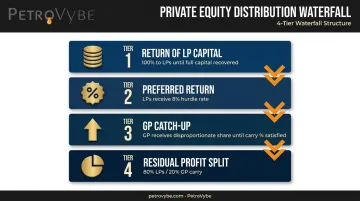
The Four-Tier Waterfall
A common waterfall structure works as follows:
- Return of LP capital — 100% of proceeds go to LPs until they recover their full investment
- Preferred return (hurdle rate) — LPs receive their agreed preferred return, typically set at 8% annually per Preqin's fund terms data
- GP catch-up — in some funds, the GP receives a disproportionate share of the next tranche until their carry percentage is satisfied
- Residual profit split — remaining profits split 80% to LPs and 20% to the GP as carried interest
If the fund never clears the hurdle, the GP earns no carry. Full stop. Many funds also include a clawback provision: if the GP receives carry early in the fund's life but the fund ultimately underperforms, LPs can recover previously distributed carry.
Timing matters here. Bain's 2026 Global Private Equity Report notes that buyout holding periods currently average around seven years — which directly affects both when carry is paid and how it's taxed.
A Concrete Example
Assume a $100M fund with an 8% hurdle rate and a 20% carry:
- Final fund value: $140M
- Total profit: $40M
- LP preferred return (8% on $100M): $8M — paid to LPs first
- Remaining profit: $32M
- GP carry (20% of $32M): $6.4M
- LP share of remaining profit: $25.6M
The GP's $6.4M carry comes from the profits above the hurdle, not from the total gain. The LP recovers $100M in capital, $8M in preferred return, and $25.6M from the residual split — totaling $133.6M.
Carry is distributed from realized profits after a liquidity event. That timing — and the long holding periods typical in private equity — is central to understanding how the IRS treats it.
How Is Carried Interest Taxed?
Carried interest taxation hinges on one key distinction: whether gains are treated as capital gains or ordinary income. That choice determines whether fund managers pay roughly 24 cents or 41 cents on every dollar of profit — and it's the source of most political debate around this compensation structure.
The Capital Gains Advantage
For federal tax purposes, carried interest is generally treated as long-term capital gains rather than ordinary income, provided the fund holds its underlying assets for more than three years. That 17-percentage-point gap in top rates translates directly into millions of dollars for high-earning fund managers.
Current federal rate comparison:
- Long-term capital gains: Maximum 20%, plus 3.8% NIIT for high earners = up to 23.8% combined maximum
- Ordinary income (top bracket): 37% for tax year 2026, plus 3.8% NIIT where applicable = up to 40.8%
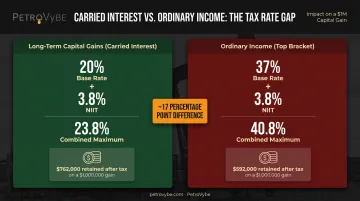
Per the IRS, the 20% long-term capital gains rate applies above applicable thresholds, and NIIT applies when modified adjusted gross income exceeds $200,000 (single) or $250,000 (married filing jointly).
The Three-Year Rule (IRC Section 1061)
The Tax Cuts and Jobs Act of 2017 added IRC Section 1061, extending the minimum holding period for capital gains treatment from one year to three years. Assets held three years or less trigger short-term recharacterization, pushing the tax rate up to 40.8% (37% + 3.8% NIIT).
In practice, this constraint rarely affects carry distributions. Most private equity funds hold assets five to seven years — well beyond the three-year threshold.
Two Additional Structural Advantages
Beyond the rate differential, carried interest benefits from two structural features:
- Pass-through taxation: Private equity funds are typically structured as limited partnerships, meaning income passes through to partners' individual returns without entity-level tax
- Tax deferral: Taxes are owed only upon a realization event (when the fund sells an investment and distributes profits), which can delay liability for years
The Carried Interest Debate
Carried interest has survived four decades of legislative scrutiny without structural change — and the reason comes down to a genuine disagreement about what carried interest actually is.
The Critics' Case
Critics argue that carried interest is economically indistinguishable from a performance bonus — compensation for services rendered. Under that view, taxing it at capital gains rates gives fund managers a preferential rate unavailable to other high earners who receive bonuses taxed as ordinary income. The Congressional Budget Office's December 2024 analysis estimated that taxing carried interest as ordinary income would generate $13.0 billion in additional revenue over 2025–2034.
The Defenders' Case
The American Investment Council and fund industry advocates argue that GPs function more like entrepreneurs than employees. Their carry represents a share of gains from selling capital assets — assets whose appreciation was driven by the GP's work, judgment, and risk of a failed fund. On this view, the tax treatment mirrors how founders and business owners are taxed on capital appreciation, not wages.
Those competing arguments have played out repeatedly on Capitol Hill, with neither side achieving a decisive win.
The Legislative Record
Multiple attempts to reform carried interest have failed:
- 2007–2010: Multiple House bills passed; Senate provisions were stripped before enactment
- 2017 (TCJA): Congress extended the holding period from one to three years — a compromise that modified but preserved the structure
- 2022 (Inflation Reduction Act): A carried interest provision was removed after Senator Kyrsten Sinema made its removal a condition of her vote, replaced with a 1% stock buyback excise tax per Reuters reporting
The pattern is telling: Congress has consistently chosen incremental modification over wholesale reform, suggesting the debate is less about tax fairness in theory and more about the political cost of changing rules that govern a large, well-organized industry. Whether that holds in the next legislative cycle is an open question.
What Carried Interest Means for Accredited Investors
Understanding the mechanics matters, but what does carried interest actually mean for an investor writing a check into a private fund?
Evaluating Net-of-Carry Returns
As an LP, carried interest is a cost you pay to the fund manager. Before comparing fund opportunities, focus on:
- Net IRR — return after carry and fees
- Net MOIC — multiple on invested capital after carry is deducted
- Hurdle rate terms — a higher hurdle protects investors by requiring more performance before carry kicks in
Gross returns can look compelling. Net returns tell the real story.
LPs Don't Get Capital Gains Treatment on Everything
That net-return picture also has a tax dimension many investors overlook. Investing in a private equity fund does not give LPs capital gains treatment on all gains. LP returns are taxed based on the character of underlying income generated by the fund — capital gains remain capital gains, ordinary income remains ordinary. This is distinct from the GP's Section 1061 carry rules.
A Different Tax Structure Entirely: Direct Oil and Gas Investment
Accredited investors seeking more direct control over their tax outcomes may find the comparison with direct investment structures worth examining. The tax mechanics are fundamentally different.
In a direct oil and gas investment structured as a working interest, the investor holds direct exposure to the asset — not a fund interest. That structure unlocks Intangible Drilling Cost (IDC) deductions under Section 263(c), which allow qualifying drilling costs to be expensed immediately.
For qualifying structures, these deductions are not subject to passive activity loss limitations in the same way as other investments. That means they can offset active income — including W-2 wages and capital gains.
PetroVybe, a Texas-based oil and gas development company, offers accredited investors direct equity participation through a limited partnership structure (PetroVybe Partners LP). Recent partner results include:
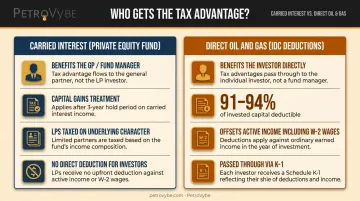
- IDC deductions of 91–94% of invested capital against active income
- First-year deduction projected at approximately 70% of invested capital
- Deductions passed through via K-1 directly to each investor's individual return
This differs structurally from carried interest: carry benefits the fund manager (the GP) at the expense of the investor's net return. IDC deductions in a direct participation structure benefit the investor directly — providing an immediate reduction in federal tax liability against their largest income sources.
Investors considering this structure should review the offering's Private Placement Memorandum, consult a qualified CPA or tax attorney regarding passive activity rules and at-risk limitations under IRC Sections 469 and 465, and evaluate how their individual tax situation interacts with the deduction mechanics.
Frequently Asked Questions
How does 20% carried interest work?
After LPs receive their invested capital back plus any required preferred return, the GP takes 20% of the remaining profits. On a $40M gain above the hurdle, the GP would receive $8M in carry while LPs receive the other $32M.
What is the difference between carried interest and a management fee?
The management fee (typically 2% of AUM annually) is charged regardless of fund performance to cover operating costs. Carried interest is earned only when fund profits exceed the agreed hurdle rate — it's a performance-only payment.
What is a hurdle rate and how does it relate to carried interest?
The hurdle rate (historically benchmarked at 8% per Preqin data) is the minimum return LPs must receive before the GP earns any carry. Miss that threshold, and the GP receives nothing.
Why is carried interest controversial?
Critics argue it allows fund managers — who are providing services — to pay capital gains tax rates of up to 23.8% instead of ordinary income rates of up to 37%, creating a tax advantage unavailable to other high earners receiving performance bonuses.
Can carried interest tax treatment change under new legislation?
Congress has introduced proposals to tax carried interest as ordinary income repeatedly since 2007. The structure has survived each attempt, though the CBO's $13B revenue estimate keeps it on the political agenda — making the 2025-2026 tax reform cycle the most relevant window to watch.
How does carried interest taxation compare to direct oil and gas investment tax benefits?
Carried interest benefits fund managers (GPs), not investors (LPs). Direct oil and gas investments work differently — IDC deductions pass through to investors via K-1, allowing those deductions to offset active ordinary income, including W2 earnings and capital gains.