
Introduction
Every year, local governments across the U.S. place tax liens on millions of properties due to unpaid property taxes — and private investors can purchase those claims. According to the National Tax Lien Association's market research, in 2019 alone there were over 6.4 million late property-tax bills representing nearly $15.8 billion in delinquent taxes, with more than 2 million certificates sold to private buyers.
This guide is written for investors exploring passive income alternatives beyond stocks, bonds, or traditional rental properties — particularly those who want real estate exposure without landlord responsibilities.
Tax lien investing can be profitable — but success demands local legal knowledge, careful due diligence, and comfort with processes that vary widely from state to state and county to county. This is not a plug-and-play strategy.
What follows is a straightforward breakdown of how tax lien investing works mechanically, its potential benefits, the real risks involved, and how it stacks up against other tax-efficient investment strategies.
Key Takeaways
- Tax lien investing means buying a government-issued debt claim on a property, earning returns through interest or penalties paid by the homeowner
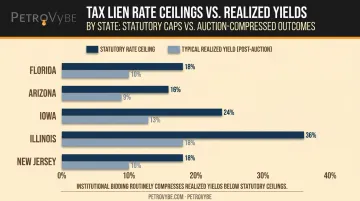
- Statutory interest rate ceilings range from roughly 16–18% in states like Florida, New Jersey, and Arizona, but auction competition typically compresses realized returns well below those maximums
- The strategy is governed by state and local law and is not available in every state
- Core risks include illiquidity, uncertain timelines, property condition issues, legal complexity, and institutional competition at auction
- Interest income from tax lien certificates is taxed as ordinary income by the IRS, not at capital gains rates, which meaningfully reduces after-tax returns for high earners
What Is Tax Lien Investing?
The Basic Mechanics
A tax lien is a legal claim a government places on a property when the owner fails to pay property taxes. Once a lien is issued, the property cannot be sold or refinanced until the underlying debt is resolved.
When governments want to recover unpaid taxes quickly rather than waiting out the homeowner's repayment timeline, they sell tax lien certificates to private investors at public auctions. The investor pays the outstanding tax debt to the government and receives the right to collect repayment — plus interest and penalties — directly from the property owner.
The certificate documents the parcel, the amount paid, the sale date, and the applicable interest rate. It does not convey ownership of the property.
Tax Liens vs. Tax Deeds
These two terms are often confused, but they represent different instruments:
| Instrument | What the Investor Receives | When It Applies |
|---|---|---|
| Tax Lien Certificate | Right to collect a debt secured by the property | Purchased at auction before foreclosure |
| Tax Deed | Actual ownership of the property | Transferred after redemption period expires without payment |
Most investors start with tax liens rather than tax deeds. Tax deeds carry far more complexity and risk: you're acquiring a property outright, with no guarantees about its condition, occupancy, or title history.
How Tax Lien Investing Works
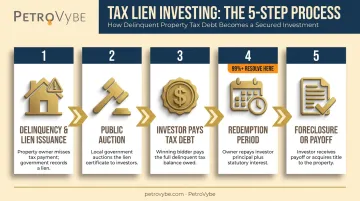
The process follows a predictable sequence, though specific rules vary by jurisdiction.
Step 1 — Delinquency and Lien Issuance
When a property owner misses a tax deadline, the county or municipality places a lien on the property and creates a certificate documenting the amount owed, any accrued interest, and applicable penalties.
Step 2 — Public Auction
Governments sell these certificates at annual public auctions — held in-person or online at the county level. Counties typically list available certificates weeks in advance on their websites.
Two common bidding formats:
- Highest cash bid — the certificate goes to the investor offering the most
- Bid-down interest rate — investors compete by accepting a lower interest rate; the certificate goes to whoever accepts the lowest rate (used in Florida, Arizona, and New Jersey, among others)
Step 3 — Investor Pays the Tax Debt
Winning the auction doesn't mean owning the property. The investor pays the outstanding tax bill to the government, and the homeowner then owes that amount — plus interest — back to the investor.
Step 4 — Redemption Period
State law sets a window during which the homeowner can repay the full lien amount plus interest to clear the title. This period ranges from 6 months (Maryland) to 3 years (Arizona). If repaid, the investor collects their principal plus earned interest — and the transaction is complete.
Step 5 — Foreclosure (Rare)
If the homeowner doesn't repay within the redemption window, the investor can initiate foreclosure proceedings to take title. According to NTLA data, more than 99% of delinquent taxpayers eventually pay — meaning fewer than 1% of tax liens actually reach foreclosure. When they do, the properties involved are typically vacant lots or abandoned structures, not occupied homes.
Benefits of Tax Lien Investing
Potentially High Statutory Returns
Tax lien certificates carry statutory interest rates well above most traditional fixed-income alternatives. For comparison:
- Florida: up to 18% per year (bid down at auction)
- Arizona: up to 16% simple annual interest (bid down at auction)
- Iowa: 2% per month
- Illinois: up to 18% penalty per six-month period
- 10-year U.S. Treasury: 4.55% (as of July 15, 2026)
The key caveat: competitive auctions in desirable markets routinely bid these rates down to a fraction of their statutory ceiling. The advertised rate is not the realized rate.
Low Barrier to Entry
Some certificates are available for a few hundred dollars. Sarpy County, Nebraska's 2025 sale included parcels with less than $400 in delinquent taxes, with a $20 certificate fee. This low floor lets investors spread capital across multiple certificates and markets rather than concentrating risk.
That accessibility also makes it easier to test multiple jurisdictions before committing larger capital — a practical advantage when rules and auction dynamics vary significantly by county.
Asset-Backed Security
Unlike unsecured debt instruments, a tax lien certificate is backed by an identifiable piece of real property. In Arizona, for example, property-tax liens hold statutory priority over pre-existing mortgages and most other encumbrances. This provides a meaningful layer of collateral protection — though it doesn't guarantee clean title, full cost recovery, or a problem-free outcome if foreclosure becomes necessary.
Risks and Limitations to Know Before You Invest
Illiquidity and Uncertain Timelines
Tax lien certificates cannot be traded on an exchange. Capital can be locked up for anywhere from 6 months to 3+ years, with no guarantee of when repayment will come — or whether it will arrive before foreclosure proceedings become necessary.
Some states allow certificate assignment, meaning transfer is legally possible. But there's no standardized secondary market. Plan to hold until redemption or resolution.
Property Condition and Title Risk
If foreclosure does occur, you acquire the property as-is. Properties with delinquent taxes often have additional complications:
- Physical disrepair or abandonment
- Pre-existing mortgages or HOA liens (note: federal tax liens can survive certain nonjudicial sales under IRC 7425 if proper notice requirements aren't met)
- Environmental contamination (the EPA's Bona Fide Prospective Purchaser protections require "all appropriate inquiries" before acquisition, plus ongoing compliance to maintain those protections)
Each of these issues can turn a promising certificate into a costly liability. Due diligence on the specific property is as critical as understanding the general process.
Legal and Administrative Complexity
Rules differ not just by state — they vary by county, property type, and year of issuance. Missing a filing deadline or failing to follow precise procedural requirements can result in losing the lien entirely, with no recourse. Investors must actively track:
- Certificate expiration dates
- Redemption period deadlines
- Required foreclosure notice procedures
- Jurisdiction-specific bidding rules
Active calendar management and jurisdiction-by-jurisdiction procedural compliance aren't optional — they're what separates investors who preserve their position from those who lose it on a technicality.
Auction Competition and Compressed Returns
Institutional buyers (banks, hedge funds, investment funds) participate actively in tax lien auctions, particularly in higher-demand markets. Their competitive bidding drives down interest rates and can shut out individual investors in the most attractive certificates entirely.
The realistic after-auction yield on many certificates, after accounting for bidding competition and jurisdictional rules, often falls well short of what the statutory ceiling suggests.
Tax Treatment of Returns
Interest income from tax lien certificates is taxed as ordinary income under IRC 61 , not at the lower long-term capital gains rate. For investors in the 32%, 35%, or 37% federal brackets, this sharply cuts into after-tax returns.
The 3.8% Net Investment Income Tax (NIIT) under IRC 1411 applies to interest income for single filers with MAGI above $200,000 and married joint filers above $250,000. For high-income investors, the combined effective tax rate on tax lien interest can push well past 40%.
Tax Lien Investing vs. Other Tax-Efficient Investments
How Tax Liens Compare to REITs and Direct Real Estate
| Vehicle | Liquidity | Tax Character | Ownership |
|---|---|---|---|
| Tax Lien Certificates | Low (no exchange) | Ordinary income | None (unless foreclosure) |
| Listed REITs | High (exchange-traded) | Mostly ordinary dividends | Indirect |
| Direct Rental Property | Low | Mixed (depreciation helps) | Direct |
REITs offer meaningful diversification and daily liquidity but don't produce the high fixed-rate interest that tax liens can deliver. Direct rental property builds equity and provides depreciation deductions — but also demands active management. Tax liens occupy an awkward middle ground: relatively hands-off during the redemption period, but legally complex and illiquid throughout.
The Tax Efficiency Gap for High-Income Investors
For investors in higher tax brackets, the core problem is structural: tax lien returns carry no deduction, no income offset, and no tax deferral. You earn interest, you owe ordinary income tax on it.
Investors specifically looking to reduce their tax burden — not just earn a yield — may find that other investment vehicles offer structurally different mechanics. For example, accredited investors in oil and gas development partnerships can access a category of deduction unavailable in any other asset class.
PetroVybe's 2025 partners achieved a 94% tax deduction against active income through this structure; 2024 partners received 91%. One verified investor eliminated a $30,000 tax liability entirely through the IDC deduction.
The ~70% first-year deduction on invested capital flows through to individual investors via K-1, with the option to spread it equally over five tax years instead.
No equivalent mechanic exists within a tax lien certificate — which is why investor profile matters before choosing between these approaches.
Evaluating Fit Based on Your Investor Profile
| If You Are... | Tax Liens May Fit If... | Consider Alternatives If... |
|---|---|---|
| Lower capital, active learner | You have time to research state law and attend auctions | You need liquidity within 12 months |
| High-income W2 earner | You want real estate exposure without active management | You're primarily trying to reduce tax burden |
| Accredited investor with $100K+ | You're diversifying beyond stocks | You want a first-year active income deduction |
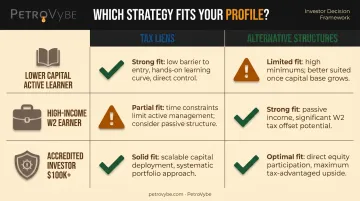
Tax lien investing may suit investors with time, local legal knowledge, and smaller capital to deploy. Investors prioritizing immediate, substantial tax reduction against active income — particularly high-earning W2 earners or those with capital gains events — are likely better served by investment structures specifically designed for that purpose.
Frequently Asked Questions
Are tax yield investments legit?
Yes — tax lien and tax deed investing are legal, government-administered programs that have existed for decades. That said, results vary significantly by state, county, property, and auction competition. Due diligence on specific certificates is essential; the legal framework doesn't guarantee a profitable outcome.
Who has to pay the 3.8% net investment income tax?
The NIIT under IRC 1411 applies to individuals with modified adjusted gross income above $200,000 (single filers) or $250,000 (married filing jointly). Interest earned from tax lien certificates qualifies as net investment income and is subject to this additional tax, increasing the effective rate for higher earners.
What are the best tax-efficient investments?
"Best" depends on your income type, tax bracket, and liquidity needs. Common options include municipal bonds (10-year AAA tax-equivalent yield of 4.89% as of July 1, 2026), I Bonds (4.26% current rate, state/local exempt), Roth accounts, and oil and gas investments with IDC deductions — each with structurally different benefits.
What is the difference between a tax lien and a tax deed?
A tax lien gives an investor the right to collect a debt secured by the property, while a tax deed transfers actual ownership of the property after the redemption period expires without repayment. Tax deeds carry higher potential upside but also higher risk — you're acquiring whatever property exists, regardless of its condition.
How are returns from tax lien investing taxed?
Interest income from tax lien certificates is taxed as ordinary income at your marginal federal rate — not at the lower long-term capital gains rate. High-income investors may also owe the 3.8% NIIT on top of that rate. After-tax returns can fall well below the statutory yield as a result.
What states allow tax lien investing?
Tax lien investing is not available in all states — some use tax deed sales instead. Verified lien states include Florida, Arizona, Iowa, Illinois, New Jersey, Maryland, and Nebraska, among others. Contact the county treasurer or tax collector in your target jurisdiction for current rules and upcoming auction schedules.