

Introduction: What High Earners Get Wrong About Upstream Tax Planning
Most tax planning happens after the damage is done: income earned, gains realized, taxes owed. Upstream tax planning takes a different approach — repositioning assets before taxes are triggered, often across generations.
This guide covers two distinct but complementary dimensions of upstream planning:
- Estate-level upstream gifting — transferring appreciated assets to older family members so those assets may qualify for a step-up in cost basis at death, potentially eliminating embedded capital gains
- Upstream oil and gas investment — using Intangible Drilling Cost (IDC) deductions to reduce current-year active income taxes today, not just at death
According to a 2024 Brookings/Tax Policy Center study, unrealized capital gains represent 41% of wealth held by the top 1% of U.S. households, totaling an estimated $48.2 trillion nationally. For high earners carrying that embedded exposure, both tools address real tax events — on different timelines and through different mechanisms. This guide breaks down how each works, where they complement each other, and what to watch out for before acting.
Key Takeaways
- Upstream estate planning transfers appreciated assets to an older relative to qualify for a stepped-up cost basis under IRC § 1014, which can eliminate embedded capital gains at death
- The one-year rule under IRC § 1014(e) is the most critical constraint — wrong timing or structure can deny the step-up entirely
- Trust structures like the Upstream Power of Appointment Trust (UpSPAT) use IRC § 2041 to trigger estate inclusion without requiring an outright asset transfer
- Upstream planning carries real risks: loss of asset control, IRS scrutiny, state tax complications, and a potential basis step-down
- High-income W2 earners have a separate tool: oil and gas upstream investments, which generate IDC deductions against active ordinary income — something estate-level planning cannot do
What Is Upstream Tax Planning?
Upstream tax planning is a strategy in which a younger family member transfers appreciated assets up the generational chain — typically to a parent — so those assets can receive a step-up in cost basis when the older relative passes. Done correctly, this eliminates significant embedded capital gains before they're ever realized as taxable income.
This is the opposite of traditional estate planning, which moves wealth downstream from older to younger generations. What's changed is which tax matters most.
Why This Strategy Is Gaining Traction Now
With the passage of the One Big Beautiful Bill Act (Public Law 119-21, signed July 4, 2025), the federal estate tax basic exclusion amount increased to $15 million for 2026, indexed for inflation thereafter. For most affluent families, federal estate tax is no longer the primary concern. Capital gains tax is.
That $48.2 trillion in unrealized gains sitting across American households isn't going away. Families holding concentrated stock positions, investment real estate, or closely held business interests face potentially massive capital gains bills — gains that upstream planning can, with proper structure, eliminate entirely at the federal level.
What Assets Work Best
Not every asset benefits equally. Upstream planning works best with:
- Investment real estate with substantial appreciation
- Concentrated stock positions (public or private)
- Closely held business interests
- Family limited partnership interests
- Qualified Small Business Stock (QSBS)
- Collectibles
High appreciation combined with low liquidity is the ideal profile. The bigger the embedded gain, the greater the potential benefit from a basis reset.
The Gift Tax Consideration
One complexity that surprises many families: the initial transfer to an older relative may itself constitute a taxable gift. That triggers a potential Form 709 filing and draws on the donor's lifetime exemption — $13.99 million in 2025, rising to $15 million in 2026.
Upstream planning is never a simple transfer. From day one, it demands coordination across estate law, income tax, and gift tax rules — each with its own filing requirements and timing considerations.
How the Step-Up in Basis Works: The Engine of Upstream Planning
IRC § 1014 in Plain Language
When a person dies, assets includible in their taxable estate generally receive a new cost basis equal to fair market value on the date of death. Any appreciation that occurred during their lifetime is effectively erased for capital gains purposes. This is the step-up in basis under IRC § 1014.
A simplified example illustrates the stakes:
| Scenario | Cost Basis | FMV at Death | Taxable Gain on Sale |
|---|---|---|---|
| Without step-up | $500,000 | $2.5 million | $2 million |
| With step-up | $2.5 million | $2.5 million | $0 |
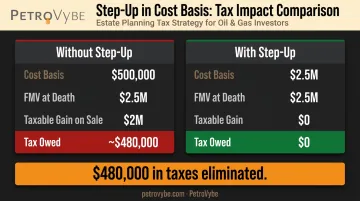
That $2 million in embedded gain — at a 20% federal capital gains rate plus 3.8% net investment income tax — could otherwise cost heirs nearly $480,000 in taxes. The step-up eliminates it.
The One-Year Rule: IRC § 1014(e)
IRC § 1014(e) imposes a hard limit on the step-up benefit. If:
- Appreciated property is gifted to someone
- That person dies within one year, and
- The asset passes back to the original donor or their spouse
...the expected step-up is denied. The basis reverts to what it was immediately before death.
This rule makes timing and structure essential. Families where the older relative has serious health concerns face real risk in outright gifting arrangements and should evaluate trust-based alternatives or installment sale structures instead.
IRC § 2041: The Trust Strategy's Legal Foundation
Those trust-based alternatives rely on a specific statutory mechanism: IRC § 2041. Assets over which a person holds a General Power of Appointment (GPOA) at death are included in their taxable estate. This is how upstream trust structures achieve basis inclusion without requiring the older family member to directly own the asset:
- The trust holds the asset
- The GPOA triggers estate inclusion
- IRC § 1014 delivers the step-up
One critical boundary: Revenue Ruling 2023-2 confirmed that assets in an irrevocable grantor trust do not automatically receive a step-up in basis simply because the grantor dies. The assets must be includible in the gross estate under a qualifying IRC § 1014(b) category — estate inclusion is not assumed.
Wealth Transfer Strategies in Upstream Planning
Upstream Gifting
The most straightforward approach: the younger family member transfers assets directly to a parent or older relative. The asset leaves the donor's taxable estate, the older relative holds it, and at death, heirs inherit with a stepped-up basis.
The mechanics require careful attention to gift tax rules:
- The annual gift tax exclusion is $19,000 per donee in 2025 and 2026
- Transfers above that amount require a Form 709 filing
- Amounts above the annual exclusion reduce the donor's lifetime exemption ($15 million in 2026)
The major drawback of outright gifting: the recipient gains full legal control of the asset. If family relationships are anything less than rock-solid — or if the older relative's estate is already large — this approach carries real risk.
The Upstream Power of Appointment Trust (UpSPAT)
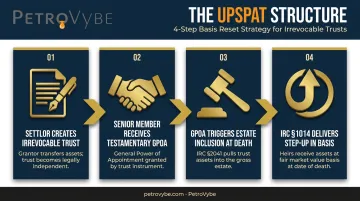
The UpSPAT is the most structured and commonly used upstream planning vehicle. The structure works in four steps:
- The younger family member (the settlor) creates an irrevocable trust, typically for the benefit of their descendants
- A senior family member receives a testamentary General Power of Appointment (GPOA) over trust assets
- At the senior member's death, the GPOA causes trust assets to be included in their taxable estate under IRC § 2041
- IRC § 1014 delivers the step-up in basis
Two funding approaches:
- Gifting assets to the trust — simpler, but subject to IRC § 1014(e) if the senior member dies within a year
- Selling assets to the trust via installment note — a bona fide arms-length sale is not an acquisition "by gift" under the statute, so the one-year rule typically does not apply. Deferred gain on the installment sale remains taxable, however
Formula GPOA as a risk-mitigation tool: Sophisticated drafting limits the GPOA's scope to assets within the senior member's remaining estate tax exemption. This prevents unintended estate tax exposure if asset values rise or legislative changes occur.
That said, one structural limitation deserves direct attention. While the statutory components (IRC § 2041 and IRC § 1014) are well-established, no IRS ruling has specifically approved the complete UpSPAT structure as marketed. Families should engage experienced estate planning counsel and treat published planning analyses as commentary rather than safe harbors.
Other Trust Structures Worth Knowing
These structures don't replace the UpSPAT — they work alongside it. Three vehicles commonly appear in the same planning conversation:
- Intentionally Defective Grantor Trusts (IDGTs): Can move assets outside the taxable estate while preserving income tax attributes — often used for installment sale funding of an UpSPAT
- Spousal Lifetime Access Trusts (SLATs): Retain indirect spousal access while repositioning assets; can be drafted with upstream elements
- Dynasty Trusts: Serve as the long-term receiving vehicle after a step-up is achieved, shielding assets across multiple generations from estate tax
Key Risks Every Investor Should Understand
Upstream planning offers real advantages, but each strategy carries specific failure points that can erase the expected benefit.
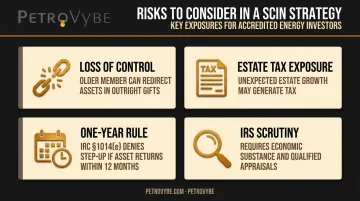
The Four Primary Risk Categories
| Risk | Description |
|---|---|
| Loss of control | The older family member becomes legal owner (in outright gifts) and can redirect assets |
| Estate tax exposure | If the senior generation's estate grows unexpectedly, transferred assets may generate estate tax |
| The one-year rule | IRC § 1014(e) denies the step-up if the asset returns to the original donor within 12 months of death |
| IRS scrutiny | Transactions must have economic substance, proper qualified appraisals, and complete gift tax reporting |
Two of these risks deserve closer attention because their consequences are often underestimated.
The Step-Down Risk
Basis adjustments under IRC § 1014 work in both directions. If an asset declines in value below its original cost basis before the older relative dies, the step-down can actually increase future capital gains exposure. Asset selection, therefore, is about more than maximizing the step-up — it's equally about screening out assets with significant downside risk before the transfer occurs.
State-Specific Complications
Federal analysis only gets families partway. State-level issues that can materially affect outcomes include:
- State income tax on the transfer or subsequent sale
- State estate or inheritance taxes (Oregon, for example, requires an estate return for gross estates of $1 million or more in 2025)
- Property tax reassessment (California's Proposition 19 significantly limits the intergenerational property tax exclusion for non-primary residences)
- Title issues or mortgage due-on-sale clauses for real estate transfers
Each state introduces its own layer of complexity, and a plan built on federal analysis alone can produce unexpected tax bills or legal complications at the state level. Jurisdiction-specific legal counsel is required before any transfer closes.
Upstream Oil and Gas Investments: A Complementary Tax Strategy for Active Income
Estate-level upstream planning solves a long-term problem: embedded capital gains that will eventually be realized at death or sale. But high-income W2 earners face a more immediate problem — crushing ordinary income taxes this year.
The IDC Deduction: Active Income Relief
Oil and gas upstream investments address this through Intangible Drilling Cost (IDC) deductions under IRC § 263(c). Qualifying costs — labor, fuel, supplies, and similar items incidental to drilling — can be deducted in the year paid or incurred rather than capitalized.
The critical distinction: under IRC § 469(c)(3), a working interest held through an entity that does not limit the taxpayer's liability is excluded from passive activity classification. This means qualifying IDC losses can be applied against other active income, a benefit that most alternative investments cannot offer.
Important caveats: This active income treatment applies only when the working interest structure genuinely doesn't limit the taxpayer's liability. Limited-liability structures may not qualify. Other limits — IRC § 465 at-risk rules, IRC § 461(l) excess business loss limits, AMT treatment of excess IDCs, and IRC § 1254 recapture — can restrict or partially reverse the benefit. Investors should confirm their specific structure with a qualified CPA.
How PetroVybe's Model Works in Practice
PetroVybe, a Texas-based private oil and gas development company, structures accredited investor partnerships in South Texas natural gas development through a limited partnership (PetroVybe Partners LP). Partners receive K-1 tax documents reporting IDC deductions against ordinary income, and the company's documented track record shows partners achieved 91% and 94% tax deductions against active income in 2024 and 2025, respectively.
One verified investor, Nizar A., reported eliminating a $30,000 tax liability through the structure. A redacted 2025 K-1 sample shows a $600,000 capital contribution producing $401,772 in deductions associated with ordinary income loss and IDC deductions.
Beyond the tax benefit, PetroVybe's investment model is backed by independent validation and a documented operational track record:
- 10-year target MOIC: ~2.2–5.8x
- Projected IRR: ~26%
- Proved reserves valuation: $48 million (PV-09, licensed third-party engineering firm)
- Chief Geophysicist well success rate: 75.2% over a 48-year career, versus an industry average below 40%
Why These Two Strategies Work Together
| Strategy | Benefit | Timeline |
|---|---|---|
| Upstream gifting / UpSPAT | Capital gains elimination at death | Long-term (multi-year) |
| Oil & gas IDC deductions | Ordinary income reduction now | Current tax year |

High-net-worth investors can pursue upstream gifting or UpSPAT structures for appreciated assets while simultaneously using oil and gas investments to reduce current-year tax liability. The result: two distinct tax problems addressed through two coordinated strategies.
The minimum investment for PetroVybe ONE is $100,000, and participation requires verified accredited investor status under SEC Regulation D 506(c).
Frequently Asked Questions
What is upstream planning?
Upstream planning is an estate and income tax strategy in which a younger family member transfers appreciated assets to an older relative — typically a parent — so those assets may qualify for a step-up in cost basis under IRC § 1014 at death. This can eliminate embedded capital gains that would otherwise be taxed upon sale.
What are the 5 D's of tax planning?
The five principles are: Deduct (reduce taxable income), Defer (delay recognition), Divide (split income across family members or entities), Discount (reduce the taxable value of assets), and Donate (use charitable giving for tax benefits). This is a practical organizing framework drawn from planning literature, not a statutory category.
What is the one-year rule in upstream planning?
Under IRC § 1014(e), if appreciated property is gifted to someone who dies within one year and the asset passes back to the original donor or their spouse — directly or indirectly through a trust — the expected step-up in basis is denied. The basis reverts to what it was immediately before death, making proper timing and structure essential.
What types of assets work best for upstream planning?
Highly appreciated, low-liquidity assets with significant embedded gains are ideal: investment real estate, concentrated stock positions, closely held business interests, and collectibles. These benefit most from a cost basis reset because the tax savings from eliminating a large embedded gain far outweigh the planning costs involved.
Do you need a trust for upstream planning?
Outright gifts are possible, but they transfer full legal control to the recipient. Irrevocable trust structures — particularly the UpSPAT — are often preferred because they provide governance controls, asset protection, and a mechanism (via GPOA under IRC § 2041) to include assets in the senior generation's estate for step-up purposes without surrendering full control outright.
Can oil and gas investments be part of an upstream tax planning strategy?
Yes — as a complementary tool. Estate-level upstream planning addresses long-term capital gains through a step-up at death, while oil and gas investments offer immediate IDC deductions against active ordinary income in the current tax year. The two strategies target different tax problems and suit investors carrying both active income and appreciated asset exposure.
This article is for educational purposes only and does not constitute legal, tax, or financial advice. Readers should consult qualified estate planning attorneys, CPAs, and financial advisors before implementing any of the strategies described.