
Modern Portfolio Theory (MPT) answers that question with precision. Developed by Harry Markowitz and published in his landmark 1952 paper "Portfolio Selection" in The Journal of Finance, MPT earned Markowitz the Nobel Memorial Prize in Economic Sciences in 1990 and fundamentally changed how institutional investors approach portfolio construction.
This article covers what MPT is, how its core principles work, how investors apply it today, and where it genuinely falls short.
Key Takeaways
- Portfolio risk depends more on how assets correlate with each other than on any individual asset's volatility
- The efficient frontier shows every portfolio offering maximum return for a given level of risk — anything below it is suboptimal
- True diversification means holding assets with low correlation, not simply holding many assets
- MPT's reliance on historical data and normal distribution assumptions creates real-world limitations
- Alternative assets with low market correlation, such as direct energy investments, can serve as legitimate diversifiers within an MPT framework
What Is Modern Portfolio Theory?
MPT, also called mean-variance analysis, is a mathematical framework for constructing a portfolio that maximizes expected return for a given level of risk. Markowitz's 1952 paper introduced a deceptively simple but powerful insight: an asset's risk and return should never be evaluated in isolation. What matters is how each asset contributes to the overall portfolio's behavior.
This was a genuine shift from how investors thought before. Prior to MPT, the dominant approach was finding the "best" individual securities — high-quality companies with strong returns. Markowitz showed that even a collection of excellent assets could produce an unnecessarily risky portfolio if those assets moved together.
The Problem MPT Was Built to Solve
Consider an investor holding 10 oil company stocks. On paper, they hold 10 positions across different companies. In practice, they hold a single bet on the price of oil. When crude prices drop, all 10 positions fall simultaneously — and the illusion of diversification collapses.
MPT formalizes a different approach: building portfolios where assets respond differently to the same economic event. The logic holds across asset classes:
- A drop in oil prices hurts energy stocks but can benefit airlines
- A recession often crushes equities while pushing bond prices higher
- Commodities like gold frequently move independently of equity markets
When no single event can simultaneously damage every position, the portfolio becomes more resilient than any individual asset within it.
That distinction also clarifies what MPT is not: a stock-picking tool. It doesn't forecast individual asset performance or identify undervalued securities. It tells investors how the combination of assets will behave — which is the core question in portfolio construction, and one that individual security analysis can't answer on its own.
The Core Principles: Risk, Correlation, and the Efficient Frontier
MPT works with two key variables:
- Expected return — the weighted average of individual asset returns in the portfolio
- Risk — measured as the volatility (standard deviation) of portfolio returns
The goal isn't simply to maximize return. It's to maximize return per unit of risk — a distinction that matters enormously in practice.
How Correlation Drives Diversification
The mechanism through which diversification actually works is correlation — the statistical relationship between how two assets move relative to each other. Correlation runs from -1 to +1:
- +1: Assets move in perfect lockstep — no diversification benefit
- 0: No relationship — combining them reduces portfolio volatility
- -1: Perfect inverse relationship — combining them can dramatically reduce risk
Gold and U.S. equities illustrate this well. World Gold Council research found an average gold-S&P 500 correlation of -0.07 from January 1987 through July 2010, with the relationship turning more negative during severe equity drawdowns. A near-zero correlation like that allows gold to reduce overall portfolio volatility without a corresponding drag on expected return.
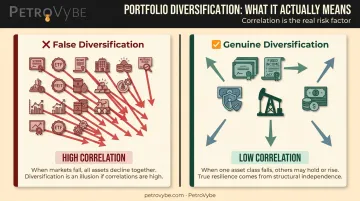
This is why MPT redefines what "diversified" actually means:
- ❌ Holding 20 highly correlated assets (false diversification)
- ✅ Holding 5 uncorrelated assets (genuine diversification)
Position count matters far less than the correlation structure between those positions.
Systematic vs. Unsystematic Risk
MPT draws a critical distinction between two types of risk:
- Systematic risk (market risk): Economy-wide risk that affects all assets — recessions, interest rate shifts, geopolitical crises. This cannot be diversified away.
- Unsystematic risk (idiosyncratic risk): Risk specific to a company, sector, or asset. This can be reduced through diversification.
MPT's practical goal is eliminating unsystematic risk through correlation management, while accepting only the systematic risk that markets compensate investors for bearing. An investor who takes on idiosyncratic risk through a concentrated portfolio is accepting risk without any corresponding expected premium.
That framework — minimizing uncompensated risk — leads directly to MPT's most important analytical tool.
The Efficient Frontier
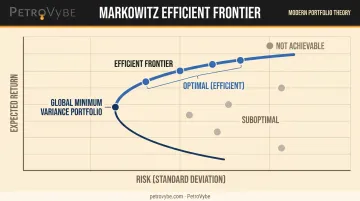
Plot every possible portfolio combination on a risk-return graph. The efficient frontier is the curve that runs along the top of that cloud of points — representing every portfolio that delivers the highest possible expected return for a given level of risk.
- Portfolios above the frontier: Not achievable
- Portfolios on the frontier: Optimal (efficient)
- Portfolios below the frontier: Suboptimal — the investor could earn more return for the same risk, or accept less risk for the same return, by rebalancing
The frontier traces a curved (hyperbolic) path — the "Markowitz Bullet" — because of the nonlinear relationship between correlation and portfolio variance.
The bottom-left point of this curve is the Global Minimum Variance Portfolio: the least risky combination of assets available given the inputs.
How Investors Apply MPT in Practice
Mean-Variance Optimization
The mechanics of applying MPT require three inputs for each asset:
- Expected return
- Expected volatility (standard deviation)
- Expected correlation with every other asset in the portfolio
A mean-variance optimizer then calculates portfolio weights that maximize return for a chosen level of risk. These inputs are typically estimated from historical data, though sophisticated managers often apply forward-looking adjustments to account for regime changes.
CalPERS — the largest public pension fund in the U.S. — provides a documented example of this process in practice. Their capital-market assumptions define projected returns, standard deviations, and correlation coefficients for asset classes, then evaluate strategic allocations against liabilities and risk tolerance. This is MPT applied at institutional scale.
The Sharpe Ratio
The practical scoring metric that emerges from MPT is the Sharpe Ratio:
(Portfolio Return − Risk-Free Rate) ÷ Portfolio Standard Deviation
A higher Sharpe Ratio means more return per unit of risk. Investors use it to compare portfolios on a risk-adjusted basis — an efficient portfolio on the frontier will have a higher Sharpe Ratio than a suboptimal portfolio with the same expected return.
William Sharpe introduced this measure in "Mutual Fund Performance" in 1966, and it remains the most widely used tool for evaluating portfolio efficiency.
Asset Allocation Across Classes
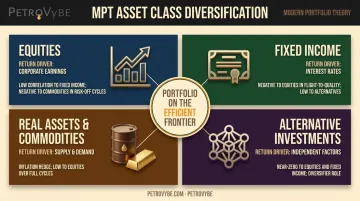
The Sharpe Ratio gives investors a score — but asset allocation is where the score gets built. MPT's real power shows up when combining asset classes with structurally different return drivers, providing a quantitative basis for deciding how much to allocate across:
- Equities
- Fixed income
- Real assets and commodities
- Alternative investments
Each combination produces a different point on the risk-return graph. MPT identifies which combinations deliver the most return for a given level of risk — and equally important, which combinations simply take on more risk without compensation.
Limitations and Criticisms of Modern Portfolio Theory
MPT is not without serious problems. Understanding them matters as much as understanding the theory itself.
The Historical Data Problem
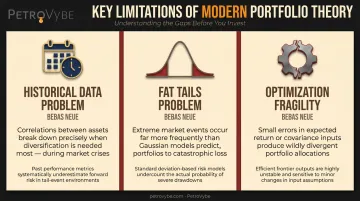
MPT relies on historical data to estimate future returns, volatility, and correlations. But past correlations can break down precisely when diversification is most needed. IMF research documents that commodity-equity correlations soared after the Lehman Brothers collapse and remained exceptionally high through 2010. Assets that appeared uncorrelated in normal markets moved together during the crisis — the opposite of what diversification is supposed to deliver.
The Fat Tails Problem
MPT assumes returns follow a normal (bell-curve) distribution. Real markets don't. Extreme events occur far more frequently than the model predicts — a phenomenon called "fat tails." Warren Buffett addressed this directly in Berkshire Hathaway's 2014 letter, writing that "volatility is far from synonymous with risk." His argument: a stock that drops 50% temporarily is not the same risk as permanently losing purchasing power — but MPT treats both identically through variance.
The Optimization Fragility Problem
Small errors in estimating expected returns — the most sensitive input — can produce dramatically different recommended portfolio weights. The gap between what the model recommends and what actually works in practice is wider than most investors assume.
Research by DeMiguel, Garlappi, and Uppal tested 14 optimized models across 7 datasets and found that none consistently outperformed a simple equal-weight (1/N) portfolio out of sample. Their calibration suggested an optimizer might require roughly 3,000 months of data for 25 assets to reliably beat equal weighting — far more history than exists for most asset classes.
That finding doesn't invalidate MPT's core logic. It does mean the optimizer's precise-looking outputs can give investors false confidence — outputs that are, in practice, highly sensitive to noisy inputs.
Diversifying with Alternative Assets Under MPT
The logic of MPT points investors toward assets with return drivers that are structurally different from traditional stocks and bonds. TD Asset Management reports that a commodity-inclusive portfolio produced a higher Sharpe ratio and lower volatility than a comparable commodity-free portfolio over 1976–2024 — direct evidence that broader diversification improves risk-adjusted outcomes.
Real assets — commodities, real estate, and direct energy investments — have historically exhibited lower correlation to public equity markets. Their returns are driven by physical supply and demand dynamics rather than investor sentiment or interest rate cycles.
For accredited investors, direct participation in natural gas and oil development offers exposure to a real asset class whose returns are tied to energy demand and commodity production — not equity market sentiment. PetroVybe, a private Texas-based natural gas developer, operates development projects in South Texas's Lavaca County with returns driven by NGL pricing and energy infrastructure demand.
One important distinction applies, however. The correlation evidence for broad commodity indices is well-documented. Direct working interests in individual wells are a different category — no comparable public benchmark exists. Investors should evaluate the specific vehicle rather than assuming commodity-index research transfers directly to participation interests.
What MPT does tell investors clearly: the search for diversification should extend beyond stocks and bonds to real, productive assets whose returns are driven by fundamentally different factors. The key question for any candidate asset is whether its return drivers are genuinely independent — not just labeled "alternative."
Frequently Asked Questions
What are the main portfolio diversification theories (e.g., Harry Markowitz and Ray Dalio)?
Harry Markowitz's MPT (1952) is the foundational framework, focused on mean-variance optimization and the efficient frontier. Ray Dalio's "All Weather" approach, launched in 1996, extends diversification to macroeconomic risk factors — balancing exposure across rising/falling growth and inflation environments rather than relying on asset-class correlation alone.
What is the 70/20/10 rule in portfolio diversification?
The 70/20/10 rule is a common allocation guideline — typically 70% in core assets (equities), 20% in secondary assets (bonds or real estate), and 10% in higher-risk or speculative positions. It's a rule of thumb, not a formula MPT produces. Actual allocation depends on individual risk tolerance, time horizon, and investment mix.
What did Warren Buffett say about diversification?
Buffett called diversification "protection against ignorance," adding that it "makes little sense if you know what you are doing" — a statement made at Berkshire's 1996 annual meeting. He also argued in Berkshire's 2014 letter that volatility is far from synonymous with risk, challenging MPT's use of standard deviation as the primary risk measure.
What is the efficient frontier in Modern Portfolio Theory?
The efficient frontier is the curve on a risk-return graph representing every portfolio that delivers the maximum possible expected return for a given level of risk. Any portfolio sitting below the frontier is suboptimal — the investor could achieve better risk-adjusted returns by rebalancing toward the frontier.
What is the difference between systematic and unsystematic risk?
Systematic risk affects all assets and cannot be diversified away — recessions and broad interest rate shifts are common examples. Unsystematic risk is company- or sector-specific and can be reduced through diversification. MPT targets unsystematic risk through correlation management; systematic risk can be managed but never fully eliminated.
Is Modern Portfolio Theory still relevant for investors today?
MPT remains the standard starting point for both institutional and individual portfolio construction, despite its known limitations. Modern extensions — including the Black-Litterman model and Post-Modern Portfolio Theory — address gaps around input sensitivity and non-normal return distributions while preserving MPT's core insight: that correlation management, not just asset selection, drives long-term portfolio efficiency.