

Introduction
Every business asset you own — equipment, vehicles, commercial buildings — loses value over time. The IRS lets you claim that loss as a deduction, recovering the cost of those assets gradually across their useful life and reducing your taxable income year after year. For high earners, how you structure those deductions can be the difference between a six-figure tax bill and a manageable one.
Understanding which depreciation method applies, how MACRS works, and when accelerated options like Section 179 and bonus depreciation make sense can shift your tax position significantly — often by tens of thousands of dollars in a single year.
And for high-income earners specifically, certain investment structures — particularly oil and gas working interests — take the concept of accelerated deductions even further, allowing deductions against active W-2 income and capital gains in ways that standard depreciation cannot.
This guide breaks down IRS eligibility rules, depreciation methods, the major accelerated options, and the oil and gas tax strategy accredited investors use to offset their highest-taxed income — with concrete numbers, not just concepts.
Key Takeaways
- Depreciation lets you recover the cost of business-use assets over their IRS-defined recovery period, reducing taxable income each year
- Assets must be owned by you, used for business or income production, have a determinable useful life greater than one year, and not be excepted property
- MACRS is the required depreciation system for most U.S. property placed in service after 1986
- Section 179 (2025 cap: $2.5M) and 100% bonus depreciation can eliminate the bulk of a qualifying asset's cost in year one
- Oil and gas IDC deductions bypass passive activity limitations, offsetting active ordinary income including W-2 wages
What Is Asset Depreciation for Tax Purposes?
Tax depreciation is the IRS-approved process of deducting the cost of a long-lived asset across its "recovery period" rather than expensing the full purchase price in year one. The IRS treats major purchases — machinery, buildings, vehicles — as capital expenditures, not immediate business expenses.
That distinction matters. A $200,000 piece of equipment doesn't become worthless the day you buy it, so the IRS doesn't let you claim the full cost immediately under standard rules. Instead, you spread that deduction over the asset's useful life.
Book depreciation vs. tax depreciation: Book depreciation follows U.S. GAAP for financial reporting purposes. Tax depreciation follows IRS-mandated methods and timelines, often producing very different deduction amounts in any given year. The IRS flags depreciation as one of the most common book-to-tax adjustment items in its Publication 946 guidance.
Each dollar of tax depreciation deduction reduces taxable income dollar-for-dollar. On a $50,000 deduction at a 37% marginal rate, that's $18,500 in actual tax savings for the year.
What Qualifies as a Depreciable Asset?
IRS Publication 946 defines four requirements an asset must meet to qualify for depreciation:
- You must own it — leased property doesn't qualify; the owner depreciates, not the lessee
- It must be used in a business or income-producing activity — personal-use property doesn't qualify
- It must have a determinable useful life — the IRS must be able to assign a recovery period
- It must be expected to last more than one year — items consumed quickly are expensed directly
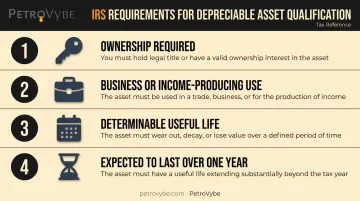
Beyond these four requirements, land and certain "excepted property" (as defined in Publication 946) cannot be depreciated even when the four tests are otherwise met.
Common qualifying assets:
- Machinery and equipment
- Commercial vehicles
- Buildings
- Office furniture and computers
Common non-qualifying items:
- Land
- Personal-use property
- Property placed in service and disposed of in the same year
Mixed-use property — like a car used 60% for business — can be partially depreciated based on the business-use percentage.
Common Depreciation Methods Explained
The IRS permits several depreciation methods depending on asset type and taxpayer elections. The method you choose affects when tax savings occur, not the total amount recovered. Accelerated methods front-load deductions; straight-line spreads them evenly.
Here's when each method makes sense:
- Straight-line: Stable, predictable income; assets that wear evenly over time
- Double-declining balance: High early income that needs offsetting; assets that depreciate faster upfront
- Units of production: Variable-output equipment where usage fluctuates year to year
Straight-Line Depreciation
The simplest method. The formula:
(Cost − Salvage Value) ÷ Useful Life = Annual Depreciation
A $50,000 machine with a $5,000 salvage value and 10-year life generates a $4,500 deduction every year. Predictable, but it produces the smallest deductions in early years — when your income is often highest.
Double-Declining Balance (DDB)
An accelerated method that applies double the straight-line rate to the asset's remaining book value each year. Because deductions are calculated on a declining balance, they're largest in year one and shrink over time.
This makes DDB useful when you need to offset higher income in the early years of ownership. When straight-line eventually produces an equal or larger deduction, the IRS requires you to switch — ensuring you recover the full asset value.
Units of Production Method
This method ties depreciation directly to actual usage — units produced, miles driven, hours operated — rather than a fixed time schedule. It's excluded from MACRS under IRC 168(f)(1) and works best for equipment with highly variable output.
High-production years generate higher depreciation; slow years generate less. It accurately tracks wear but requires detailed usage records.
Note on Sum-of-the-Years' Digits (SYD): SYD qualifies as a possible Section 167 method in limited accounting contexts but doesn't apply under current MACRS rules in Publication 946.
MACRS, Bonus Depreciation, and Section 179: Accelerated Tax Options
For most U.S. business property placed in service after 1986, the IRS requires the Modified Accelerated Cost Recovery System (MACRS). MACRS uses pre-set recovery periods and two sub-systems: the General Depreciation System (GDS) and the Alternative Depreciation System (ADS).
Common GDS recovery periods:
| Asset Class | Property Type |
|---|---|
| 5-year | Automobiles, light trucks, computers |
| 7-year | Office furniture and general equipment |
| 15-year | Qualified improvement property |
| 27.5-year | Residential rental property |
| 39-year | Nonresidential real property |
GDS uses 200% declining balance — or 150% declining balance switching to straight-line — for most property. ADS applies straight-line depreciation over longer recovery periods and is mandatory for certain asset classes, including listed property used 50% or less for business. Which sub-system applies affects both your deduction timing and your planning flexibility.
Section 179: Full First-Year Expensing (With Limits)
Section 179 allows you to immediately deduct the full cost of qualifying tangible personal property and software in the year it's placed in service. For 2025, the deduction limit increased to $2.5 million, with a phase-down beginning when qualifying property placed in service exceeds $4 million.
Constraints to plan around:
- The deduction cannot exceed your aggregate taxable income from active business activity
- Disallowed amounts carry forward to future years
- Property held primarily to produce income — rather than used in an active trade or business — generally does not qualify
Bonus Depreciation: 100% Is Back
Public Law 119-21, signed July 4, 2025, permanently restored 100% bonus depreciation for qualifying property acquired after January 19, 2025. This applies to both new and used assets that meet the qualified-property rules.
Unlike Section 179, bonus depreciation:
- Has no income limitation
- Can create or increase a net operating loss
- Is percentage-based, not dollar-capped
Section 179 vs. Bonus Depreciation at a glance:
| Feature | Section 179 | Bonus Depreciation |
|---|---|---|
| 2025 Cap | $2.5M | No cap |
| Income Limitation | Yes (active business income) | No |
| Can Create NOL? | No | Yes |
| New vs. Used | Both | Both (qualified property) |
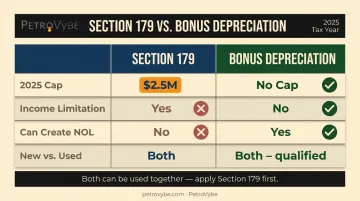
Both can be used together in the same tax year — apply Section 179 first, then bonus depreciation on any remaining basis.
The Half-Year Convention
Knowing which depreciation method applies is only part of the equation — when you place property in service also shapes your first-year deduction. Under MACRS, regardless of the actual service date, the IRS treats every asset as placed in service at the midpoint of the year. One exception: if more than 40% of your total depreciable MACRS property basis is placed in service in Q4, the mid-quarter convention applies instead, reducing your first-year deduction.
How Depreciation Reduces Your Tax Burden: A Practical Example
Consider a business with $150,000 in net income before depreciation on a $50,000 piece of equipment with a 10-year life and no salvage value.
Scenario A — Straight-Line:
- Annual deduction: $5,000
- Taxable income: $145,000
- Tax at 37%: $53,650
Scenario B — Section 179 (full first-year expensing):
- Year-one deduction: $50,000
- Taxable income: $100,000
- Tax at 37%: $37,000
- Tax savings vs. straight-line: $16,650 in year one alone
The total deductions over time are identical. The accelerated method simply moves them earlier — which matters because a dollar of tax savings today is worth more than a dollar saved in year seven.
Depreciation Recapture: The Offset You Must Plan For
When you sell a depreciated asset, the IRS recaptures a portion of the deductions you've taken. The treatment depends on the asset type:
- Section 1245 assets (equipment, machinery): gain attributable to depreciation is recaptured as ordinary income
- Section 1250 real property: unrecaptured gain is taxed at a maximum 25% rate — above the standard long-term capital gains rate of 20%
- With NIIT applied: the effective rate climbs to 23.8% on qualifying investment income, making real estate recapture particularly costly for high earners
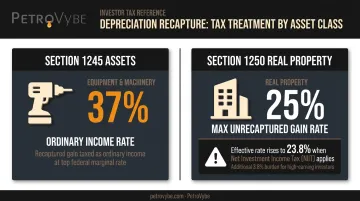
For real estate investors who've taken years of depreciation deductions, recapture tax can substantially erode proceeds at sale — making exit timing and structure worth planning well in advance.
Passive Activity Limitations
For most real estate investments and passive income vehicles, depreciation deductions can only offset passive income — not W-2 wages or other active income.
The exception is qualifying as a real estate professional under IRS rules — which requires more than 750 hours in real property trades or businesses where you materially participate, plus more than half of all personal services performed in those activities.
For high-income W-2 earners, that bar is difficult to clear. Not all depreciation-based deductions carry this restriction, however. Certain energy investments — such as Intangible Drilling Costs (IDCs) in oil and gas — are structured to offset active income directly, including W-2 wages and capital gains, regardless of real estate professional status.
Oil & Gas Tax Deductions: A More Powerful Strategy for Accredited Investors
Oil and gas investments offer something that standard depreciation cannot: the ability to deduct a large portion of invested capital directly against active ordinary income — including W-2 wages and capital gains.
Intangible Drilling Costs (IDCs)
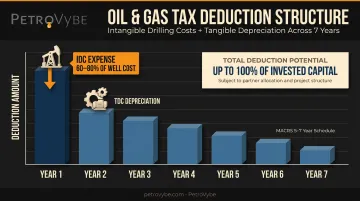
IDCs cover the expenses that have no salvage value: drilling labor, fuel, chemicals, supplies, and other costs incurred in getting a well ready for production. Under 26 CFR 1.612-4, operators may elect to expense 100% of qualifying IDCs in the year they're paid or incurred.
According to API data, IDCs typically represent 60–80% of total well cost. That means on a $100,000 investment in a new-drilling development project, $60,000–$80,000 is potentially deductible in year one.
The critical distinction from real estate: under IRC 469(c)(3), a qualifying oil or gas working interest is excluded from passive activity classification when held through a structure that does not limit the taxpayer's liability. This means IDC deductions can apply against nonpassive income — the same income category as W-2 wages.
Tangible Drilling Costs (TDCs)
The physical equipment — wellheads, pumps, casing, tanks, machinery — cannot be expensed under the IDC election because it retains salvage value. Instead, it's depreciated under MACRS, typically in IRS petroleum asset classes with GDS recovery periods of 5–7 years depending on the specific asset class (onshore drilling assets, production equipment, etc.).
This creates a multi-year deduction structure: large IDC expense in year one, followed by accelerated depreciation on tangible costs over the subsequent years.
Why This Matters for High-Income Earners
A W-2 earner in the 37% federal bracket cannot use real estate depreciation to reduce their salary income. But a qualifying oil and gas investment can generate IDC deductions that apply directly against that income. That's the mechanism — here's what it looks like in practice through a structured working interest investment.
PetroVybe structures direct working interest investments in South Texas natural gas development to give accredited investors access to exactly this deduction structure. Results to date:
- 94% total tax deduction against active income for partners in 2025
- 91% total tax deduction against active income for partners in 2024
On a $100,000 investment at a 37% marginal rate, a 70% first-year IDC deduction alone represents approximately $25,900 in federal tax savings — before accounting for the subsequent TDC depreciation that continues through year five to seven.
PetroVybe ONE requires a minimum $100,000 investment and is open exclusively to accredited investors. The investment structure targets a 10-year MOIC of approximately 2.2–5.8x and a 26% IRR. Monthly passive distributions are projected to peak above $10,000 per month during peak production, backed by a $48MM proved reserves valuation (PV-09) from a licensed third-party engineering firm.
Important: The specific tax treatment of any investment depends on your individual situation, the legal structure of the offering, and elections available under the Internal Revenue Code. Consult a qualified CPA or tax attorney before making investment decisions.
Frequently Asked Questions
What is a depreciating asset for tax purposes?
A depreciating asset is any tangible property with a limited useful life — owned by the taxpayer and used in business or income-producing activity — that loses value over time. Deductions are spread across the asset's IRS-defined recovery period.
What are the IRS rules for depreciation?
Per IRS Publication 946, qualifying assets must be owned by you, used in business or income-producing activity, have a useful life greater than one year, and not be excepted property. Most assets placed in service after 1986 are depreciated under MACRS.
How much tax do you pay on depreciation?
Depreciation itself reduces your taxable income while you hold the asset — it doesn't generate a tax bill. When you sell a depreciated asset, the IRS may recapture those deductions: Section 1245 property is recaptured at ordinary income rates, while unrecaptured Section 1250 gain (real property) is taxed at a maximum 25% rate.
What is the difference between Section 179 and bonus depreciation?
Section 179 allows a first-year deduction up to $2.5M (2025), but it is capped by active business income and cannot generate a net operating loss. Bonus depreciation is percentage-based (100% for qualifying property acquired after January 19, 2025), has no income cap, and can generate an NOL. Both can sometimes be combined.
Can depreciation deductions offset ordinary income like W-2 wages?
Standard passive depreciation — such as from rental real estate — is limited to passive income under IRS passive activity rules and cannot reduce W-2 wages. Oil and gas working interests are a notable exception: under IRC 469(c)(3), IDC deductions can apply against active ordinary income when the investment is structured appropriately. Outcomes vary based on your specific structure and tax situation.