

This guide cuts through the noise. Whether you're evaluating your borrowing capacity, building income streams, or optimizing a portfolio for tax efficiency, understanding each term precisely changes how you deploy capital.
Key Takeaways
- Passive income is money earned from assets with minimal ongoing effort — dividends, rental property, energy distributions
- Residual income (personal finance) measures what remains after monthly obligations are paid: it's a metric, not an income stream
- Residual income enables passive income — once debt and expenses drop, freed capital can move into income-generating assets
- Tax treatment varies significantly by passive income vehicle — some offer deductions against active income, most don't
- For accredited investors, direct oil and gas working interests can apply IDC deductions against W2 income and capital gains — a tax advantage most passive vehicles don't offer
Passive vs. Residual Income: At a Glance
| Category | Passive Income | Residual Income (Personal Finance) |
|---|---|---|
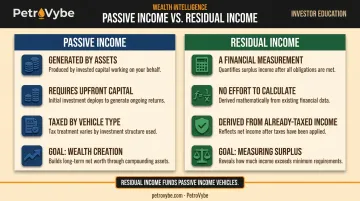
| Definition | Income generated by assets with minimal ongoing involvement | Money remaining after all monthly debt and financial obligations are paid |
| Source | Assets: rental property, dividend stocks, partnerships, royalties | Derived from existing income minus fixed expenses |
| Effort Required | Significant upfront capital or time; minimal ongoing effort | No effort — it's a calculation, not a creation |
| Tax Treatment | Varies by type: capital gains rates, ordinary income, or deductible against active income | Not separately taxed — derived from already-taxed income |
| Who It Applies To | Investors building income streams independent of their labor | Anyone evaluating financial health, borrowing capacity, or investable surplus |
| Primary Goal | Generate wealth without trading time for money | Measure financial capacity and identify investable surplus |
Note: The corporate finance definition of residual income — net operating income above a required rate of return — can overlap conceptually with passive income. The personal finance definition does not. Understanding which definition applies to your context matters before using either term to guide investment decisions.
What Is Passive Income?
Passive income is money earned from assets or systems that operate without your daily involvement after an initial investment of time, capital, or both. The IRS draws a formal line between passive income and earned income (wages, salaries, active business participation) under Publication 925, which classifies passive activities as trades or businesses in which the taxpayer does not materially participate, plus most rental activities.
The Two Main Categories
Financial/investment-based passive income:
- Dividends from stocks or funds
- Interest income from bonds or lending platforms
- REIT distributions
- Direct investment partnership distributions
Asset-based passive income:
- Rental property income
- Royalties and licensing fees
- Energy production distributions
What makes each "passive" in practice is the absence of material participation — once the asset is acquired or created, it generates income without requiring your ongoing labor.
The "Free Money" Misconception
Passive income is not effortless. Dividend stocks require capital to purchase shares. Rental property requires a down payment, maintenance reserves, and often management. Direct investment partnerships require due diligence and minimum capital commitments. The effort shifts from ongoing time to upfront capital and research — but it doesn't disappear.
How Passive Income Is Taxed
Tax treatment differs by vehicle:
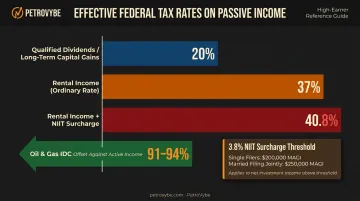
- Qualified dividends and long-term capital gains: Taxed at 0%, 15%, or 20% depending on taxable income — below ordinary income rates for most investors
- Rental income: Generally taxed as ordinary income after allowable expenses, reported on Schedule E
- Royalties: Reported on Schedule E; nonbusiness royalties are classified as portfolio income under Publication 925, not Section 469 passive income
- Net Investment Income Tax (NIIT): A 3.8% surcharge applies to applicable investment income for individuals above $200,000 (single) or $250,000 (married filing jointly) MAGI
For high earners in the 37% bracket, that NIIT layer pushes the effective federal rate on applicable investment income to 40.8% — which makes vehicle selection and tax efficiency critical, not optional.
Passive Income Use Cases for Accredited Investors
| Vehicle | Key Feature | Accreditation Required? |
|---|---|---|
| Dividend-paying stocks | Qualified dividend rates; no income floor | No |
| Publicly traded REITs | Exchange-traded; 2025 total return was 2.3% (FTSE Nareit All Equity Index) | No |
| Private/nontraded REITs | Higher minimums; less liquidity | Often yes (Rule 506(c)) |
| Rental real estate | Depreciation deductions; inflation-linked rents | No, but capital-intensive |
| Direct oil and gas working interests | IDC deductions applicable against active W2 income | Yes |
Rental income and commodity-linked investments tend to adjust upward with inflation. Fixed-rate bonds and standard savings accounts do not — their purchasing power erodes as the CPI rose 2.9% from December 2023 to December 2024.
Why Oil and Gas Working Interests Are Different
Under IRC 469(c)(3), a qualifying oil and gas working interest held directly or through an entity that does not limit liability is expressly excluded from passive activity treatment. This means IDC (Intangible Drilling Cost) deductions aren't confined to offsetting passive income — they can reduce ordinary taxable income, including W2 earnings and capital gains.
PetroVybe's structure is built on this distinction. Partners in PetroVybe ONE received a 94% tax deduction against active income in 2024 and a 91% deduction in 2025. On a $100,000 investment, that's $91,000–$94,000 in deductions applied directly to W2 earnings or capital gains — a mechanism dividend stocks, REITs, and standard rental properties cannot replicate.
What Is Residual Income?
Residual income in personal finance is straightforward: the money remaining each month after all financial obligations — mortgage or rent, loan payments, auto loans, credit cards, and other fixed debts — have been paid.
Formula: Monthly Income − All Fixed Debt Payments = Residual Income
This is distinct from disposable income, which the Bureau of Economic Analysis defines as after-tax income before debt obligations are accounted for. Residual income goes further — it accounts for debt obligations, not just taxes.
How Lenders Use Residual Income
Banks and mortgage lenders use residual income to assess repayment capacity. The VA's loan underwriting guidelines, for example, treat residual income analysis as a central underwriting standard — measuring monthly net income remaining after federal and state taxes, debts, and shelter costs. Required minimums vary by family size and region (for a family of four in the South, the VA requires $868–$1,003/month depending on loan size).
For anyone seeking financing, residual income is a key metric lenders evaluate alongside debt-to-income ratio.
Residual Income in Corporate Finance
In corporate and equity valuation contexts, residual income means something different: net income that exceeds a company's required rate of return on equity capital. The CFA Institute defines it as:
RI(t) = E(t) − rB(t-1)
(Where E(t) is earnings, r is the required return, and B(t-1) is the prior period book value.)
This framework applies to performance measurement, equity valuation, and compensation analysis — entirely separate from the personal finance definition.
The Critical Insight: Residual Income Is a Measure, Not a Stream
Residual income is a measurement — it shows what's left over. Passive income, by contrast, is an actual income stream generated by an asset doing work on your behalf.
This distinction has a practical application: residual income creates the capital pool for passive income. When someone reduces debt or increases earnings — expanding their residual income — that surplus can be deployed into passive income-generating assets. The two concepts are complementary, not competing.
A Simple Example
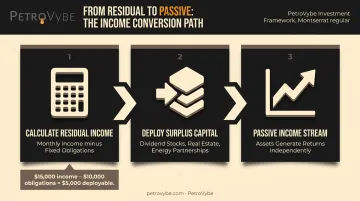
A W2 earner making $15,000/month with $10,000 in fixed monthly obligations has $5,000 in residual income. That $5,000 is the decision pool: pay down debt faster, build an emergency fund, or deploy into passive income vehicles. Investing it into dividend stocks, real estate, or a direct energy partnership converts a financial metric into a working income stream.
Increasing residual income happens two ways:
- Earn more: raises, bonuses, secondary income streams
- Spend less: debt payoff, lower fixed obligations
For high-income earners, the faster residual income grows, the sooner it can be redeployed into assets that generate returns independently — which is where the real compounding begins.
Passive Income vs. Residual Income: What's the Real Difference?
Here's the definitive breakdown — four practical differences that should end any confusion:
1. Source vs. Measure
Passive income is generated by an asset. Residual income is what's left after expenses. The first describes how money is produced; the second measures what remains after your obligations are met.
2. Effort and Setup
Passive income requires upfront investment to build — capital, time, due diligence, or all three. Residual income requires nothing to calculate; it emerges from your existing income and expense structure.
3. Tax Treatment
Passive income is taxed based on its type and source. Personal residual income is not separately taxed — it's derived from already-taxed income. Deploying it into passive vehicles creates new taxable events, but the residual income itself is not a taxable category.
4. Role in Wealth Building
Passive income grows wealth by generating returns without labor. Residual income funds the tools that grow wealth. Understanding which one you're optimizing at any given moment determines where your next financial move should go.
Where the Terms Overlap
There is one genuine convergence point: when passive income increases total monthly income, it also increases residual income. If a rental property generates $3,000/month, your residual income calculation rises by $3,000. In that moment, the asset's output (passive income) feeds the measure (residual income) that funds future investment.
Royalties from past creative work present a similar overlap — they're passive in the sense of requiring no ongoing effort, and residual in the sense of arriving after the creative work is complete. But this is context-specific, not definitionally equivalent.
A Framework for High-Income Earners
If you're building wealth seriously, here's a practical three-step sequence:
- Calculate your current residual income — subtract all fixed monthly obligations from net income. This is your baseline and investable surplus
- Redirect a portion into passive income vehicles — prioritize vehicles with the best risk-adjusted return for your income bracket
- Prioritize tax efficiency aggressively — at a 37% marginal federal rate plus 3.8% NIIT, after-tax returns on standard passive vehicles can be significantly compressed. Vehicles that allow deductions against active income — not just passive income — compound the math significantly

For a W2 earner paying 37% on ordinary income, the ability to deduct $94,000 of a $100,000 investment against that active income doesn't just reduce taxes. It generates an immediate, calculable cash equivalent return before the first production distribution arrives.
Frequently Asked Questions
What is an example of residual income?
In personal finance, residual income is the money left after paying all monthly obligations — mortgage, car loan, credit cards. A household earning $10,000/month with $6,500 in fixed debts has $3,500 in residual income. In a business context, a publisher continuing to earn royalties from a book years after its release is often described as earning residual income.
Does passive income affect SSDI?
Generally, passive investment income does not reduce SSDI benefits. The SSA's test targets substantial gainful work activity, with 2026 thresholds at $1,690/month (nonblind) and $2,830/month (blind). However, rules vary based on income source and level of services performed. Consult a benefits advisor before assuming any investment income is exempt.
Is passive income taxed differently than earned income?
Yes. Qualified dividends and long-term capital gains are taxed at 0%, 15%, or 20%, below ordinary income rates. Rental income is taxed as ordinary income after expenses. Certain vehicles, like direct oil and gas working interests, offer deductions that offset active income and reduce overall tax burden.
Can residual income be converted into passive income?
Yes, and this is the core wealth-building mechanism. Residual income (money left after expenses) can be invested into dividend stocks, real estate, or direct investment partnerships. Over time, those assets generate their own income stream, converting a financial surplus into self-sustaining passive income.
What is the difference between passive income and active income?
Active income requires ongoing time and effort: wages, salaries, freelance work. Passive income is generated by assets or systems that operate without your daily involvement. The IRS formally distinguishes the two under Publication 925, primarily through material participation tests that determine how income and losses are classified for tax purposes.
What types of passive income are best for high-income earners?
High-income earners benefit most from tax-efficient vehicles: real estate with depreciation deductions, dividend stocks taxed at capital gains rates, and direct energy investments with IDC deductions against active income. At the 37% bracket plus NIIT, tax drag is substantial. Vehicle selection determines a significant portion of real after-tax returns.