Most people interact with the results of capital investment daily without thinking about it. But understanding how it actually works changes the way you see both business and opportunity.
This article covers what capital investment means, how it functions in practice, the major asset types, real-world examples across industries, and how accredited investors can participate directly — particularly in capital-intensive sectors like oil and gas development.
Key Takeaways
- Capital investment funds long-term assets that help businesses grow, operate, or gain competitive advantage — not day-to-day expenses
- Funding sources range from internal cash flow to bank loans, equity offerings, and direct investor participation
- Oil and gas, manufacturing, and infrastructure are among the most capital-intensive industries in the economy
- Accredited investors can access capital investment structures with direct tax advantages, tangible asset exposure, and returns that compound beyond stocks and bonds
What Is Capital Investment and How Does It Work?
Capital investment refers to funds committed to acquiring long-term assets or financing business growth. The defining characteristic: these expenditures are meant to generate benefits over years or decades, not just the current operating period.
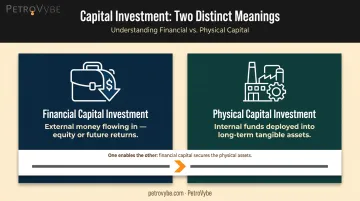
The Two Meanings of Capital Investment
The term carries two distinct but related meanings depending on context:
- Financial capital investment: An individual, venture capital firm, or institution provides money to a business in exchange for equity or future returns — "capital" here means cash flowing into the business.
- Physical capital investment: Management allocates funds to purchase long-term tangible assets — machinery, land, buildings, or infrastructure — that generate ongoing value across years of operation.
Both definitions matter. A company receiving $5 million from a private equity firm is experiencing financial capital investment. That same company spending $5 million on a new production line is making a physical capital investment. Often, one enables the other.
How Capital Investment Works in Practice
Capital investment works on a single core principle: a large upfront commitment in exchange for extended future benefits. This is what separates capital investment from operating expenses — a monthly software subscription is an operating expense; buying the servers that run the software is a capital investment.
Funding sources typically include:
- Internal cash flow (the least expensive source)
- Bank loans and credit facilities
- Bond issuances
- Equity offerings or stock issuances
- Venture capital and angel investors
- Private equity and direct investor participation
Each source carries different costs, risks, and implications for ownership. Debt preserves equity but introduces fixed obligations. Equity financing dilutes ownership but reduces cash pressure.
On financial statements, capital investments don't appear as immediate expenses. Under GAAP, qualifying long-lived assets are capitalized at cost and depreciated over their estimated useful life — spreading the cost across the periods that benefit from the asset. The one exception: land carries an indefinite useful life and is not depreciated.
This accounting treatment affects both reported profitability and tax liability, which is why the distinction between capital expenditure and operating expense matters enormously to investors and financial analysts alike.
Types of Capital Investment
Capital investments span a wide range of asset categories. The right type depends on the industry, business strategy, and growth objectives involved.
Land
Companies acquire bare land for development, expansion, or production purposes. Strategically, it can represent access to scarce resources — mineral rights, port locations, agricultural acreage, or real estate in constrained markets.
Its accounting treatment is unique: land is the only capital investment that is never depreciated, because its useful life is indefinite and it doesn't deteriorate or become obsolete.
Buildings and Physical Structures
Manufacturing plants, office headquarters, storage facilities, and warehouses provide the operational infrastructure businesses need to function at scale. These are depreciated over their estimated useful lives, typically ranging from 15 to 39 years depending on classification.
Machinery and Equipment
Production equipment is the engine of most capital-intensive industries. Factory assembly lines, drilling rigs, mining equipment, processing facilities — these assets are core to generating revenue and are depreciated over their useful life. The IRS classifies computers and peripheral equipment (including AI servers) with a 5-year MACRS recovery period for tax purposes.
Technology and Software
Software development and computing infrastructure qualifies for capitalization. Under ASC 350-40, qualifying development-stage costs for internal-use software can be capitalized rather than immediately expensed. This matters practically: capitalization spreads the cost over the asset's useful life rather than hitting the income statement all at once, which can significantly affect reported earnings and tax timing.
Equity Stakes in Other Businesses
Unlike the operational assets above, equity stakes represent a financial or strategic position rather than a physical one. Companies acquire ownership positions in other firms to expand market share, enter new segments, or achieve vertical integration. Companies account for these under ASC 321 or ASC 323 — not as property, plant, and equipment. For individual investors, direct participation vehicles in private companies operate on the same principle: capital deployed for an ownership stake, with returns tied to that entity's performance.
Benefits and Risks of Capital Investment
Advantages of Capital Investment
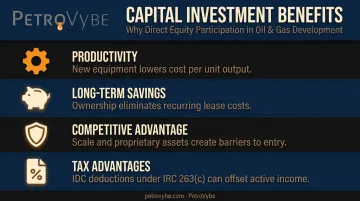
Increased productivity and efficiency. New equipment or technology allows businesses to produce more output at lower cost per unit. Federal Reserve Beige Book contacts have specifically cited automation investments as a mechanism for improving productivity and managing costs amid labor constraints.
Long-term cost savings. Owning equipment outright eliminates years of recurring rental or service expenses — often at a fraction of the total lease cost over the asset's full lifecycle.
Competitive advantage and barriers to entry. Substantial capital investment creates structural advantages that competitors struggle to replicate quickly — proprietary infrastructure, exclusive resource rights, or operational scale. The 2023 DOJ/FTC Merger Guidelines specifically note that scale economies can impede market entry and impose costs on new competitors that incumbents don't face.
Tax advantages — particularly in oil and gas. Under IRC 263(c), qualifying intangible drilling and development costs (IDCs) may be deducted as current expenses rather than capitalized. For accredited investors holding a working interest directly — or through an entity that does not limit liability — IRC 469(c)(3) excludes that interest from passive activity status. That means IDC deductions can potentially offset active income, including W2 earnings and capital gains.
Most capital investments don't allow deductions against W2 income. This one does. (Individual tax outcomes depend on specific circumstances; consult a qualified tax advisor.)
Risks and Drawbacks
These advantages come with real trade-offs. Understanding the downside is as important as the upside.
Liquidity constraints and capital lock-up. Capital investments — especially in illiquid assets like land, specialized equipment, or private energy projects — tie up cash for extended periods. As FINRA notes in its liquidity risk guidance, the danger is an inability to convert assets to cash at the expected time and price without unacceptable losses.
Short-term earnings pressure. Large capital expenditures can suppress near-term profitability. Depreciation charges hit the income statement over time, and cash outlays reduce available operating funds — a tension that publicly traded companies managing quarterly earnings pressure face directly.
Real-World Capital Investment Examples
These three examples span different asset types, stages, and scales — but each shows the same principle at work: committed capital deployed into productive assets that generate long-term returns.
Amazon: Infrastructure at Scale
Amazon's balance sheet as of December 31, 2025 reported $357 billion in property and equipment, net — capital investments in fulfillment centers, data infrastructure, robotics, and logistics that power its entire business model. That figure reflects cumulative investment in productive assets, not market capitalization. It took decades of reinvestment to build a moat that competitors simply can't replicate overnight.
Apple: Early-Stage Equity
In 1977, Mike Markkula provided $250,000 in financing during Apple Computer's formation — a mix of personal capital and credit that helped launch what became one of the most valuable companies in history. Early-stage capital investment can yield returns that dwarf the original commitment, though outcomes vary widely and most early-stage ventures carry substantial risk.
Oil and Gas Development: Pre-Production Capital
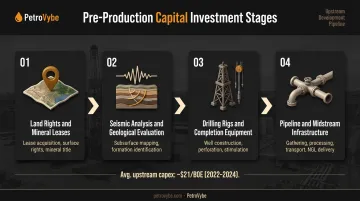
Before a single barrel or BTU reaches market, an energy developer must invest capital across multiple cost centers:
- Land rights and mineral lease acquisition
- Seismic analysis and geological evaluation
- Drilling rigs and completion equipment
- Pipeline and midstream infrastructure
Upstream capital expenditure for U.S. public producers averaged approximately $21 per barrel of oil equivalent from mid-2022 through 2024. That pre-production commitment is why oil and gas ranks among the most capital-intensive industries in the economy — and why investors who enter at the development stage carry the highest risk alongside the highest potential return.
Capital Investment in the Energy Sector
Oil and gas exploration and production requires massive upfront capital commitments before meaningful production begins. Land rights, geological analysis, drilling rigs, completion services, gathering lines, and processing infrastructure all must be in place — and paid for — before the asset generates revenue.
This pre-production capital intensity is why the sector has historically attracted institutional capital — and why direct participation was largely inaccessible to individual investors until recently.
Direct Participation for Accredited Investors
Accredited investors can now hold working interests directly in oil and gas development projects — moving beyond public market exposure into ground-floor ownership of productive assets. This structure combines:
- Monthly passive income from production revenues
- Front-loaded tax deductions through IDC treatment (subject to individual tax circumstances and applicable IRC provisions)
- Tangible asset exposure backed by independently engineered proved reserves
PetroVybe structures this type of access through its PetroVybe ONE partnership, operating in Lavaca County, Texas. The project carries a $48 million proved reserves valuation (PV-09) determined by a licensed third-party engineering firm, and partners in 2025 achieved a 94% tax deduction against active income through the IDC mechanism.
The minimum liquidity threshold is $100,000, and participation requires verified accredited investor status under SEC Regulation D 506(c).
Natural Gas and the AI Demand Tailwind
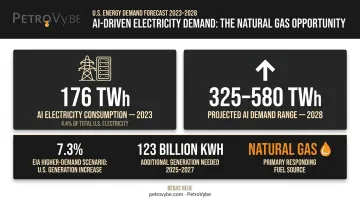
The macro case for natural gas development investment has grown materially stronger — and the driver is a structural shift in electricity demand, not a cyclical one. According to Lawrence Berkeley National Laboratory, U.S. data center electricity consumption reached 176 TWh in 2023 — approximately 4.4% of total U.S. electricity use — and is projected to reach 325–580 TWh by 2028 as AI workloads scale. That projection reflects significant uncertainty but points to a structural shift in power demand with no near-term ceiling.
Natural gas is already the largest single fuel source for U.S. electricity generation. EIA's higher-demand scenario projects that faster-than-expected electricity demand growth could drive U.S. generation up 7.3% (123 billion kWh) from 2025 to 2027, with natural gas among the primary generation sources responding to that demand.
For investors considering energy as a capital allocation category, this demand trajectory matters most at the development stage — where assets are priced before production confirms value, and before rising power demand works its way into commodity pricing.
Frequently Asked Questions
What does high capital investment mean?
High capital investment signals a company or sector is making substantial bets on long-term growth, often correlating with economic expansion and rising demand for productive capacity. It can also introduce short-term earnings pressure and liquidity risk, since large sums are committed to assets that don't immediately convert back to cash.
What is the difference between capital investment and operating expenses?
Capital investments fund long-term assets recorded on the balance sheet and depreciated over their useful life. Operating expenses support current operations and are expensed in the period incurred. The distinction comes down to asset lifespan and accounting treatment: a new manufacturing line is a capital investment, while the electricity to run it is an operating expense.
What are the main sources of capital investment?
Sources include internal cash flow, bank loans, bond issuances, equity offerings, venture capital, private equity, and direct investor participation. Each differs in cost, risk, and ownership impact — internal cash flow avoids dilution, while equity financing preserves cash at the cost of reduced ownership stakes.
Is oil and gas a capital investment?
Yes. Oil and gas exploration and production is one of the most capital-intensive industries in the economy, requiring substantial upfront commitments in land rights, drilling equipment, and infrastructure before production begins. Accredited investors can hold direct working interests in these assets, earning production income while accessing specific tax treatment under IRC 263(c) and IRC 469(c)(3).
How is capital investment recorded in accounting?
Capital investments are recorded at cost on the balance sheet as noncurrent assets, then depreciated over their useful life using methods such as straight-line or declining balance. Land is an exception, as its indefinite useful life means no depreciation applies. Equity investments in other businesses are accounted for separately under ASC 321 or ASC 323.
What is the biggest risk of making a capital investment?
The primary risk is capital lock-up: large sums committed to illiquid, long-term assets that can't easily be converted to cash if circumstances change. Market shifts, operational setbacks, or broader economic conditions can prevent expected returns from materializing, making illiquidity the risk that warrants the most scrutiny before committing.