
Introduction
Most investors use the words "asset" and "investment" interchangeably. That's understandable — but the distinction matters more than most people realize.
The core distinction: all investments are assets, but not all assets are investments. Your car and your stock portfolio both qualify as assets under formal definitions — only one is actively compounding your wealth.
How you classify what you own shapes your thinking on risk, tax strategy, liquidity, and long-term compounding. Investor.gov defines investing specifically as committing money to assets with an expectation of return — a narrower bar than simply owning something of value.
Getting that classification right is what separates a portfolio that builds wealth from one that just holds it.
Key Takeaways
All investments are assets, but not all assets are investments — intent and expected return make the difference.
Acquired specifically to generate income or appreciation, investments are a subset of assets with a defined financial purpose.
The four major asset classes are cash, bonds, equities, and alternative investments, each carrying different risk, return, and liquidity characteristics.
Asset classification drives smarter decisions around diversification, liquidity, and tax efficiency.
Tangible, income-producing assets like direct oil and gas positions offer cash flow, tax advantages, and long-term appreciation in a single structure.
What Is an Asset? Understanding the Foundation
An asset is anything with economic value that a person or entity owns. That includes cash, real estate, vehicles, intellectual property, and collectibles. The value isn't sentimental — it's what the market will actually pay.
How quickly you can access that market value is just as important as the value itself.
Liquid vs. Illiquid Assets
Not all assets convert to cash with equal ease. This matters for portfolio planning.
- Liquid assets — stocks, gold, ETFs — can be sold quickly at or near market value
- Illiquid assets — real estate, private placements — require more time to sell and often involve higher transaction costs and longer exit timelines
The SEC warns that private placement investors should be prepared to hold restricted securities indefinitely, with resale conditions under Rule 144 potentially requiring a one-year holding period for nonreporting issuers.
Appreciating vs. Depreciating Assets
This is where the asset-investment divide starts to sharpen.
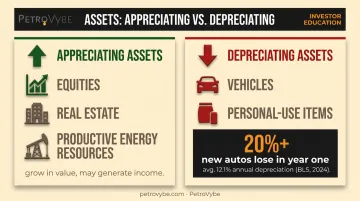
- Appreciating assets — equities, real estate, productive energy resources — grow in value over time and may generate income
- Depreciating assets — vehicles, personal-use items — lose value and cost money to maintain
A 2024 BLS analysis found that new automobiles can lose more than 20% of their value in the first year, with average annual depreciation of 12.1%. That's a cost center, not a return generator.
The Federal Reserve defines net worth as assets minus liabilities — which means a financed vehicle with a large outstanding loan effectively behaves more like a liability than an asset, even if it technically has value.
What Is an Investment? How Intent Transforms an Asset
The defining factor isn't what you own — it's why you own it.
An investment is an asset purchased with the deliberate expectation of generating a financial return. That return can come through:
- Income — dividends, interest, rent, royalties
- Appreciation — the asset rises in value and can be sold at a profit
- Both — many strong investment assets produce income and grow in value simultaneously
IRS Publication 550 defines investment income as gross income from property held for investment, including interest, dividends, annuities, and royalties. The IRS separately distinguishes personal-use assets (a home, household furnishings) from stocks and bonds "held as investments" — confirming that the tax code treats the two categories differently.
What Doesn't Count as an Investment
Buying a car for personal use, furnishing your home, or purchasing a collectible for enjoyment involves real expenditure — but without the intent to generate a financial return, none of it qualifies as an investment.
Spending money on something expensive doesn't make it an investment — the intent to generate a return is what separates the two.
Once the question of intent is settled, the next question becomes return — and what it costs you to pursue it.
The Risk-Return Tradeoff
Every investment carries uncertainty. Returns are expected, not guaranteed — and higher potential returns come with higher risk. Investor.gov defines risk as the uncertainty or potential financial loss that accompanies any return-seeking decision. Knowing where a given asset sits on that spectrum — low yield and stable, or high upside and volatile — is what separates informed allocation from speculation.
Is an Investment an Asset? Clarifying the Relationship
Yes — every investment is an asset. By definition, an investment must have economic value and be owned by someone, which satisfies the requirements for asset classification. The reverse is not true.
A Practical Example
A primary residence illustrates the distinction cleanly:
- As an asset: Your home has market value and you own it — it qualifies as an asset
- As an investment: That same home may not qualify as an investment if it generates no income and you haven't purchased it with the intent to sell at a profit
The moment you rent it out or buy it specifically to resell, the intent shifts — and so does the classification.
What Signals Investment Intent?
The SEC uses this distinction practically. Under SEC Rule 501, the accredited investor net-worth test excludes a primary residence — recognizing that owning a home is not the same as holding investment assets. Qualifying as an accredited investor requires more than $1 million in net worth excluding the primary residence, or income exceeding $200,000 individually (or $300,000 jointly).
What Makes an Investment Asset Strong?
Not all investment assets are equal. The characteristics that distinguish high-quality investment assets include:
- Generates regular cash flow that compounds over the hold period
- Appreciates beyond its purchase price — not just keeps pace with inflation
- Carries tangible backing (physical collateral or proved reserves) that supports valuation
- Qualifies for favorable tax treatment, improving after-tax returns
The strongest wealth-building assets check all four boxes. For accredited investors, direct-participation energy assets — like oil and gas development partnerships — often satisfy each criterion while adding a layer of tax efficiency unavailable in most other asset classes.
The 4 Major Asset Classes Explained
Most investment portfolios are built across four primary asset classes. Each carries distinct risk levels, return potential, and portfolio roles.
Cash and Cash Equivalents
This class includes savings accounts, money market funds, and certificates of deposit. Cash is the most liquid and lowest-risk category — but Vanguard notes that cash "may not keep pace with inflation," which erodes real purchasing power over time. Cash belongs in portfolios for emergencies and short-term goals, not long-term wealth building.
Bonds (Fixed-Income Securities)
As defined by Investor.gov, bonds are debt obligations — the investor lends to a government or corporation in exchange for interest payments and return of principal at maturity. Bonds reduce overall portfolio volatility and provide steady income, though they carry interest-rate, credit, and inflation risks.
Equities (Stocks)
Stocks represent ownership stakes in companies. They offer capital appreciation and may pay dividends. Equities carry more risk than bonds or cash — but the long-term return gap is dramatic. In Damodaran's 1928–2025 dataset, $100 grew to $1,157,598.95 in the S&P 500 with dividends reinvested, compared to $7,752.88 in 10-year Treasuries and $2,578.30 in 3-month Treasury bills.
Alternative Investments
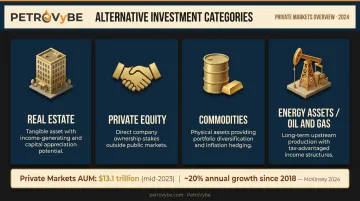
The CFA Institute defines alternatives as asset classes outside the traditional stock-bond-cash spectrum. This includes:
- Real estate
- Private equity
- Commodities
- Energy assets (oil and gas)
- Private credit
According to McKinsey's 2024 Global Private Markets Report, private-markets AUM reached $13.1 trillion at mid-2023, with nearly 20% annual growth since 2018. Alternatives can deliver income, diversification, and capital growth — but they reward investors who understand the asset, vet the operator, and commit to longer holding periods than public markets require.
What Makes an Investment a Strong Asset?
For accredited investors building long-term wealth, evaluating any investment against a few core criteria produces better decisions than chasing projected upside alone.
The criteria that define a strong investment asset:
- Generates regular income (cash flow that doesn't depend on selling the asset)
- Holds or grows in value over time
- Carries tangible or collateral backing
- Offers favorable tax treatment that improves after-tax returns
Tax Treatment as a Real Differentiator
Tax efficiency separates investment assets in ways most investors underestimate. Certain energy investments offer tax advantages unavailable in stocks, bonds, or most real estate structures.
Direct working interest positions in oil and gas development — structured under IRC 263(c) — allow investors to deduct Intangible Drilling Costs (IDCs) in the year they are incurred. For directly held working interests, IRS Publication 925 classifies this income as nonpassive — meaning IDC deductions can offset active income, including W-2 earnings and capital gains.
PetroVybe, a Texas-based natural gas development company, offers accredited investors direct working interest participation in its upstream development projects. Partners in PetroVybe ONE achieved a 94% tax deduction against active income in 2024 and 91% in 2025 — outcomes that reflect how execution quality, not just tax code provisions, determines actual investor results.

Why Diversification Across Asset Classes Matters
No single asset class performs best in all market conditions. Equities face volatility, cash erodes under inflation, and bonds suffer when interest rates rise. Each concentration carries a distinct vulnerability.
Combining traditional assets with income-producing alternatives — energy positions, real estate, commodities — reduces overall portfolio risk while maintaining compounding potential. The CFA Institute identifies income and diversification as two of the primary roles that alternative investments play in a well-constructed portfolio.
Frequently Asked Questions
Are investments considered assets?
Yes — all investments are assets because they have economic value and are owned by the investor. But the reverse isn't true: not every asset is an investment. A vehicle or personal-use item is an asset without qualifying as an investment under any standard definition.
What are the 4 major assets?
The four major asset classes are cash and cash equivalents, bonds (fixed-income securities), equities (stocks), and alternative investments. Each carries different risk levels, return profiles, and liquidity characteristics — making the mix you hold as important as the individual assets within it.
What is the difference between an asset and an investment?
An asset is anything with economic value you own. An investment is a specific type of asset purchased with the deliberate intent of generating a financial return — through income, appreciation, or both. The intent behind ownership is the defining difference.
Can something be an asset but not an investment?
Yes. A personal vehicle, a collectible kept for enjoyment, and a primary residence that generates no rental income are all assets — but without intent to produce financial returns, none qualifies as an investment under SEC, IRS, or financial accounting definitions.
What is the best asset class for long-term wealth building?
The right mix depends on risk tolerance, time horizon, tax situation, and financial goals. Historically, income-producing and appreciating assets — equities, real estate, and certain energy investments — have delivered the strongest long-term wealth creation.
How do alternative investment assets differ from traditional ones?
Alternatives like commodities, private equity, and oil and gas operate outside stock and bond markets. They often have different return drivers, longer liquidity timelines, and unique tax advantages — including IDC deductions for energy investments — making them valuable tools for accredited investors seeking genuine diversification.