

Key Takeaways
- File for unemployment benefits immediately — delays can mean lost payments that can't be recovered
- Prioritize bills by consequence, not by who calls loudest: housing first, unsecured debt last
- 45% of adults lacked three months of emergency savings in 2024 — making income disruptions far more damaging than they need to be
- Government programs like SNAP, Medicaid, and LIHEAP exist specifically for these moments — don't leave them on the table
- High earners are not immune — income disruptions expose single-paycheck dependence before a second income stream is in place
What Counts as a Loss of Income?
Loss of income means the reduction or elimination of earned wages, salary, self-employment revenue, or business income. It's distinct from losing money in investments or watching an asset depreciate — those are capital losses, not income losses.
The most common triggers:
- Layoff or termination — 1.7 million Americans were laid off or discharged in May 2026 alone
- Illness or disability — only 22.8% of people with a disability were employed in 2025, according to BLS data
- Divorce — 672,502 divorces were recorded in 2023 across 45 states and D.C., each representing a financial restructuring event
- Business failure — 24,737 business bankruptcy filings occurred in the year ending December 2025
Each of these triggers also carries a specific legal and financial definition — and the terminology matters. Insurance companies define loss of income based on policy language. Personal injury law separates past lost earnings from diminished future earning capacity. The IRS characterizes it by what a payment was intended to replace. If you're navigating a disability claim, a legal settlement, or a tax filing, confirm which definition applies before proceeding.
Your First 48 Hours: Immediate Steps to Take
Assess Your Financial Position Before Panic Sets In
The most valuable thing you can do in the first two days isn't to make calls — it's to get clear. Build a snapshot of your financial reality:
- Total fixed monthly expenses (rent/mortgage, utilities, insurance, loan minimums)
- All debt balances and upcoming due dates
- Current emergency savings balance
- Any remaining income sources: a partner's income, freelance work, rental income, investments
That snapshot tells you your cash runway — how many weeks or months you can operate before something breaks. Without it, every decision you make is a guess.
Hold off on major moves — tapping retirement accounts, signing new loans, selling assets — until you know exactly where you stand.
File for Benefits Without Delay
If you lost a job, file for unemployment insurance now. Don't wait to see how things shake out. The DOL advises filing in the state where you worked, not necessarily where you live, and warns that delays can result in lost benefits that cannot always be recovered retroactively.
Have your former employer's address, employment dates, and separation reason ready. First payments generally take 2–3 weeks after filing.
If income loss stems from illness or injury rather than job loss, separate resources apply:
- Short-term and long-term disability coverage — check your employer's HR documentation immediately
- SSDI — for disabilities expected to last at least 12 months; be aware that initial decisions typically take 6–8 months and approved claims carry a five-month waiting period before benefits begin
- Health coverage — losing job-based coverage triggers a 60-day Special Enrollment Period for ACA marketplace plans
Contact Creditors Before You Miss a Payment
Call your lenders, credit card companies, mortgage servicer, and utilities before anything goes delinquent. The CFPB has documented that all surveyed mass-market credit card issuers offered forbearance programs of at least 13 months in 2023 and 2024 — but these programs aren't always advertised. You have to ask.
When you call, ask specifically for:
- A forbearance or hardship plan
- Temporary interest rate reduction
- Waived late fees for the current cycle
- An extended due date or revised payment schedule
Proactive outreach protects your credit score and preserves negotiating leverage. Once a payment is missed and reported as 30 days past due, most hardship programs close — and that mark stays on your credit report for seven years.
How to Prioritize Bills and Manage Debt When Income Drops
Not all bills are equal. The CFPB's framework for managing financial hardship evaluates consequences — prioritize the expenses with the most severe and hardest-to-reverse outcomes.
Priority order:
- Housing — eviction and foreclosure are the most difficult consequences to undo
- Essential utilities and food — electricity, water, heat, groceries
- Secured debts — auto loans, where default means repossession
- Government obligations — taxes, child support (these carry unique enforcement powers)
- Unsecured debts — credit cards, personal loans
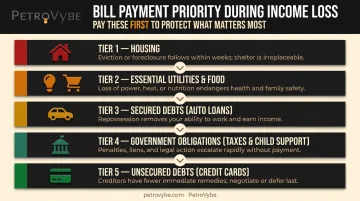
Aggressive collection calls about credit card balances don't change this order. Don't let the loudest creditor become your highest priority.
Government Debts Require Special Attention
Government creditors have enforcement powers that private lenders don't. Act quickly on these:
- Federal income taxes — contact the IRS immediately to request an installment agreement
- Property taxes — contact your county treasurer; unpaid property taxes can result in liens
- Child support — petition the family court to modify payments if income has dropped significantly. This cannot be done retroactively, so act fast
Student Loans and Retirement Accounts
Federal student loan borrowers can apply for income-driven repayment plans that can reduce monthly payments to as little as $0 depending on income and family size. Deferment is also available. Private loan borrowers should call their servicer directly — don't assume relief isn't possible.
On retirement accounts: don't touch them unless you have exhausted every other option. In 2025, 6% of nearly 5 million eligible Vanguard participants took at least one hardship withdrawal — up from 5% the year before.
Early distributions from a traditional 401(k) or IRA trigger two simultaneous hits: the withdrawal counts as taxable income, plus a 10% penalty if you're under 59½. On a $20,000 withdrawal, that can easily cost $7,000–$9,000 in combined taxes and penalties — before you see a dollar of relief.
Government and Community Resources That Can Help
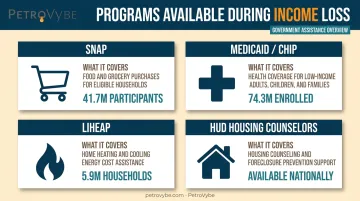
These programs exist for exactly this situation. Eligibility requirements vary by state and household size, but don't disqualify yourself before you check.
| Program | What It Covers | Scale |
|---|---|---|
| SNAP | Grocery assistance for qualifying households | 41.7M average monthly participants in FY2024 |
| Medicaid/CHIP | Health coverage for low-income individuals and children | 74.3M enrolled as of March 2026 |
| LIHEAP | Utility bill assistance (heating and cooling) | 5.9M households assisted in FY2024 |
| HUD Housing Counselors | Free or low-cost negotiation with landlords and mortgage servicers | Available nationally |
Health insurance deserves its own look. Losing job-based coverage triggers a 60-day ACA Special Enrollment Period. COBRA lets you keep your current plan but at full cost — up to 102% of the plan's premium. For most people facing income loss, an ACA marketplace plan is worth comparing.
Nonprofit credit counseling is another option worth knowing about. Organizations listed at NFCC.org can negotiate with creditors and set up debt management plans — without the long-term credit damage of bankruptcy. Bankruptcy (Chapters 7, 11, 12, and 13) can remain on your credit report for up to 10 years, making it a measure to consider only after other options are exhausted.
Beyond Survival: Building Income That Doesn't Stop
If the disappearance of one paycheck threatens your financial stability, that's not a budgeting problem — it's a structural one. The paycheck is the vulnerability.
The answer isn't a side hustle. It's income diversification: building revenue streams that flow regardless of whether you're actively employed. Just as financial advisors recommend spreading investments across asset classes, the same logic applies to income sources.
Why Real Asset Investing Matters Here
Employment income is fragile by nature — it stops when you do. Passive income from real assets doesn't share that dependency.
For accredited investors, direct participation in energy development offers a specific combination of features that most income-generating assets don't:
- Monthly distributions tied to production output, not your employment status
- Oil and gas reserves carry independently appraised, third-party-validated value
- Significant tax advantages through Intangible Drilling Cost (IDC) deductions
The IDC Deduction Advantage
This is the part most high-income earners don't know about. Under IRC 263(c), Intangible Drilling Costs (the majority of the cost of drilling a well) can be deducted in the year they're incurred. More specifically, for working interests held in qualifying structures, these deductions can offset active income, including W-2 wages and capital gains, not just passive income.
That's a structural distinction that separates oil and gas investing from real estate. Real estate losses are generally restricted to passive income for most investors; you can't use them to reduce your W-2 tax bill unless you qualify as a full-time real estate professional. IDC deductions from a qualifying working interest don't carry that restriction.
PetroVybe ONE: Designed for This Purpose
PetroVybe is a private Texas-based natural gas development company focused on South Texas and the Gulf Coast Basin — specifically Lavaca County, with additional operations in Colorado County and the Haynesville/Middle Bossier area in East Texas.
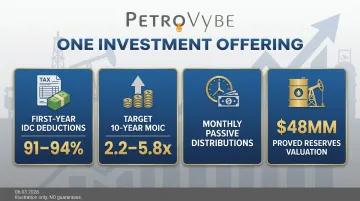
For accredited investors building income resilience, PetroVybe ONE offers:
- First-year IDC deductions of 91–94% against ordinary active income (documented in 2024 and 2025 partner K-1 filings)
- 10-year target MOIC of approximately 2.2–5.8x, with a target IRR of approximately 26%
- Monthly passive distributions projected to peak at $10,000+ per unit during peak production
- $48MM proved reserves valuation (PV-09), independently validated by a licensed third-party engineering firm
Chief Geophysicist Michael Stamatedes brings a 75.2% career hit rate across 48 years of well selection — nearly double the industry peer average of below 40%.
This is a long-hold, illiquid investment — not a near-term income replacement. The hold period before first distribution is projected at 2–3 years minimum, and the structure is designed for investors with low cash-flow urgency. But for high earners whose goal is building income infrastructure that survives the next disruption, it addresses the underlying problem directly.
Investments in oil and gas development carry material risks, including commodity price volatility and drilling uncertainty. Consult your CPA, tax attorney, or financial advisor before making any investment decisions.
Frequently Asked Questions
What is the meaning of loss of income?
Loss of income refers to the reduction or elimination of earned wages, salary, self-employment revenue, or business income due to circumstances like job loss, disability, divorce, or business failure. This is separate from investment losses or declines in asset value — those fall under a different category entirely.
What does loss of income cover?
Coverage applies across insurance claims, legal disputes, and disability contexts. It typically addresses wages, salaries, and self-employment earnings lost during the period someone couldn't work — not drops in investment value or property worth.
How is loss of income calculated?
Typically by comparing what a person earned before the disruption — using pay stubs, tax returns, or invoices — to what they actually earned (or couldn't earn) during the period of loss. The methodology varies by context: insurance, litigation, and tax filings each use different standards.
How do you show proof of loss of income?
Document your loss with pay stubs, prior-year tax returns, employer letters confirming missed time, and bank statements. Self-employed individuals can use invoices, billing records, and documentation of canceled client work.
How can I prevent income loss from derailing my finances in the future?
Start with a 3–6 month emergency fund and adequate disability insurance. Then build passive income through real asset investments — so no single employer or client holds your financial future hostage.