

Introduction
Earning a high income is not the same as building wealth. Many high-income earners watch their net worth stagnate because taxes take 30–40% off the top, inflation cuts purchasing power by 3–4% annually, and low-yield accounts do the rest. The result: a six-figure salary that produces a net worth far smaller than the gross income suggests.
Building wealth over time means growing your net worth faster than inflation, generating income that doesn't require your labor, and creating financial security that compounds decade over decade. Getting there takes more than a steady paycheck. It takes coordinated decisions about how you save, invest, and protect what you earn from taxes.
This article walks through each piece of that coordination: the financial foundation you need before investing a dollar, how compound growth actually works, which investment vehicles deserve your attention, and how tax efficiency acts as a hidden multiplier on every dollar you keep.
Key Takeaways
- Wealth requires disciplined saving, consistent investing, and tax efficiency — not just high income
- Compound growth rewards those who start early — time in the market cannot be bought back
- Diversifying across asset classes — not just within stocks — reduces correlated risk
- Controlling tax liability on active income is one of the highest-leverage moves a high earner can make
- Accredited investors can access structures that generate passive income while offsetting active income taxes
Build a Financial Foundation Before You Invest
Before putting a dollar into the market, two things must be in place: your high-interest debt is gone, and you have liquid savings to absorb life's disruptions.
Pay Off High-Interest Debt First
Federal Reserve data from May 2026 shows average credit card APRs at 20.94% across all accounts. The S&P 500 has returned roughly 10.4–11.0% annually over the past 20–30 years, according to Fidelity. Paying off credit card debt is effectively a guaranteed 20%+ return — something no investment reliably matches.
Carrying revolving debt while investing in equities is reliably a losing trade.
Build Your Emergency Fund
Only 55% of adults had three months of emergency savings in 2024, according to the Federal Reserve's household survey. The FDIC recommends at least six months of living expenses in a federally insured, liquid account.
Without that buffer, you become a forced seller — liquidating investments at exactly the wrong time when an unexpected expense hits. That protection keeps your investment strategy intact when life doesn't cooperate.
Use a Budget as a Wealth Tool
A budget works when it directs money toward your goals on autopilot. A simple framework:
- 50% of take-home pay covers essential expenses
- 30% covers discretionary spending
- 20% goes directly to savings and investments
The specific split matters less than the consistency. Automating that 20% transfer removes the temptation to spend it and keeps savings growing regardless of income changes.
The Power of Compounding: Why Time Is Your Greatest Wealth-Building Tool
Compound interest earns returns on both your original principal and every dollar of previously accumulated interest. Returns on returns. That mechanism is what transforms linear savings into exponential growth.
What the Numbers Actually Look Like
At a hypothetical 7% annual return, a $400 monthly contribution grows to approximately:
| Timeframe | Approximate Balance |
|---|---|
| 10 years | ~$69,000 |
| 20 years | ~$207,000 |
| 30 years | ~$486,000 |
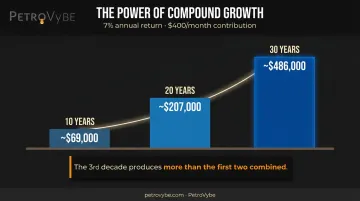
The contribution is identical each month. The difference is time. The third decade produces more than the first two combined — because by year 20, your accumulated balance is itself generating substantial returns.
The Rule of 72
Divide 72 by your expected annual return to estimate how many years it takes to double your money.
- At 6%: money doubles in ~12 years
- At 8%: money doubles in ~9 years
- At 10%: money doubles in ~7.2 years
This mental shortcut helps you evaluate investment options quickly and understand why even modest differences in return rates produce vastly different outcomes over time.
The Cost of Waiting
Fidelity illustrates this starkly: an investor saving 15% of salary from age 25 to 67 at a hypothetical 7% return accumulates roughly $2.69 million. Starting at 35 instead produces approximately $1.46 million — about $1.23 million less, from the same contribution rate, with only a 10-year delay.
Time in the market is one of the only inputs in wealth building that genuinely cannot be recovered once lost. That same logic extends well beyond savings accounts. Dividend reinvestment, rising asset values, and production income channeled back into the asset base all compound the same way — any income stream that feeds back into the principal is compounding.
Investment Vehicles That Grow Wealth Over Time
The Core Asset Classes
A diversified portfolio typically starts with three building blocks:
- Stocks — ownership stakes in companies, offering capital appreciation and dividends. Higher volatility, higher long-term return potential
- Bonds — debt instruments that pay fixed income with lower risk. They stabilize a portfolio during equity downturns
- Mutual funds and ETFs — diversified pools that reduce single-stock exposure. Passive index funds, in particular, eliminate the need to pick individual winners
Each serves a different purpose. Most investors need all three in proportions that match their timeline and risk tolerance. Accredited investors with larger portfolios sometimes extend beyond these vehicles — adding direct energy partnerships, private placements, or real assets to complement a stock-and-bond foundation.
Retirement Accounts: Start Here
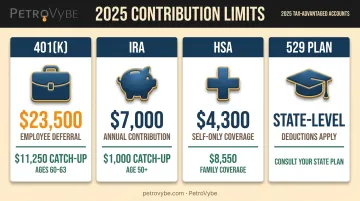
For most investors, tax-advantaged retirement accounts are the first and most important investment destination. The 2025 limits:
- 401(k): $23,500 employee deferral ($11,250 catch-up for ages 60–63)
- Traditional/Roth IRA: $7,000 ($1,000 catch-up over age 50)
- HSA: $4,300 self-only / $8,550 family
If your employer offers a 401(k) match, contribute at least enough to capture it fully. Vanguard's 2025 plan data shows 86% of plans offered a match, averaging 4.6% of pay. Skipping that match means surrendering roughly $2,300–$4,600 per year in employer contributions — money that compounds in your favor for decades if captured early.
Traditional vs. Roth: Traditional contributions reduce your taxable income now; you pay taxes at withdrawal. Roth contributions use after-tax dollars, but growth and qualified withdrawals are entirely tax-free. High-income earners who expect lower rates in retirement often prefer Traditional; those who expect rates to rise favor Roth.
Risk Tolerance and Asset Allocation
Two variables should drive how you allocate across these assets:
- Time horizon — a 30-year runway absorbs volatility that a 5-year horizon cannot
- Risk tolerance — your psychological and financial ability to hold through a 30–40% market decline without selling
A 30-year-old can hold 80–90% equities. A 60-year-old approaching retirement needs more capital preservation. Neither allocation is universally right — only situationally appropriate.
Once you've set an allocation that fits your situation, the next challenge is sticking to it — especially when markets move against you.
Automate Everything
Automating contributions to investment accounts prevents the reactive decisions that erode returns. Research on 66,465 brokerage households from 1991–1996 found the most active traders earned 11.4% net versus 17.9% for the market. Frequent trading costs returns through transaction costs, taxes, and behavioral errors. Automation enforces consistency and protects against reactive decisions during market swings.
Tax Efficiency: The Hidden Multiplier of Long-Term Wealth
For high-income earners, taxes are often the single largest drag on wealth accumulation. A 37% marginal rate means the government takes more than a third of each additional dollar earned. Reducing that liability is mathematically equivalent to earning a higher return.
The Foundation: Max Your Tax-Advantaged Accounts
Four vehicles deserve priority:
- 401(k) pre-tax contributions reduce your current-year taxable income dollar for dollar
- Roth IRA allows after-tax contributions to grow and withdraw tax-free — especially powerful over decades
- HSA offers a triple advantage: deductible contributions, tax-free growth, and tax-free qualified medical distributions
- 529 plans provide tax-free growth for education expenses, with state-level deductions available in many states
Max these accounts before moving into taxable investing. Once they're filled, active planning is where the next layer of tax savings comes from.
Active Tax Planning Strategies
These strategies run year-round — not just at filing time:
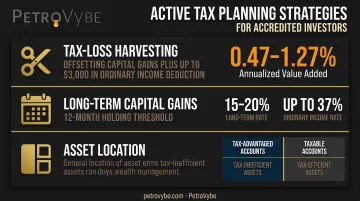
- Tax-loss harvesting: Selling investments at a loss to offset gains (and up to $3,000 of ordinary income annually). Vanguard simulations estimate 0.47–1.27% annualized value under optimized conditions — meaningful over decades
- Long-term capital gains treatment: Holding investments over 12 months qualifies gains for the 15–20% long-term rate rather than ordinary income rates up to 37%
- Asset location: Placing tax-inefficient investments (high-dividend funds, REITs) inside tax-advantaged accounts and tax-efficient holdings in taxable accounts. Vanguard estimates roughly 5–30 basis points of annual after-tax value from this strategy alone
High earners should also note the 3.8% Net Investment Income Tax that applies above $200,000 (single) or $250,000 (joint) in modified AGI — making tax planning even more consequential at upper income levels.
What Accredited Investors Can Access
Beyond standard vehicles, accredited investors have access to structures that create tax advantages unavailable through public markets — particularly in oil and gas development.
Intangible Drilling Costs (IDCs) — covering labor, fuel, geology, engineering, and drilling services — are deductible under 26 CFR 1.612-4 in the year they are incurred. Because IDCs typically represent 60–80% of total invested capital in a new drilling project, a $100,000 investment can generate a $60,000–$80,000 deduction.
What distinguishes this from most passive investment deductions is the income it can offset. Properly structured working interests apply IDC deductions against W-2 income, capital gains, and other active income — not just passive income.
PetroVybe structures its accredited investor partnerships around this mechanism, with operations in Lavaca County, Texas. Partners in 2024 and 2025 achieved 91–94% tax deductions against active income — verified through K-1 tax documents. One partner, Nizar A., eliminated a $30,000 tax liability through this structure. The investment itself carries a 10-year horizon with monthly passive distributions projected to peak above $10,000 per month — and a third-party proved reserves valuation of $48 million (PV-09).
Tax results vary by individual. Consult a qualified tax professional before making investment decisions.
Diversify Beyond Stocks and Bonds
Holding a diversified stock portfolio reduces single-company risk. But when equity markets decline broadly — as they do periodically — everything in that portfolio moves together. True diversification means holding assets that behave differently under the same economic conditions.
Why Alternative Assets Matter
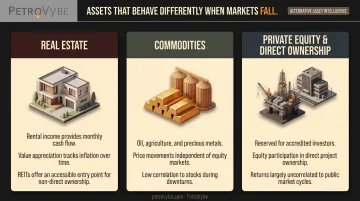
When equities sell off, alternative assets often respond differently. Real assets tied to production, rental income, or commodity prices can hold value — or even appreciate — while public markets fall. That asymmetry reduces overall portfolio volatility without necessarily reducing long-term returns.
Key alternative categories available at different investment levels:
- Real estate: Direct ownership or REITs provide rental income and inflation-linked appreciation
- Commodities: Oil, agricultural products, and precious metals often move independently of equity markets
- Private equity and direct business ownership: Typically require accredited investor status but offer returns uncorrelated with public markets
Natural Gas and Energy Development
Among these categories, energy development deserves closer attention. Natural gas assets generate production-based income tied to real physical output — income that adjusts with inflation in ways bond coupons don't.
The demand backdrop is strengthening. Berkeley Lab data shows U.S. data centers consumed 176 TWh — 4.4% of total electricity — in 2023, with projections reaching 325–580 TWh, or 6.7–12%, by 2028.
The IEA forecasts natural gas will supply more than 40% of additional U.S. data center electricity demand through 2030. AI infrastructure runs on dispatchable power, and natural gas is the most scalable source available at that scale.
For accredited investors, PetroVybe's direct participation structure in natural gas development provides asset ownership, production income, and the IDC tax advantages described above. That's a structurally different risk/return profile than an energy ETF or MLP, which offers no direct tax pass-through and represents assets already at mature valuation.
Frequently Asked Questions
What is the best investment for wealth creation?
There's no single best investment — the right choice depends on your time horizon, risk tolerance, and tax situation. Historically, long-term wealth builders have combined diversified equity exposure through low-cost index funds, tax-advantaged retirement accounts, and alternative assets that reduce correlation to public markets.
How much do I need to invest to earn a desired monthly passive income?
Divide your target annual passive income by your expected yield rate. For $1,000 per month ($12,000 annually) at a 6% yield, you'd need roughly $200,000 in invested assets. The exact figure varies depending on asset type, leverage, and distribution policy.
What is the 8-4-3 rule for wealth creation?
The 8-4-3 rule describes a compounding pattern where an investment doubles in roughly 8 years, then again in 4, then again in 3 — showing how compounding accelerates as the base grows. Return rates and contribution levels shift the exact timeline, but the directional insight holds: time in the market compounds your advantage.
How does compound interest help build wealth over time?
Compound interest generates returns on both your original principal and all previously earned interest, causing wealth to grow exponentially rather than linearly. The longer money remains invested without interruption, the more pronounced this acceleration becomes. Starting early is the single most reliable way to maximize it.
What is the difference between saving and investing for wealth building?
Saving preserves capital with low risk and low return, making it appropriate for emergency funds and short-term goals. Investing accepts measured risk in exchange for higher long-term returns. Both are necessary, but lasting wealth typically requires moving available savings into growth-oriented investments once your financial foundation is in place.
How can high-income earners reduce taxes while building wealth?
Core strategies for high-income earners include:
- Maximize 401(k) and IRA contributions each year
- Use tax-loss harvesting to offset realized gains
- Hold investments over 12 months to qualify for long-term capital gains rates
- Explore alternatives that generate deductions against active income
Oil and gas development structured as a working interest can produce IDC deductions applicable to W-2 and capital gains income — a particularly effective tool during peak earning years.