

"Investment allowance" is an umbrella term covering multiple IRS-recognized deductions tied to investment activity. These range from interest expense deductions on borrowed funds to oil and gas-specific provisions that can offset W2 wages directly. Knowing which allowance applies to your income type — and how to structure an investment to access it — is where the real tax advantage lives.
This guide breaks down each major allowance, explains who qualifies, and identifies where the most powerful opportunities exist for accredited investors.
Key Takeaways
- Investment allowances are IRS-recognized deductions that reduce taxable income from qualifying investment activity
- The IDC deduction in oil and gas working interests can offset active income — including W2 wages and capital gains — an advantage most other deductions don't offer
- Investment interest expense deductions are capped at net investment income, with unused amounts carrying forward indefinitely
- Passive activity rules restrict most investment deductions; oil and gas working interests are a statutory exception under IRC Section 469
- Always consult a qualified CPA or tax attorney to model the impact on your specific tax situation before investing
What Is an Investment Allowance?
An investment allowance is a tax provision that lets investors deduct qualifying investment-related costs from taxable income, reducing what they owe. The IRS does not use a single "investment allowance" umbrella — instead, relevant deductions arise under separate code sections: investment interest under IRC 163(d), capital losses under IRC 1211(b), depreciation under IRC 168(k), Section 179 expensing, depletion under IRC 613A, and intangible drilling costs (IDCs) under IRC 263(c) — the provision that drives the largest upfront deductions available to oil and gas investors.
Which of these provisions actually benefits you depends on the type of income you're earning and the nature of the investment itself.
Active vs. Passive Income: Why It Matters
The value of any allowance depends on three things:
- Your tax bracket — higher brackets amplify the benefit of deductions
- Your income type — active (W2, business) vs. passive (rental, limited partnership distributions)
- The nature of the investment — some deductions are restricted to passive income; others are not
Most investors discover this distinction too late. A rental property depreciation deduction, for example, generally cannot offset W2 income unless you qualify as a real estate professional.
Oil and gas working interests are different. Under IRC 263(c), intangible drilling cost deductions are specifically permitted to offset active income — including W2 earnings and capital gains — without the passive activity restrictions that limit most other investment deductions.

Types of Investment Allowances US Investors Should Know
Investment Interest Expense Deduction (IRC 163(d))
This deduction applies when you borrow money to purchase taxable investments (a margin loan to buy stocks, for example). The deduction is capped at net taxable investment income for the year. Any unused amount carries forward without expiration.
Key mechanics:
- Calculated on Form 4952, claimed as an itemized deduction on Schedule A
- Qualifying investments must produce taxable income (interest, ordinary dividends, capital gains)
- Does not apply to tax-exempt investments like municipal bonds (per IRC 265)
- Rental property interest is deducted separately on Schedule E, not here
- Qualified dividends taxed at preferential rates don't count as investment income unless you elect to treat them as ordinary (and that election is irrevocable without IRS consent)
Capital Loss Deduction (IRC 1211(b))
Capital losses offset capital gains dollar-for-dollar. If losses exceed gains:
- Up to $3,000 can be applied against ordinary income annually ($1,500 if married filing separately)
- Remaining losses carry forward to future tax years until absorbed
- The wash-sale rule disallows a loss when substantially identical securities are repurchased within 61 days of the sale
Section 179 Expensing and Bonus Depreciation
These allowances benefit business owners and investors in equipment or property. Instead of spreading deductions over years, they allow immediate or accelerated write-offs.
Under Public Law 119-21 (enacted July 4, 2025):
- Section 179 maximum deduction increased to $2.5 million for 2025 (up from $1.25M), with a phaseout threshold of $4 million
- Bonus depreciation was restored to 100% for qualified property acquired and placed in service after January 19, 2025 (property acquired before that date generally remains at 40% for 2025)
Percentage Depletion Allowance (IRC 613A)
Unlike the allowances above, this one applies specifically to natural resource investments. It lets investors in oil, gas, and mineral operations deduct a percentage of gross income annually, accounting for the gradual depletion of the underlying asset.
- The statutory rate for qualifying domestic oil and gas production by independent producers is 15% of gross income
- Unlike cost depletion, percentage depletion is not limited by the property's adjusted basis — it can continue even after basis reaches zero, provided statutory eligibility and income limits are met
- Subject to a 65% of adjusted taxable income ceiling overall, and 100% of taxable income from the specific property
Intangible Drilling Cost (IDC) Deduction (IRC 263(c))
The IDC deduction is the least visible allowance available to individual investors, yet often delivers the largest year-one tax impact. IDCs are the non-salvageable costs of drilling and completing a well: wages, fuel, drilling fluids, chemicals, hauling, and supplies. Under Treasury Regulation 1.612-4, investors holding a working interest may elect to expense these costs in the year they're paid or incurred.
The distinction between intangible and tangible costs matters for calculating the year-one deduction:
- Intangible costs (wages, chemicals, drilling fluids): expensed immediately
- Tangible equipment (casing, tubing, production equipment): capitalized and depreciated separately over time

Oil and Gas Investment Allowances: A Powerful Tool for Active Income Reduction
Oil and gas investments offer two allowances that simply don't exist in other asset classes: the IDC deduction and the percentage depletion allowance. Together, they deliver an immediate deduction in year one and a continuing reduction in taxable income across the life of the producing asset.
The Working Interest Exception: Offsetting Active Income
The most important distinction is buried in IRC Section 469. Passive activity rules generally prevent investment losses from offsetting active income like W2 wages. But IRC 469(c)(3)(A) specifically exempts working interests in oil and gas properties from passive activity treatment — provided the interest is held directly or through an entity that does not limit the taxpayer's liability.
In plain terms: a qualifying oil and gas working interest holder can apply IDC deductions against W2 income, capital gains, or any other active income. This is not available through real estate, stock losses (beyond the $3,000 cap), REITs, or mutual funds.
A royalty interest does not qualify — royalty income is generally treated as portfolio income. The investor must hold a working interest to access this exception.
How the Numbers Work: A Simplified Example
Consider an accredited investor who commits $100,000 to an oil and gas working interest partnership. If IDCs represent approximately 70% of the project costs, that investor may be able to deduct roughly $70,000 against ordinary or W2 income in year one. This is illustrative — actual figures depend on project structure, timing, and individual tax circumstances — but it shows the scale of the benefit relative to most other investment deductions.
Beyond year one, percentage depletion continues to reduce taxable income from the producing wells annually, extending the tax benefit across the life of the asset. Real-world partnership results show what these numbers look like in practice.
PetroVybe's Documented Results
PetroVybe, a Texas-based natural gas development company operating in Lavaca County and the Gulf Coast Basin, structures its investor partnerships specifically to deliver these allowances. Its partners achieved a 91% tax deduction against active income in 2024 and a 94% tax deduction in 2025, figures documented through K-1 tax reporting. Those results are independently corroborated by verified investor reviews on Invest Clearly, where PetroVybe holds a 5.0 rating with 100% five-star reviews. One verified investor confirmed the elimination of a $30,000 tax liability through the IDC structure.

PetroVybe's proved reserves are independently valued at $48MM (PV-09) by a licensed third-party engineering firm, giving investors a concrete measure of the long-term asset behind the tax benefit.
Key Limitations Investors Must Understand
At-Risk Rules (IRC 465)
Investors can only deduct losses up to the amount they have "at risk" — their actual capital contribution plus qualifying recourse debt. Important nuances for oil and gas:
- Amounts protected by guarantees, stop-loss arrangements, or nonrecourse debt generally do not increase at-risk basis
- The qualified nonrecourse financing exception that applies to real estate specifically excludes mineral property — so nonrecourse financing secured by oil and gas assets typically doesn't increase an investor's at-risk amount
- In leveraged partnership structures, this means investors should understand exactly how much of their capital is truly at risk before projecting maximum deductions
At-risk rules cap your deduction exposure — but a second constraint can affect high-income investors even when at-risk amounts are sufficient.
AMT Considerations
IDC deductions can create an Alternative Minimum Tax (AMT) preference item under IRC Section 57(a)(2). Excess IDCs — meaning the Section 263(c) deduction amount above 65% of net income from the relevant oil, gas, and geothermal properties — may be subject to AMT.
- Integrated oil companies are subject to this preference item
- Independent producers receive a partial exception, though the reduction in AMTI cannot exceed 40% of AMTI computed without the exception
- High-income investors should model AMT exposure with a CPA before committing capital
How Accredited Investors Can Maximize Their Investment Allowance
Time investments strategically. IDC deductions are triggered in the year costs are incurred. Investing in an oil and gas working interest before year-end can shift a large deduction into the current tax year. Consult a CPA in Q3 or early Q4 to model the timing benefit against your projected income.
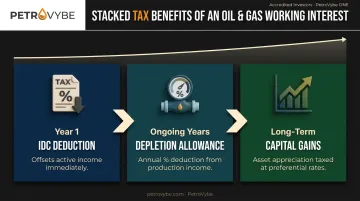
Stack allowances across years. The tax efficiency compounds:
- Year 1: Large IDC deduction reduces immediate tax burden on active income
- Ongoing: Percentage depletion reduces taxable production income annually
- Long-term: Asset appreciation may generate capital gains taxed at preferential rates
Vet the operator rigorously. The operator's quality determines whether allowances are correctly documented and reflected on your K-1 — look for:
- Third-party engineering reserve reports
- Accurate K-1 reporting (request a redacted sample before investing)
- Verified investor reviews from independent platforms
- Regulatory compliance documentation (Texas RRC operator license, KYB/KYC verification)
PetroVybe makes its engineering reports, compliance documentation, and redacted K-1 samples available through an investor data drive before any capital commitment — so partners can review the fundamentals before committing a dollar.
Frequently Asked Questions
What qualifies for an annual investment allowance?
In the US, common qualifying allowances include interest paid on funds borrowed to purchase taxable investments, capital losses up to $3,000 against ordinary income annually, and — for oil and gas working interests — intangible drilling costs deductible in the year incurred. Eligibility depends on investment type, how costs are structured, and your specific tax situation.
What is an example of an investment allowance?
The IDC deduction is the most impactful example. An accredited investor who contributes to an oil and gas working interest may deduct 60–80% of their investment against W2 or active income in year one — directly reducing taxable income in the year costs are incurred, not spread across future years.
How does the new $6,000 senior deduction work?
Under Public Law 119-21 (enacted July 4, 2025), individuals age 65 or older by year-end may claim a $6,000 deduction ($12,000 for qualifying joint filers), available whether you itemize or take the standard deduction. It applies for 2025–2028, phases out above $75,000 AGI for single filers ($150,000 joint), and has no interaction with IDC, depletion, or investment interest expense deductions.
Can investment allowances offset W2 income?
Most investment deductions cannot — they're restricted to passive income. The major exception is the IDC deduction from oil and gas working interests. Under IRC Section 469(c)(3)(A), qualifying working interest holders can apply IDC deductions directly against active income including W2 wages, making this one of the few investment allowances that reduces a high earner's primary income tax burden.
What is the difference between an investment allowance and investment interest expense?
Investment interest expense is a narrow deduction for interest paid on borrowed investment funds, capped at net investment income for the year. "Investment allowance" is broader, covering capital loss deductions, IDC deductions, depletion allowances, and depreciation — each with its own rules, income restrictions, and limits.
Are oil and gas investments eligible for special tax allowances?
Yes. Oil and gas working interests offer two allowances unavailable in most other investment classes: IDC deductions (typically deductible in year one against active income) and the percentage depletion allowance (an ongoing annual deduction from production income). Investors must hold a working interest — not a royalty interest — to access these benefits; verify the structure with a qualified tax advisor before assuming either applies.
This article is for informational purposes only and does not constitute tax or legal advice. Consult a qualified CPA or tax attorney to evaluate how these provisions apply to your individual tax situation.