Introduction
Most balance sheets tell an incomplete story. A company might show modest physical assets on paper while holding its most valuable resources in forms you can't see, touch, or photograph — patents, brand recognition, exclusive licenses, and proprietary expertise that competitors can't easily replicate.
This gap between book value and real value has grown dramatically. According to Ocean Tomo's Intangible Asset Market Value Study, intangible assets represented approximately 92% of S&P 500 market capitalization at year-end 2025, compared to just 17% in 1975. At the global level, Brand Finance estimated $97.6 trillion in intangible value among the world's largest companies in 2025 — a 23% increase from the prior year.
For investors, that gap has real consequences. Miss it, and you risk mispricing an asset — or overlooking what makes one business worth ten times another. This guide covers definitions, types, valuation methods, and how to apply all of it when sizing up an investment.
Key Takeaways
- Intangible assets lack physical form but generate real, measurable economic value
- The four main categories are intellectual property, goodwill, brand equity, and contractual/legal rights
- Definite-life intangibles are amortized; indefinite-life intangibles are tested annually for impairment
- Standard balance sheets often understate true intangible value, making book value a misleading proxy for investment worth
- In oil and gas, intangible assets like mineral rights and geological expertise can determine whether a project succeeds or fails
What Are Intangible Assets?
Intangible assets are non-physical assets that hold economic value and provide competitive or financial advantages to a business. Under US GAAP, FASB describes them as assets lacking physical substance (excluding financial assets like cash or receivables). The international standard, IAS 38, defines an intangible asset as "an identifiable non-monetary asset without physical substance."
The Two Recognition Criteria
For an intangible asset to be formally recognized, two conditions must be met:
- Identifiability — the asset must be separable from the entity, or must arise from a contractual or legal right
- Expected future economic benefits — the asset must generate probable future income, cost savings, or other measurable value
What Intangible Assets Are NOT
For accurate reporting and investor analysis, intangible assets are distinct from:
- Financial assets (cash, receivables, stocks)
- Physical property or equipment
- Internally developed value that lacks a definable cost and lifespan
That last point trips up many investors. A company that has spent decades building its reputation hasn't typically recorded that brand value on its balance sheet — because internally generated intangibles generally don't meet GAAP capitalization criteria unless specific conditions are satisfied. That gap between recorded book value and actual market value is one reason analysts rely on far more than balance sheets alone.
The Four Main Types of Intangible Assets
While classification varies by accounting framework, intangible assets generally fall into four broad categories. Understanding each helps investors identify where genuine value resides inside a business.
Intellectual Property (Patents, Copyrights, Trade Secrets)
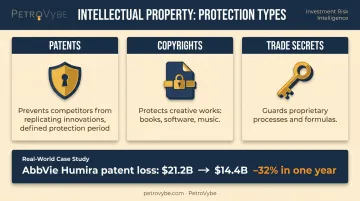
Intellectual property covers legally protected creations of the mind. The three primary forms each protect a different kind of competitive advantage:
- Patents prevent competitors from replicating innovations for a defined period
- Copyrights protect creative works — books, software, music, and more
- Trade secrets guard proprietary processes and formulas (think Coca-Cola's recipe)
The financial stakes are substantial. When US biosimilar competition began eroding AbbVie's Humira patent protection in early 2023, annual revenue from that single drug fell from $21.2 billion to $14.4 billion — a 32% decline in one year. That's the power (and the vulnerability) of a patent portfolio made visible.
Goodwill
Goodwill is the premium recorded when a company acquires another for more than the fair market value of its net identifiable assets. It captures factors like customer loyalty, workforce quality, and organizational reputation — things that don't have their own line items but clearly affect enterprise value.
Under US GAAP (ASC 350-20), goodwill is not amortized. Instead, it must be tested at least annually for impairment, with additional testing required whenever triggering events suggest the recorded value may no longer be supported.
Brand Equity
Brand equity is the incremental value a recognized brand name adds over an otherwise equivalent generic product. It's built through consistent quality, marketing investment, and accumulated customer experience, compounding in value over years and decades.
Interbrand valued Apple's brand alone at $470.9 billion in its 2025 Best Global Brands ranking. That figure doesn't appear on Apple's balance sheet, but it drives the premium pricing and customer loyalty that flow directly into financial results. Brand equity is classified as an indefinite-life intangible because it carries no set expiration date.
Contractual Rights, Licenses, and Mineral Rights
Unlike IP or goodwill, which arise from internal activity, contractual rights are granted externally — through legal agreements, regulatory bodies, or property ownership. Permits, licenses, mineral rights, water rights, and government-issued operating licenses all qualify.
In the oil and gas sector, this category is foundational. Mineral rights grant the legal authority to extract subsurface resources; drilling permits authorize specific well locations; operator licenses authorize production within a regulatory jurisdiction. These rights determine what can legally be produced — and therefore what an energy project is actually worth.
For investors evaluating upstream energy assets, the status of these rights is often the first thing to verify. Acreage without clear mineral rights, or a project without valid permits, carries development risk that no amount of geological quality can offset.
Definite vs. Indefinite Intangible Assets
Not all intangible assets age the same way. This distinction has direct implications for financial reporting and investment analysis.
| Classification | Examples | Accounting Treatment |
|---|---|---|
| Definite (finite-life) | Patents, licensing agreements, non-compete agreements | Amortized over estimated useful life |
| Indefinite-life | Brand names, certain trademarks | Not amortized; tested annually for impairment |
| Goodwill | Acquisition premium | Not amortized; tested annually for impairment |
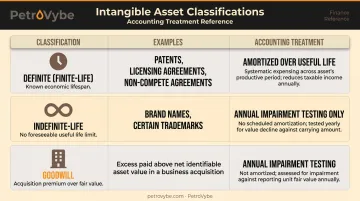
Finite-life intangibles carry a built-in clock. A patent expires, a license agreement has a term, a non-compete covenant has a sunset date. Under ASC 350-30, amortization follows the asset's consumption pattern — straight-line applies only when no reliable pattern exists.
That ticking clock has real consequences: expiring assets affect cash flow projections, compress balance sheet values, and create urgency around renewal or replacement decisions.
Indefinite-life intangibles have no scheduled write-down — but that doesn't mean they're maintenance-free. They must be monitored for signs that value has eroded. A brand that loses market relevance, or a license whose regulatory environment shifts, can face sudden impairment charges that hit earnings without warning.
The investor takeaway: finite intangibles demand calendar discipline — expiration dates, renewal windows, replacement costs. Indefinite intangibles demand something harder to model: an honest read on whether the competitive advantage behind the asset still exists.
Intangible Assets vs. Tangible Assets
Tangible assets are physical — equipment, property, vehicles, inventory, infrastructure. They can be seen, appraised, insured, and collateralized. Accountants depreciate them over a defined useful life.
The core difference:
- Tangible assets depreciate on a schedule tied to physical wear and obsolescence
- Definite intangibles amortize over their legal or economic life
- Indefinite intangibles are tested for impairment rather than systematically written down
The Book Value Problem
A company with modest tangible assets on paper may hold enormous value in proprietary technology, exclusive licenses, or brand recognition — none of which appear at full value on a standard GAAP balance sheet. This is why price-to-book ratios for intangible-heavy businesses routinely exceed 4x or more: the market is pricing in value the balance sheet doesn't capture.
The MSCI World Index carried a price-to-book ratio of 4.15 as of June 30, 2024 — meaning investors paid more than four times accounting book value for the average large-cap global company. That gap between book value and market price is largely what intangible assets look like from the outside.
Tangible and Intangible Working Together
In many industries, these asset categories are inseparable. Consider oil and gas development: physical wells are tangible assets, but they're only as valuable as the mineral rights and operator licenses that authorize production. A wellbore without valid mineral rights produces nothing. The intangible assets define what the tangible assets are legally permitted to do — and therefore what they're worth.
PetroVybe's development operations in South Texas illustrate this directly. The company's physical production infrastructure in Lavaca County operates under a Texas Railroad Commission operator license held by PetroVybe OpCo LLC — a regulatory authorization that is as foundational to production value as the wells themselves. The $48 million proved reserves valuation (PV-09) certified by independent engineering firms reflects both dimensions working together.
How Are Intangible Assets Valued?
Unlike a piece of equipment, intangible assets have no fixed market price. Valuation requires judgment, comparable data, and an understanding of how the asset generates economic benefit. The AICPA and International Valuation Standards (IVS) recognize three primary approaches.
The Income Approach
The income approach projects the future economic benefits an intangible asset is expected to generate — cash flows, royalties, licensing revenue — and discounts them to present value. According to IVS 210, this is the most common method for intangible asset valuation.
A widely used sub-method is the relief-from-royalty method: estimate the royalty rate a company would have to pay if it didn't own the asset outright, then calculate the value of avoiding those payments. This works well for patents and trademarks where comparable royalty rates exist in the market.
The Market Approach
The market approach values an intangible by comparing it to similar assets sold in arm's-length transactions. The challenge is finding truly comparable transactions — particularly for unique assets like proprietary geological data or exclusive regulatory permits.
The Cost Approach
The cost approach estimates what it would cost to recreate or replace the intangible asset. This works reasonably well for internally developed software or proprietary processes, but it doesn't capture future economic benefit or time value — so it tends to understate value for assets with strong growth trajectories.
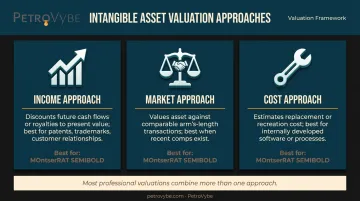
Most professional valuations combine more than one approach. Which method carries the most weight depends on the asset type and available data:
- Income approach: Best for patents, trademarks, and customer relationships where future cash flows can be modeled
- Market approach: Best when recent, comparable arm's-length transactions exist
- Cost approach: Best for internally developed software or processes where replacement cost is calculable
Why Intangible Assets Matter for Investors
Intangible assets are often the primary source of what Morningstar calls an "economic moat" — the sustainable competitive advantage that protects long-term profitability. Morningstar identifies five moat sources, and intangible assets (patents, brands, regulatory licenses) appear prominently among them.
The investment implications are concrete. McKinsey research found that high-growth companies invested 2.6 times more in intangibles as a share of revenue than low-growth peers. Sectors investing more than 12% of gross value added in intangibles grew 28% faster than peers between 1995 and 2019. McKinsey notes that other factors influence growth outcomes — but the association between intangible investment intensity and growth is consistent across industries and timeframes.
What This Means for Direct Investment Evaluation
When evaluating any business or direct investment position, ask what intangibles underpin the value proposition:
- Is there proprietary technology that competitors can't easily replicate?
- Are there exclusive licenses or permits that create barriers to entry?
- Does the team possess domain expertise that functions as a competitive advantage?
- Are mineral rights or other contractual rights secured and verified?
In direct energy development, the answers to these questions often separate average outcomes from exceptional ones. That's where the difference between a verifiable intangible and a vague competitive claim becomes material.
PetroVybe's investment model in South Texas natural gas development combines tangible production infrastructure with verifiable intangible advantages: publicly recorded mineral leases in Lavaca County, an RRC operator license through PetroVybe OpCo LLC, and the geological expertise of Chief Geophysicist Michael Stamatedes.
Stamatedes brings a 48-year career and a 75.2% well success rate — compared to an industry peer average below 40%. That track record translates directly into more accurate decline curve modeling, better location selection, and stronger probability of production outcomes investors can underwrite with confidence.

For accredited investors evaluating direct positions in energy development, intangible advantages like these are the foundation of the underwriting — not supporting context.
Frequently Asked Questions
What type of asset is an investment?
Investments — stocks, bonds, or direct ownership positions — are classified as financial assets, not intangible assets. However, an investment may represent or derive its value from underlying intangibles; a stake in a business whose value is driven by patents or mineral rights is a financial asset backed by intangible value.
What are 5 examples of intangible assets?
Patents, trademarks, goodwill, mineral rights, and brand equity are five common examples. Each provides economic value without physical substance, though accounting treatment varies by type and lifespan.
What are the four types of intangible assets?
The four broad categories are intellectual property (patents, copyrights, trade secrets), goodwill, brand equity, and contractual/legal rights (licenses, permits, mineral rights). Classification can vary slightly depending on whether you're applying US GAAP, IFRS, or another framework.
Are mineral rights an intangible asset?
Yes. Mineral rights arise from legal agreements granting ownership of subsurface resources — they carry economic value and legal standing but no physical form. In oil and gas accounting, acquisition costs are capitalized as property costs under ASC 932, using either the successful-efforts or full-cost framework.
How are intangible assets valued?
The AICPA and IVS recognize three primary valuation approaches: the income approach (discounted future cash flows or royalties), the market approach (comparable transactions), and the cost approach (replacement cost). Most professional valuations combine methods depending on the asset type and available data.
What is the difference between tangible and intangible assets?
Tangible assets have physical form (equipment, property, inventory) and are depreciated over their useful life. Intangible assets — patents, goodwill, licenses — lack physical substance and are either amortized over a defined life or, if indefinite-lived, tested annually for impairment instead of being systematically written down.