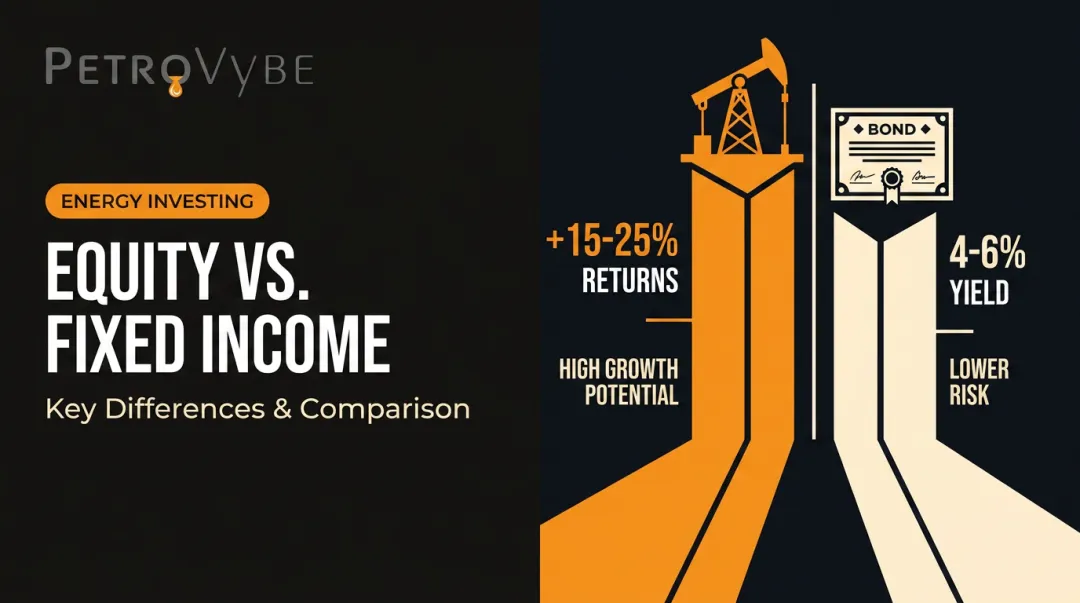
Most investors treat debt as "safe" and equity as "risky." That framing is too simple. For accredited investors with significant W2 income or capital gains, the after-tax math often shifts dramatically in favor of well-structured equity — particularly in asset classes like oil and gas development, where the tax code creates deduction opportunities unavailable anywhere else in the investment universe.
This article breaks down how equity and debt financing actually work, where each fits in an investor's portfolio, and how to evaluate which structure serves your specific tax profile and wealth-building goals.
Key Takeaways
- Equity gives you ownership, uncapped upside, and potential deductions against active W2 income and capital gains
- Debt delivers predictable, fixed returns but caps your upside and taxes interest at ordinary income rates (up to 37% in 2025)
- Oil and gas equity investors can deduct Intangible Drilling Costs (IDCs) directly against active income — something debt instruments don't offer
- High-income investors often find equity in hard assets outperforms debt on an after-tax basis
- The right choice depends on your tax situation, time horizon, liquidity needs, and risk tolerance
Equity vs. Debt Financing: A Quick Comparison
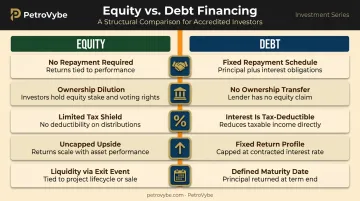
The table below compares equity and debt across five dimensions that matter most to accredited investors:
| Dimension | Equity | Debt |
|---|---|---|
| Repayment Obligation | None — investors earn through profit sharing and asset appreciation | Fixed repayment schedule with interest, regardless of performance |
| Ownership & Control | Ownership stake; profit entitlement and potential voting rights | No ownership; relationship ends when loan is repaid |
| Tax Advantages | Varies by structure; O&G equity investors may qualify for IDC deductions against active income | As the lender, the investor receives no tax deduction — interest income earned is typically taxable at ordinary rates |
| Return Profile | Uncapped upside tied to asset performance; higher risk, higher potential reward | Fixed, predictable returns; limited upside beyond the interest rate |
| Liquidity & Exit | Often illiquid, especially in private placements; exit through sale or buyout | More structured exit via amortization schedule or maturity date |
What Is Equity Financing?
Equity financing means raising capital by selling an ownership stake in an asset, business, or project. Investors receive a proportional share of profits, losses, and value appreciation — with no repayment obligation from the company or operator.
Core Forms of Equity
Investors encounter equity across several structures:
- Public common stock — shares of publicly traded companies
- Private equity — pooled capital deployed into private companies, typically with 10-year or longer fund horizons per SEC guidance
- Venture capital — equity in early-stage businesses with high growth potential
- Direct project investment — working interests in private projects such as oil and gas development, where investors participate at the point where value is created
Direct project investments often offer structures unavailable in public markets — including the tax treatment that makes O&G equity compelling for high-income investors.
The IDC Tax Advantage
Oil and gas equity offers a tax treatment unavailable in nearly every other investment category.
Under IRC Section 263(c) as described in IRS Publication 535, eligible working interest holders may elect to deduct qualifying Intangible Drilling Costs (IDCs) as a current business expense rather than capitalizing them. IDCs typically cover:
- Wages and drilling services
- Fuel, supplies, and survey work
- Other costs incidental to preparing a well for production
As documented in IRS Publication 925, a working interest held directly or through an entity that does not limit the taxpayer's liability is not treated as a passive activity, regardless of material participation. Qualifying IDC losses are nonpassive and not confined to passive income under IRC Section 469.
The deduction can offset W2 wages and capital gains — not just passive investment income.
PetroVybe's direct equity participation model in South Texas natural gas development illustrates this in practice. Partners in the PetroVybe ONE project achieved a 91% tax deduction against active income in 2024 and 94% in 2025. The first-year deduction — driven primarily by IDCs, which typically represent 60–80% of invested capital in development projects — runs approximately 70% of committed capital. Depletion allowances, depreciation, and ordinary business loss deductions account for the remainder.

Risks to Understand
Equity is subordinate to debt in the capital stack — meaning equity holders are last in line during liquidation. Private equity investments also carry illiquidity risk; the SEC notes that PE funds commonly have 10-year or longer horizons, and restricted securities may face Rule 144 holding period requirements before they can be transferred.
Use Cases for Equity Financing
Equity works best for:
- Investors seeking long-term wealth accumulation rather than near-term income
- High-income W2 earners or those with capital gains looking for meaningful tax offsets
- Those willing to accept a multi-year lock-up in exchange for higher return potential and asset ownership
What Is Debt Financing?
Debt financing means borrowing capital that must be repaid over time, plus interest — through instruments such as corporate bonds, government bonds, private credit notes, or peer-to-peer lending. The lender earns a fixed return; the borrower retains ownership but takes on a repayment obligation.
Core Forms of Debt Investors Use
- Corporate bonds — as of July 14, 2026, the ICE BofA US Corporate Index effective yield stood at 5.32%
- US Treasuries — the 10-year Treasury yield was 4.58% on the same date
- Money market instruments — 3-month T-bills yielding 3.71%
- Private credit — privately negotiated loans, less transparent and less standardized
- Secured vs. unsecured debt — secured debt is backed by collateral; unsecured relies on issuer creditworthiness alone
Benefits and Drawbacks
Benefits:
- Predictable, contractually obligated returns
- Priority claim over equity holders in bankruptcy
- Lower volatility than equity
- Defined exit via maturity date or amortization schedule
Drawbacks:
- Returns are capped at the interest rate — no participation in asset upside
- Fixed interest erodes real purchasing power during inflationary periods
- Default risk can cause total loss even in "lower risk" instruments — Moody's reported a 4.3% trailing 12-month global speculative-grade default rate as of May 2026
- Interest income is taxed as ordinary income at rates up to 37% for top earners in 2025, per IRS rate tables
The Tax Problem with Debt for High Earners
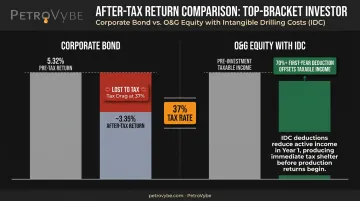
That 37% tax treatment has real consequences. A pre-tax yield of 5.32% on an investment-grade corporate bond becomes roughly 3.35% after federal tax at the top marginal rate — before state taxes, which range from 2.5% in Arizona to 13.3% in California per Tax Foundation data.
There are no deduction benefits flowing to the investor, no asset appreciation, and no ownership stake. The yield is the entire return — and the IRS takes a third of it.
Use Cases for Debt Financing
Debt works best for:
- Investors prioritizing capital preservation over growth
- Those in lower tax brackets where ordinary income taxation is less burdensome
- Short investment horizons requiring liquidity within 1–3 years
Equity vs. Debt: Which Works Better for Accredited Investors?
For most investors, debt and equity serve distinct portfolio roles. For high-income accredited investors with significant tax burdens, the math often shifts decisively in favor of equity — particularly in tax-advantaged structures like direct O&G development partnerships.
The Three-Factor Decision Framework
1. Tax Profile
Investors in the 37% federal bracket lose more than a third of every dollar of fixed interest income to taxes before reinvesting. An equity structure with substantial IDC deductions can instead reduce that year's taxable income — including W2 wages — by 70% or more in year one. That first-year deduction alone can deliver substantial cash-equivalent ROI before production income starts.
2. Return Expectations
Debt caps your return at the coupon rate. Cambridge Associates reports a 15.05% 10-year annualized pooled horizon IRR for US private equity through June 30, 2024. Direct equity in an operator-led hard asset can offer a projected MOIC of 2x–5x or more over a 10-year window, a ceiling debt instruments cannot approach.
3. Risk Tolerance and Liquidity Needs
Debt is lower risk and more liquid; equity carries higher risk and longer lock-up periods. Private placements are illiquid by design.
Situational Guidance
| Your Situation | Better Fit |
|---|---|
| Need liquidity in 1–3 years | Debt instruments |
| Lower income bracket, minimal tax burden | Debt instruments |
| $100k+ to deploy, multi-year horizon | Equity in hard assets |
| High W2 or capital gains tax burden | Equity with IDC deduction structures |
| Want inflation-resistant passive income | Equity in producing assets |
Addressing the "Equity Is Riskier" Assumption
This framing applies to businesses raising capital, not to investors deploying it. For an accredited investor, equity in a strong operator-led project with IDC deductions can yield superior risk-adjusted after-tax returns compared to fully-taxable bond income. The 91–94% first-year deduction achieved by PetroVybe partners effectively reduces net capital at risk before production income begins, which shifts the risk calculus in ways a bond coupon cannot.
Sophisticated investors often hold both: debt for stability and predictable cash flow, equity for growth and tax efficiency. The allocation depends on income, timeline, and goals.
For investors whose profile fits the equity column above, PetroVybe's direct equity participation model targets exactly that combination: immediate tax relief through IDC deductions and long-term wealth compounding through natural gas development in South Texas. The projected 10-year IRR is approximately 26%, with a MOIC window of roughly 2.2x–5.8x and monthly passive distributions projected to peak above $10,000 per unit during peak production.
Conclusion
Equity and debt are not universally better or worse: they serve different investor profiles. Debt offers predictability, priority claim in bankruptcy, and defined exit timelines. Equity offers ownership, uncapped upside, and — in the right structures — tax advantages that materially shift the after-tax return picture.
For high-income earners looking to reduce their tax burden, build tangible long-term assets, and generate inflation-resistant passive income, equity-based investments in real assets like natural gas development deserve serious consideration.
PetroVybe's investment model combines direct working interest positions, IDC deductions against active income, and a producing asset in Lavaca County, Texas. It's a concrete illustration of how equity financing can simultaneously cut your tax bill, generate monthly distributions, and build an ownership stake in a hard asset over a 10-year horizon.
Frequently Asked Questions
What is the main difference between debt capital and equity capital?
Debt capital is borrowed money that must be repaid with interest on a fixed schedule, regardless of business performance. Equity capital represents an ownership stake with no repayment obligation — investors earn through profits, asset appreciation, and in some structures like oil and gas, significant tax deductions against active income.
Is debt to equity the same as debt to capital?
They measure financial leverage but use different denominators. Debt-to-equity compares total liabilities to shareholders' equity, while debt-to-capital compares total debt to total capital (debt plus equity). Both signal financial risk — debt-to-capital simply includes equity in the denominator.
What are the 4 types of capital?
The four main types are: debt capital (borrowed funds with repayment obligations), equity capital (ownership investment), working capital (current assets minus current liabilities for near-term operations), and trading capital (funds allocated to buying and selling securities). Debt and equity are the primary long-term financing categories.
Which is better for accredited investors: equity or debt financing?
For high-income investors with significant W2 or capital gains tax burdens, equity in tax-advantaged structures typically wins — delivering deductions against active income, passive cash flow, and long-term asset appreciation that debt instruments simply can't match. The right answer shifts based on your time horizon and return goals.
What are the tax advantages of equity financing in oil and gas?
Oil and gas equity investors can deduct Intangible Drilling Costs (IDCs) against active income — including W2 earnings and capital gains — often resulting in a first-year deduction of approximately 70% of invested capital. Unlike real estate deductions, this benefit applies to active income and is unavailable through debt instruments.
Can equity financing provide passive income?
Yes. Equity investments in producing assets — such as oil and gas working interests — generate ongoing passive income through production revenues while also offering long-term asset appreciation and a potential capital exit. Debt instruments, by contrast, are limited to interest payments with no upside participation.