

Introduction
Picture this: you sell a rental property you've held for a decade, expecting a clean payday. Then your tax bill arrives — and it's far larger than anticipated. What happened? Depreciation recapture.
Every year you claimed depreciation deductions, you reduced your taxable income. The IRS remembers that. When you sell a depreciated asset at a gain, it taxes a portion of that gain as ordinary income — effectively clawing back the prior tax benefit. That recaptured amount is taxed at rates up to 25% for real property — on top of any capital gains tax you may owe.
This article covers everything you need to know: what depreciation recapture is, which assets trigger it, how to calculate it step by step, real numerical examples, how to report it correctly, and legal strategies to reduce or eliminate your exposure. Knowing the rules before you sell — not after — is where the real tax savings happen.
Key Takeaways
- Depreciation recapture is triggered when you sell a depreciated asset at a gain — losses do not trigger recapture
- Section 1245 (personal property) recaptures all accumulated depreciation as ordinary income, up to the amount of gain
- Section 1250 (real property) typically taxes depreciation at a maximum 25% rate as "unrecaptured gain"
- Calculate recapture using three inputs: original cost basis, accumulated depreciation, and sale price
- 1031 exchanges, stepped-up basis at death, and energy investment structures can defer or reduce exposure
What Is Depreciation Recapture?
Depreciation recapture is the IRS mechanism for taxing gains that are attributable to depreciation deductions previously claimed on a business or investment asset.
When you depreciate an asset, the IRS lets you deduct a portion of its cost each year, reducing your taxable income. That's the benefit. But when you sell the asset for more than its adjusted (depreciated) basis, the IRS treats some or all of that gain as ordinary income — reversing the tax benefit you received.
When Does It Apply?
Three conditions must be met:
- The asset was held for more than one year
- It was used in a trade or business or held for investment
- You sold it at a gain
If the asset sells at a loss, there is no depreciation recapture — no gain means no income to recapture.
Recapture vs. Capital Gains Tax
These are separate calculations on the same transaction — and understanding the split matters when estimating your actual tax bill:
- Depreciation recapture: The portion of gain tied to prior depreciation is taxed at ordinary income rates (or up to 25% for certain real property under Section 1250)
- Capital gains: Any gain above total depreciation taken may qualify for lower long-term capital gains rates
- Both can apply: On a single sale, you can owe recapture tax and capital gains tax simultaneously
Knowing which portion of your gain falls into each bucket is the starting point for any accurate tax estimate.
Which Assets Trigger Depreciation Recapture: Section 1245 vs. Section 1250
The IRS divides depreciable assets into two categories, each with different recapture treatment.
Section 1245 Property
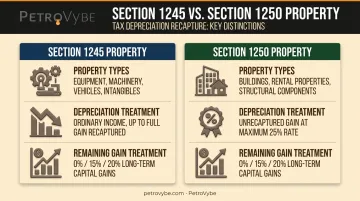
Section 1245 covers depreciable personal property used in a business: equipment, machinery, vehicles, computers, furniture, and certain intangible property like patents and copyrights.
When Section 1245 property is sold at a gain, accumulated depreciation is recaptured as ordinary income — up to the lesser of total accumulated depreciation or the total gain. Any gain exceeding accumulated depreciation is treated as long-term capital gain.
Section 1250 Property
Section 1250 covers depreciable real property: rental properties, commercial buildings, warehouses, and structural components.
For property placed in service after 1986 and depreciated using the straight-line method (standard under MACRS), there is generally no ordinary income recapture. However, the total straight-line depreciation claimed creates what's called "unrecaptured Section 1250 gain" — taxed at a maximum rate of 25%, per IRS Topic No. 409. This is still higher than the standard long-term capital gains rate of 0–20%.
Note: Ordinary Section 1250 recapture (at full income rates) applies only when accelerated depreciation was used — a rare scenario for post-1986 properties, which are almost always straight-line under MACRS.
Side-by-Side Comparison
Here's how the two categories compare at a glance:
| Category | Property Type | Depreciation Tax Treatment | Gain Above Depreciation |
|---|---|---|---|
| Section 1245 | Equipment, machinery, vehicles, intangibles | Recaptured as ordinary income (up to full gain amount) | Long-term capital gains: 0%, 15%, or 20% |
| Section 1250 | Buildings, rental properties, structural components | Taxed as unrecaptured gain at max 25% | Long-term capital gains: 0%, 15%, or 20% |
How to Calculate Depreciation Recapture Step by Step
These five steps apply whether you're selling investment real estate, equipment, or other depreciable assets. Work through each in sequence before estimating your tax liability.
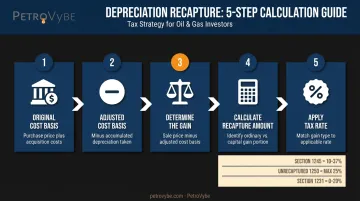
Step 1: Determine Original Cost Basis
Start with the purchase price plus acquisition costs — closing costs, fees, and commissions. This is your baseline before adjustments.
Step 2: Calculate Adjusted Cost Basis
Subtract all accumulated depreciation from the original cost basis.
Example: Original cost $100,000 – accumulated depreciation $20,000 = adjusted basis $80,000
⚠️ Critical rule: The IRS applies the "allowed or allowable" standard under IRC 1016(a)(2). Even if you didn't claim depreciation in prior years, the IRS still reduces your basis by the amount you were allowed to deduct. Skipping depreciation deductions doesn't prevent recapture — it just increases your taxable gain without any of the prior-year deduction benefit. Missing this rule has cost investors thousands at sale time.
Step 3: Determine the Gain
Subtract the adjusted cost basis from the sale price.
- Positive result → gain exists, recapture may apply
- Negative result → loss, no recapture
Step 4: Calculate the Recapture Amount
- Section 1245: Recaptured amount = the lesser of (a) total accumulated depreciation or (b) total gain. This portion is taxed as ordinary income.
- Section 1250 (straight-line): Unrecaptured Section 1250 gain = total depreciation taken, up to the total gain amount. Taxed at a maximum 25% rate.
- Any remaining gain above the depreciation amount is taxed at long-term capital gains rates.
Step 5: Apply the Appropriate Tax Rate
Once you've identified which gain type applies, match it to the corresponding rate below:
| Gain Type | Tax Rate |
|---|---|
| Section 1245 recapture | Ordinary income rate (10%–37% for tax year 2026) |
| Unrecaptured Section 1250 gain | Maximum 25% |
| Remaining Section 1231 gain | 0%, 15%, or 20% (long-term capital gains) |
Recapture calculations get complicated fast — especially when depreciation spans multiple years, methods, or asset classes. A CPA familiar with Section 1231 transactions can catch errors that change your outcome materially.
Depreciation Recapture Examples
Section 1245 Example: Equipment Sale
A business purchases a company truck for $20,000 and claims $8,000 in total depreciation over four years.
- Adjusted basis: $20,000 – $8,000 = $12,000
- Sale price: $14,000
- Total gain: $14,000 – $12,000 = $2,000
Since the gain ($2,000) is less than accumulated depreciation ($8,000), the entire $2,000 gain is recaptured as ordinary income and taxed at the seller's marginal rate. Nothing remains for capital gains treatment.
Real property under Section 1250 follows a different set of rules — and the tax treatment of any gain at sale shifts accordingly.
Section 1250 Example: Rental Property Sale
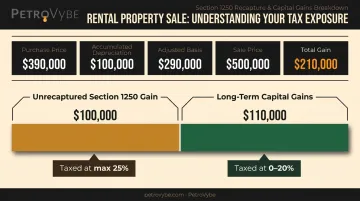
A rental property is purchased for $390,000. Over ten years, $100,000 in straight-line depreciation is claimed.
- Adjusted basis: $390,000 – $100,000 = $290,000
- Sale price: $500,000
- Total gain: $500,000 – $290,000 = $210,000
How that $210,000 is taxed:
- $100,000 (equal to total depreciation) → Unrecaptured Section 1250 gain, taxed at maximum 25%
- $110,000 (gain above depreciation) → Taxed at long-term capital gains rates (0%–20%)
No ordinary income recapture applies here. Straight-line depreciation was used throughout, so the recaptured amount faces a capped 25% rate rather than the seller's full marginal rate — a meaningful distinction for high-income investors.
How to Report Depreciation Recapture on Your Tax Return
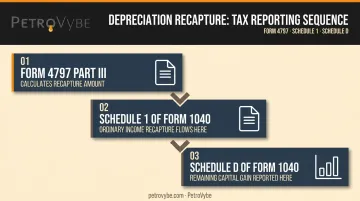
Depreciation recapture is reported using IRS Form 4797 (Sales of Business Property). Section 1245 and Section 1250 recapture are calculated in Part III of that form.
Reporting follows this sequence:
- Part III of Form 4797 — calculates the recapture amount
- Schedule 1 of Form 1040 — ordinary income recapture from Form 4797 flows here, added to other income
- Schedule D of Form 1040 — any remaining capital gain (the non-recaptured portion) is reported here
Both Form 4797 and Schedule D must be attached when applicable, per the 2025 Form 4797 Instructions.
The "Allowed or Allowable" Reporting Trap
When completing Form 4797, you must report the full amount of depreciation you were allowed to take — even if you didn't actually claim it in prior years. Investors who skipped depreciation deductions to simplify their filing are often surprised to find they still owe recapture tax — without ever having taken the deduction benefit. It's an expensive mistake with no upside.
How to Minimize or Avoid Depreciation Recapture
Several legal strategies can defer or reduce depreciation recapture exposure.
1031 Like-Kind Exchange
The most widely used deferral strategy. By reinvesting sale proceeds into a replacement property of like-kind, both capital gains tax and depreciation recapture tax are deferred. Since the Tax Cuts and Jobs Act, only real property qualifies — personal property exchanges no longer apply.
Important qualifier: a 1031 exchange defers gain by preserving carryover basis. Boot received or replacement property of a different character can still trigger partial recapture. This is deferral, not permanent elimination.
Step-Up in Basis at Death
Under IRC 1014, heirs generally receive inherited property at its fair market value on the date of the owner's death. This resets the basis, removing prior accumulated depreciation from the heir's gain calculation. Pre-death recapture liability effectively disappears. This is a long-term estate planning strategy — not useful for near-term sales.
Two Additional Approaches
- Timing the sale in a low-income year can reduce the ordinary income tax rate applied to recaptured depreciation
- Qualified Opportunity Funds (QOFs) allow deferral of eligible gains by investing proceeds into designated census tracts. Under current law, deferral on the original gain ends no later than December 31, 2026 — so timing matters considerably for new investments
A Structurally Different Approach: Oil and Gas IDC Deductions
Beyond deferral strategies, some investors turn to asset structures that generate significant upfront deductions without creating the same depreciation recapture exposure in the first place.
Oil and gas direct participation programs use Intangible Drilling Cost (IDC) deductions under IRC 263(c). IDCs are expensed in the year they are incurred, not depreciated over time.
Because they are expense deductions rather than depreciation, IDCs operate outside the standard Section 1245 and Section 1250 recapture framework — a meaningful structural difference for tax-sensitive investors.
Investors should note, however, that IRC Section 1254 can recapture prior IDC deductions as ordinary income upon disposition of an oil, gas, or mineral property interest. This is a distinct recapture category from Sections 1245 and 1250, and the treatment varies based on how the investment is structured.
PetroVybe, a Texas-based natural gas development company, structures investments as limited partnership units (PetroVybe ONE) in Lavaca County, Texas. Partners received a 91% IDC deduction against active income in 2024 and 94% in 2025 — applicable to W-2 earnings and capital gains, not just passive income.
The minimum investment is $100,000, and participation is limited to accredited investors. As with any investment, consult a qualified tax professional to evaluate how the tax treatment applies to your specific situation.
Frequently Asked Questions
Can I offset capital gains with depreciation?
Depreciation deductions reduce ordinary taxable income during the ownership period — not capital gains directly. However, depreciation lowers your adjusted basis, which increases the gain when you sell. Claiming depreciation each year still typically delivers greater net tax benefit than skipping it, even accounting for recapture.
Do you pay both capital gains and depreciation recapture?
Yes — on the same sale. The portion of gain tied to prior depreciation is taxed as ordinary income (Section 1245) or at up to 25% (unrecaptured Section 1250 gain). Any remaining gain above total depreciation is taxed at long-term capital gains rates. These are separate calculations on different portions of the same transaction.
How do I avoid paying depreciation recapture?
Three primary strategies exist:
- 1031 like-kind exchange — defers recapture by rolling proceeds into replacement real property
- Holding until death — gives heirs a stepped-up basis, eliminating prior depreciation from their gain calculation
- Alternative investment structures — oil and gas programs using IDC expense deductions operate outside standard depreciation rules, though Section 1254 recapture may still apply on exit
What is the depreciation recapture tax rate?
For Section 1245 property, recaptured depreciation is taxed at the taxpayer's ordinary income marginal rate — ranging from 10% to 37% for tax year 2026, per IRS inflation adjustments. For Section 1250 real property using straight-line depreciation, unrecaptured gain is taxed at a maximum of 25%, regardless of the taxpayer's actual long-term capital gains rate.
What happens to depreciation recapture when you inherit property?
Heirs receive a stepped-up basis equal to the property's fair market value at the date of death under IRC 1014, which removes the decedent's accumulated depreciation from the gain calculation — so pre-death recapture liability does not transfer. If the heir continues depreciating the property and later sells, new recapture exposure arises from post-inheritance depreciation only.
Does depreciation recapture apply to oil and gas investments?
Oil and gas direct participation programs typically use IDC deductions, expensed in the year incurred rather than depreciated — so Section 1245 and 1250 recapture do not apply. However, Section 1254 creates a separate recapture rule: upon disposition, prior IDC deductions can be recaptured as ordinary income. A qualified tax professional should evaluate the specifics for any given investment structure.
This article is for informational purposes only and does not constitute tax or legal advice. Consult a qualified tax professional for guidance specific to your situation.