

For most people, that distinction lives in the footnotes. For high-income W2 earners, accredited investors, and business owners who want to use the tax code strategically, it's one of the most actionable concepts in personal finance. The gap between what a business reports and what it owes isn't fixed. It can be engineered — legally — through deliberate investment choices.
This article covers the core definitions, a side-by-side comparison, the critical difference between temporary and permanent book-tax divergences, and how sophisticated investors put that gap to work.
Key Takeaways
- Book income follows GAAP and reports to shareholders — taxable income follows the IRC and determines what you actually owe the IRS.
- The gap between them arises from timing differences that eventually reverse, and permanent differences that never do.
- Depreciation is the most common driver — tax law often allows far faster deductions than GAAP permits.
- Certain investments, particularly oil and gas development, can create large, legally authorized divergence between book and taxable income.
- For accredited investors, this gap can be engineered to offset W2 income and capital gains — legally, and often substantially.
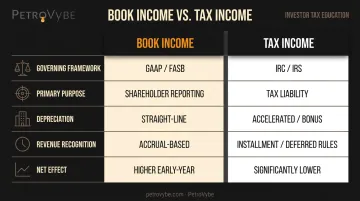
Book Income vs. Tax Income: Quick Comparison
The table below shows where book income and tax income diverge across the categories that matter most to investors and financial planners.
| Category | Book Income | Tax Income |
|---|---|---|
| Governing Framework | GAAP, set by FASB | Internal Revenue Code, set by Congress and administered by the IRS |
| Primary Purpose | Reflects economic performance for shareholders, lenders, and regulators | Determines actual federal tax liability |
| Depreciation Treatment | Straight-line, spread over the asset's useful life | Accelerated schedules, bonus depreciation, cost segregation — front-loaded |
| Revenue Recognition | Accrual-based — recognized when earned | Often differs; installment sales, deferred revenue, and prepaid items each follow separate tax rules |
| Net Effect | Higher in early years when tax deductions are front-loaded; shows profitability to outside parties | Can be significantly lower than book income, reducing or eliminating tax owed |
What Is Book Income?
Book income is the profit (or loss) a company reports on its income statement, prepared under Generally Accepted Accounting Principles (GAAP). Its purpose is straightforward: give investors, lenders, and regulators a consistent, comparable picture of a company's financial health over time.
How Accrual Accounting Shapes It
Book income uses accrual accounting. Revenue is recognized when it's earned, not when cash arrives. Expenses are matched to the period they relate to, even if payment happens later. A business that invoices a client in December but collects in January records that revenue in December.
This means book income includes non-cash items:
- Depreciation and amortization of long-term assets
- Unrealized gains on investments
- Warranty accruals and estimated bad debt expense
Because book income captures economic activity rather than cash movement, it can diverge significantly from what a business actually collected or paid. That gap is why analysts use the cash flow statement alongside the income statement — to separate accounting recognition from real dollars in and out.
Book income is not a measure of tax liability. A company can report strong book profits and owe very little in federal taxes. Tax rules are written by Congress with specific policy goals — accelerating deductions, incentivizing investment — that deliberately diverge from GAAP's focus on accurate period reporting.
Where Book Income Gets Used
- Shareholders use it to evaluate performance and management effectiveness
- Lenders use it to assess creditworthiness and loan covenants
- Analysts use it to calculate EPS, return on equity, and EBITDA — the ratios that drive investment comparisons across industries
- Regulators may require it for compliance disclosures
What Is Tax Income?
Taxable income is the portion of income subject to federal taxation, calculated under the Internal Revenue Code.
Unlike book income — which aims to reflect economic reality — tax income is shaped by policy decisions: which industries Congress wants to incentivize, what qualifies as a deductible expense, and how income timing should be treated for government revenue purposes.
How It Gets Calculated
Taxable income starts with gross income and applies specific deductions, credits, and adjustments authorized by the IRS. The result often looks very different from book income — sometimes dramatically so.
The IRS requires larger corporations (those with $10 million or more in total assets) to formally reconcile book income and taxable income on Schedule M-1 or Schedule M-3. That reconciliation makes the gap between the two numbers explicit and auditable.
Net Operating Losses
That reconciliation gap also reveals something most people don't expect: taxable income can be negative even when book income is positive, producing a net operating loss (NOL). Under IRC §172, post-2017 NOLs carry forward indefinitely and can offset up to 80% of taxable income in future years. For high-income investors with uneven earnings — such as those with significant capital gains in one year — this carryforward creates real leverage across tax years.
Who Cares Most About Taxable Income
Taxable income is particularly important for pass-through entities — partnerships and LLCs — because income or loss flows directly to individual partners. Key mechanics to understand:
- K-1 reporting: Each partner receives a K-1 showing their share of the entity's taxable income or loss
- Personal liability: Partners owe tax on that allocated income on their personal returns
- Cash distribution disconnect: Tax liability applies regardless of whether a cash distribution was actually received
This matters most for limited partnership investors, where the taxable income allocated to a partner can differ significantly from the cash they see in their account.
Key Accounting Differences: Temporary vs. Permanent
The differences between book and tax income fall into two categories with very different implications. Getting this wrong leads to poor tax planning.
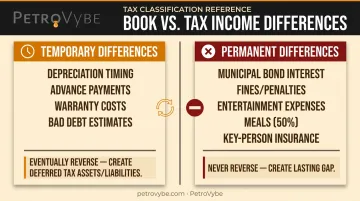
Temporary Differences
Temporary differences arise when an item of income or expense is recognized in different periods for book and tax purposes — but eventually nets to zero over time. They create deferred tax assets or liabilities on the balance sheet.
Depreciation is the most common case. A company buys equipment and depreciates it over 10 years on a straight-line basis for book purposes. For tax purposes, it uses accelerated depreciation or bonus depreciation — deducting a large portion in year one. In early years, taxable income is lower than book income. In later years, that reverses. The total deduction is identical; only the timing differs.
Other common temporary differences include:
- Advance payments recognized for book but deferred for tax until earned
- Warranty costs accrued for book but deductible for tax only when paid
- Bad debt expense estimated for book but deductible for tax only upon actual write-off
Permanent Differences
Permanent differences are items treated one way for book and another way for tax — and that treatment never reverses. They create lasting divergence between book income and taxable income and do not generate deferred tax assets or liabilities.
Common permanent differences:
| Item | Book Treatment | Tax Treatment |
|---|---|---|
| Municipal bond interest | Included in income | Excluded under IRC §103 |
| Government fines & penalties | Expensed | Generally nondeductible under IRC §162(f) |
| Entertainment expenses | Fully expensed | 0% deductible post-TCJA |
| Meals | Fully expensed | 50% deductible |
| Key-person life insurance premiums | Expensed | Generally nondeductible when employer is beneficiary |
One category on this list deserves a closer look — not because it fits neatly into the permanent difference framework, but because it behaves differently from everything else.
The Oil and Gas Exception: A Permanent-Style Deduction Worth Knowing
That exception is Intangible Drilling Costs (IDCs) in oil and gas development.
Under IRC §263(c) and Treasury Regulation 1.612-4, qualifying IDC expenditures — wages, fuel, repairs, hauling, supplies, and similar costs incident to drilling and well preparation — can be fully deducted in the year they are incurred.
This isn't a multi-year amortization. It's a current-year expense election, available to operators and working interest holders.
For accredited investors, three characteristics make IDCs stand apart:
- They generate a large first-year deduction relative to the amount invested
- Under IRC §469(c)(3), working interests in oil and gas are excluded from passive activity loss rules — meaning qualifying investors can apply IDC deductions against active income, including W2 wages and capital gains
- The deduction does not require material participation
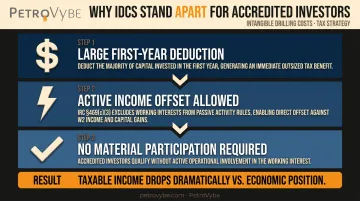
The result: an investor's taxable income in year one can drop dramatically relative to their actual economic position — a gap that no standard depreciation timing difference comes close to replicating.
Why This Gap Matters for High-Income Investors
For most people, book vs. tax income is an accounting technicality. For high-income W2 earners and accredited investors, it's one of the most actionable levers available for legal tax reduction.
The gap between what you earn and what's taxable isn't fixed — it responds directly to investment decisions made during the year.
How Oil and Gas Investments Widen the Gap
Certain investments are structured to generate large first-year tax deductions, creating significant divergence between an investor's economic position and their taxable income. Oil and gas development working interests are the clearest example.
An accredited investor who participates in a qualifying oil and gas working interest can apply IDC deductions against W2 income, capital gains, and other active income in the same tax year — not restricted to passive income offsets the way real estate typically is.
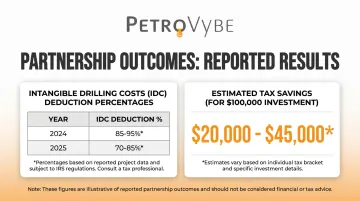
PetroVybe, a Texas-based private oil and gas development company, structures its investment partnerships precisely this way. Partners invest as limited partners in PetroVybe Partners LP and receive K-1s reporting IDC deductions applicable against active income. Reported outcomes — not projections — from recent partnership years include:
- 2024: Partners received a 94% tax deduction against active income as a percentage of invested capital
- 2025: That figure came in at 91%
- $100,000 investment: IDC deductions typically represent $60,000–$80,000 in first-year deductible costs
- At a 37% effective rate: That translates to $22,000–$30,000 in immediate tax savings — before any production distributions begin
This is not tax evasion. Congress wrote these incentives into the tax code deliberately to encourage domestic energy development, and they have existed in substantially similar form since 1913.
Understanding the Gap Before Your Accountant Files
Most investors discover these opportunities after the tax year closes — when it's too late to act. The investors who benefit most are the ones who understand the book-tax gap well enough to make deliberate choices during the year, not just document them at year-end.
If you're carrying a significant tax burden and want to understand how oil and gas participation could offset your W2 or capital gains income, schedule a 30-minute consultation with PetroVybe CEO Peter Snell. Participation requires verified accredited investor status and a minimum of $100,000 in liquid capital. Results are forecast-dependent and subject to applicable limits including at-risk rules and basis limitations.
Conclusion
Book income and taxable income serve entirely different purposes. Book income tells a story of financial performance for stakeholders; taxable income determines what is actually owed to the government. Neither is wrong, and understanding the distinction is foundational to making informed financial decisions.
For high-income professionals and accredited investors, the gap between those two numbers is not just an accounting concept — it represents real dollars. Industries like oil and gas development carry congressionally authorized deductions that can legally compress taxable income well below economic earnings, allowing investors to keep more of what they generate and deploy that capital further.
For those carrying a significant W2 or capital gains tax burden, knowing where that gap exists — and how to position within it — is where strategy begins.
This article is for educational purposes only. PetroVybe and its officers are not financial advisors. Investments in oil and gas development involve material risks and are available exclusively to verified accredited investors under SEC Regulation D 506(c). Past performance, including the 91% and 94% tax deductions referenced above, is not a guarantee of future results. Prospective investors should review the Confidential Private Placement Memorandum and consult with qualified legal and tax counsel before making any investment decision.
Frequently Asked Questions
What is the difference between book profit and taxable income?
Book profit is calculated under GAAP for financial reporting purposes, while taxable income is calculated under the Internal Revenue Code to determine tax liability. These figures frequently diverge due to different rules for timing, depreciation, and what qualifies as deductible.
What is book income?
Book income is the profit a company reports on its financial statements under GAAP, designed to give shareholders and lenders a consistent picture of financial performance. It follows different rules than tax law and is never used to calculate taxes owed.
How do you calculate book income?
Book income uses accrual-based accounting: start with total revenues, subtract operating expenses (including straight-line depreciation spread over the asset's useful life), and account for non-cash items. The result is net income as shown on the income statement.
What are temporary vs. permanent differences between book and tax income?
Temporary differences (such as depreciation timing) reverse over time and create deferred tax assets or liabilities on the balance sheet. Permanent differences — like tax-exempt municipal bond interest or non-deductible fines — never reverse, creating a lasting gap between book and taxable income.
How does depreciation affect book income vs. taxable income?
Book accounting uses straight-line depreciation spread over an asset's useful life. Tax law allows accelerated depreciation schedules and bonus depreciation that front-load deductions, making taxable income lower than book income in early years.
Can investing in oil and gas reduce my taxable income below my book income?
Yes. Oil and gas working interest investments allow qualifying investors to deduct Intangible Drilling Costs in the year incurred — directly against active income including W2 wages and capital gains. Subject to basis, at-risk limits, and other restrictions, this creates a significant, legal gap between economic earnings and taxable income.