

Introduction
When a business buys a $200,000 piece of equipment, the IRS doesn't let them write off the full cost that year. Instead, they recover it gradually — a few thousand dollars at a time — through annual depreciation deductions. That's the rule.
Depreciation is also a tax strategy tool. Sophisticated investors actively structure their asset purchases around depreciation schedules to reduce their taxable income year after year — in some cases, offsetting six figures of active income in a single filing year.
This guide covers everything you need to know: what qualifies as a depreciable asset, how the IRS calculates deductions, which methods accelerate your deductions fastest, and how high-income investors use depreciation-related provisions to build tax-efficient wealth. For certain asset classes — oil and gas in particular — the first-year deduction potential runs far ahead of what standard depreciation schedules allow.
Key Takeaways
- Long-term tangible business assets are recovered through annual depreciation deductions, not a single upfront expense
- The IRS assigns recovery periods from 3 to 39 years depending on asset class
- MACRS accelerates deductions in early years; straight-line spreads them evenly
- Section 179 (up to $2.5M for TY2025) and 100% bonus depreciation allow large first-year write-offs on qualifying property
- Oil and gas IDC deductions can deliver ~70% first-year write-offs against active income, including W2 wages and capital gains
What Qualifies as a Capital Asset for Depreciation Purposes?
The Five IRS Requirements
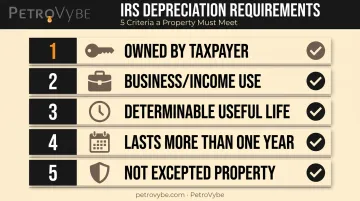
Not every business purchase qualifies for depreciation. IRS Publication 946 establishes five cumulative tests that property must meet:
- Owned by the taxpayer — leased property generally doesn't qualify
- Used in business or an income-producing activity — personal-use property is excluded
- Has a determinable useful life — the asset must wear out, decay, or become obsolete
- Expected to last more than one year — consumables don't count
- Not excepted property — land, certain intangibles, and property disposed of in the same year it's placed in service are excluded
Common Qualifying Assets
| Asset Type | Examples |
|---|---|
| Machinery & Equipment | Manufacturing equipment, heavy tools |
| Vehicles | Cars, trucks, vans used for business |
| Technology | Computers, servers, peripherals |
| Office Assets | Furniture, fixtures |
| Real Property | Buildings, warehouses, rental properties |
| Land Improvements | Fences, sidewalks, parking lots |
Land itself is never depreciable — it doesn't wear out or become obsolete. Buildings and qualifying improvements on that land can be depreciated, so when you purchase real property, you must allocate the total cost between the non-depreciable land portion and the depreciable structures or improvements.
Capital Expenses vs. Operating Expenses
How you classify an expense determines when you get the tax benefit:
- Operating expenses such as rent, utilities, and payroll are deducted fully in the year incurred
- Capital expenses for equipment, buildings, and vehicles are recovered gradually through depreciation
Under IRC Section 263(a), amounts paid to acquire or improve property must be capitalized, not expensed immediately. One exception: the IRS de minimis safe harbor allows businesses with an applicable financial statement to expense items costing $5,000 or less per unit without capitalizing them.
How Capital Asset Depreciation Works
The Core Concept
Depreciation allocates an asset's cost over its useful life as an annual tax deduction. Each year, you deduct a portion of the asset's cost — reducing taxable income without requiring a new cash outflow that year. The cash was spent when you bought the asset; depreciation simply determines when you get the tax benefit.
Three Inputs Drive Every Calculation
1. Cost Basis — The purchase price plus acquisition costs (installation, freight, sales tax). This becomes your starting depreciable amount.
2. Salvage Value — The estimated remaining value at end of useful life. Under MACRS (the standard IRS method), salvage value is not factored in — the full basis is recovered.
3. Recovery Period — The IRS-assigned useful life for your asset class, ranging from 3 to 39 years.
A Simple Example
A business purchases equipment for $50,000 with a 5-year IRS recovery period:
- Straight-line depreciation: $50,000 ÷ 5 = $10,000/year
- Each year, taxable income drops by $10,000
- Over 5 years, the full $50,000 cost is recovered
Accumulated Depreciation and Book Value
Each year's deduction adds to accumulated depreciation on the balance sheet, reducing the asset's book value (carrying value). After year 3 in the example above, the asset's book value would be $20,000 — not what it could sell for, but what remains to be deducted.
When a fully depreciated asset is sold, gain or loss equals the sale price minus the adjusted basis. Because depreciation reduces adjusted basis, selling a fully depreciated asset for anything above zero creates taxable gain.
For Section 1245 property, that gain is generally taxed as ordinary income — not capital gains — to the extent of depreciation previously taken. This is called depreciation recapture. It means the IRS effectively claws back the tax savings from prior deductions at your ordinary income rate, not the lower capital gains rate — a meaningful difference for high-income sellers.
Depreciation Methods and IRS Schedules
Straight-Line vs. MACRS
Straight-line depreciation divides cost evenly across the recovery period. It's simple and predictable, but it front-loads nothing: you get the same deduction every year, with no cash flow advantage in early years.
MACRS (Modified Accelerated Cost Recovery System) is the IRS-mandated method for most property placed in service after 1986. It front-loads larger deductions in early years, tapering off over time. This matters for cash flow: earlier deductions have higher present value.
Common MACRS Recovery Periods
| GDS Recovery Period | Asset Examples |
|---|---|
| 3 years | Tractor units, certain short-lived property |
| 5 years | Automobiles, light trucks, computers |
| 7 years | Office furniture, fixtures, most machinery |
| 15 years | Land improvements (roads, fences, sidewalks) |
| 27.5 years | Residential rental real estate |
| 39 years | Nonresidential (commercial) real estate |
Source: IRS Publication 946
GDS (General Depreciation System) applies in most cases. ADS (Alternative Depreciation System) uses longer lives and is required in certain situations or may be elected.
Depreciation vs. Amortization vs. Depletion
All three recover costs over time — but they apply to different asset types:
- Depreciation — tangible physical assets (equipment, buildings, vehicles)
- Amortization — intangible assets (patents, trademarks, goodwill)
- Depletion — natural resources (oil, gas, minerals) as they're extracted
For oil and gas investors, depletion is particularly relevant: unlike standard MACRS depreciation, depletion allowances apply to reserves as they're extracted, and intangible drilling costs (IDCs) carry their own deduction rules entirely separate from either category.
Section 179 and Bonus Depreciation: Accelerating Your Deductions
Rather than waiting years to recover an asset's cost, two IRS provisions let qualifying businesses deduct large portions immediately.
Section 179
Section 179 lets you elect to expense qualifying property in the year it's placed in service, up to an annual dollar limit.
TY2025 limits:
- Maximum deduction: $2,500,000
- Phaseout begins: when total qualifying property exceeds $4,000,000
- Key restriction: the deduction cannot exceed taxable income from active business operations — it cannot create a net operating loss. Disallowed amounts carry forward.
Section 179 works well for businesses with consistent active income who want to accelerate deductions on moderate capital purchases.
Bonus Depreciation
Bonus depreciation (the special depreciation allowance) is a separate first-year deduction with no dollar cap and no income limitation.
Per IRS Topic 704, for qualified property acquired and placed in service after January 19, 2025, the allowance is 100%. The rate had been stepping down under prior law — 80% in 2023, 60% in 2024 for property acquired before January 20, 2025 — making the 2025 restoration to full expensing a meaningful shift for capital-intensive investments.
The practical difference between the two:
| Feature | Section 179 | Bonus Depreciation |
|---|---|---|
| Dollar cap | $2.5M (TY2025) | None |
| Income limitation | Yes — active business income | No |
| Can create a loss | No | Yes |
| Application order | First | Second (on remaining basis) |
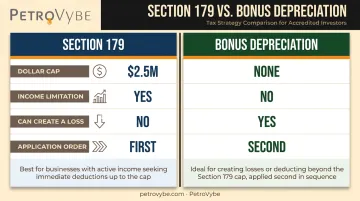
For large capital investments, bonus depreciation is more powerful when taxable income in the purchase year is limited or when the investor wants to generate a deductible loss.
Both provisions carry eligibility requirements and shift with tax legislation. Before structuring a major asset purchase around either, confirm the current rules with a qualified tax advisor — particularly if you're also evaluating energy investment deductions like IDCs, which operate under a separate set of rules.
How Depreciation Powers Tax Strategy for High-Income Investors
The Dollar-for-Dollar Advantage
Depreciation deductions reduce taxable income directly. For investors in the top federal bracket, the math is straightforward: a $100,000 depreciation deduction against income otherwise taxed at the 37% marginal rate produces roughly $37,000 in federal tax reduction. That's a simplified illustration (actual results depend on deduction eligibility, income limits, and loss limitation rules) but it captures why high-income investors treat depreciation as a genuine return driver, not just a bookkeeping entry.
The 37% rate applies in TY2025 to single filers above $626,350 and married filing jointly above $751,600.
Real Estate and Cost Segregation
Real estate investors work within 27.5-year (residential) or 39-year (commercial) schedules : long timelines that spread deductions thin. A cost segregation study accelerates this by reclassifying building components into shorter-life categories:
- Interior fixtures and finishes → 5 or 7-year property
- Land improvements (parking, landscaping, site utilities) → 15-year property
- The structural shell remains at 39 years
This doesn't create new deductions : it accelerates existing ones, pulling years of future deductions into the near term where they're worth more.
Oil and Gas: A Different Category Entirely
For investors evaluating asset classes on tax efficiency, oil and gas operates differently. Natural resource assets don't depreciate the way equipment does. Instead, two distinct mechanisms apply:
- Depletion : accounts for the gradual exhaustion of the resource itself, with percentage depletion available at 15% of gross income from qualifying production for independent producers
- IDC deductions (Intangible Drilling Costs) : expenses incurred in drilling that produce no salvageable asset (labor, fuel, site prep, cementing) are fully deductible in the year incurred under IRC Section 263(c)
The critical structural advantage: IDC deductions for qualifying oil and gas working interests are not restricted to passive income. Unlike real estate depreciation, which is generally limited to offsetting passive income, IDC deductions can offset W2 wages, capital gains, and other active income directly.
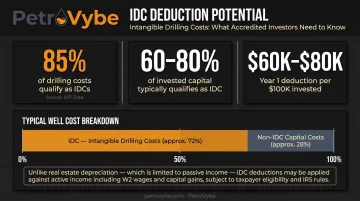
According to API data, IDCs represent up to 85% of the costs of drilling a well. In a development project focused on new drilling, 60–80% of invested capital typically qualifies as IDC PetroVybe, a Texas-based oil and gas development company focused on natural gas liquids production in South Texas, structures its limited partnerships to pass these deductions through to accredited investor partners via K-1 tax forms. Partners in 2024 achieved a 91% tax deduction against active income; partners in 2025 achieved 94%.
A redacted 2025 K-1 sample shows a partner with a $600,000 capital contribution receiving $401,772 in deductions — roughly 67% of invested capital in a single tax year.
For a $100,000 investment, the IDC deduction alone can generate $60,000–$80,000 in Year 1 deductions against active income — before any production distributions are received.
Important: IDC deductions require holding a working or operating interest through an entity that doesn't limit liability, per IRC Section 469(c)(3). Basis and at-risk limitations apply. These deductions are not automatic for every oil and gas investment structure. Independent tax counsel is essential before investing.
Frequently Asked Questions
Frequently Asked Questions
What is the depreciation of a capital asset?
Capital asset depreciation is the annual tax deduction that recovers a long-term tangible asset's cost over its useful life. Rather than deducting the full purchase price in one year, you deduct a portion each year, reducing taxable income incrementally over the IRS-assigned recovery period.
What is an example of capital depreciation?
A business purchases a $30,000 vehicle with a 5-year IRS recovery period. Under straight-line depreciation, the annual deduction is $6,000 per year for five years. Under MACRS, the deductions are front-loaded, with larger amounts in years one and two.
How many years can you depreciate an asset?
The IRS assigns recovery periods ranging from 3 years (certain short-lived property) to 39 years (commercial real estate). Common examples: 5 years for vehicles and computers, 7 years for office furniture, 27.5 years for residential rental property.
Is land a depreciable capital asset?
No. Land is never depreciable because it doesn't wear out, become obsolete, or have a determinable useful life. However, buildings and qualifying land improvements — such as fences, sidewalks, and parking areas — built on that land can be depreciated.
What is the difference between depreciation and depletion in oil and gas?
Depreciation applies to tangible physical equipment such as wellheads, pumps, and vehicles. Depletion applies to the natural resource being extracted, accounting for its gradual exhaustion. Oil and gas investments also offer IDC deductions on drilling costs, which are deductible against active income — including W2 earnings and capital gains — often generating far larger first-year tax advantages than equipment depreciation alone.