
This guide breaks down all three income types — linear, passive, and residual — and explains why understanding the difference between them is foundational to any serious wealth-building strategy. Whether you're a W2 professional, a high-income earner managing a growing tax burden, or an accredited investor evaluating new asset classes, knowing how income is categorized changes how you plan, invest, and protect what you've built.
Key Takeaways
- Linear income is time-for-money: when you stop working, the income stops
- Passive income is generated by assets or systems, not ongoing labor
- Residual income measures what's left after expenses, making it a cash flow metric rather than an income source in its own right
- High earners pay the steepest tax rates on linear income, which is why building alternative income streams matters
- Certain passive investments — including oil and gas development — offer deductions that can offset active W2 income directly
What Is Linear Income?
Linear income is the most straightforward income model: you work, you get paid. Stop working, and the income stops too.
The IRS defines earned income as taxable wages received from working for someone else, yourself, or a business you own — including W2 salaries, tips, and self-employment income. According to the Bureau of Labor Statistics, roughly 157 million Americans earn wages and salaries as their primary income source, making linear income the dominant financial reality for most working households.
The Ceiling Problem
The core limitation of linear income is structural, not a matter of pay rate. Your earnings are capped by two variables: hours available and personal capacity. A surgeon earning $500/hour still can't perform more than a finite number of procedures per week. A consultant billing $300/hour runs out of hours before they run out of ambition.
This ceiling has real consequences:
- No income during illness, disability, or forced career breaks
- Retirement requires either significant savings or a sharp drop in standard of living
- Scaling income means working more, not building more
Why High Earners Can't Afford to Stop Here
Linear income is how most wealth-building starts. It funds savings, investments, and life expenses. The issue arises when high earners never move beyond it — and that stagnation carries a compounding tax cost.
W2 wages are subject to federal income tax, state income tax, and FICA payroll taxes (6.2% Social Security plus 1.45% Medicare, with an additional 0.9% Medicare surcharge above $200,000 for single filers). High earners who rely exclusively on linear income face a tax ceiling and an income ceiling at the same time.

What Is Passive Income?
Passive income is earnings generated by assets or systems that don't require your continuous active involvement. The core distinction from linear income is simple: time and income are decoupled.
Once a passive income asset is established or an investment is made, income continues — whether you're working, traveling, or sleeping.
Common Categories of Passive Income
| Income Type | Example | Upfront Requirement |
|---|---|---|
| Rental real estate | Monthly rent from a property | Capital + management setup |
| Dividend stocks | Quarterly dividends from equities | Capital |
| Interest income | Yield from bonds or savings instruments | Capital |
| Royalties | Book, patent, or licensing revenue | Creative/IP work upfront |
| Investment partnerships | Oil and gas development, private equity | Capital + accreditation |
Each of these requires either upfront capital, upfront effort, or both. Passive income is not effortless — but the ongoing time commitment is far lower than with active income.
How the IRS Defines Passive Income
This is where most people get it wrong. The IRS Publication 925 defines passive activities as: (1) trades or businesses in which the taxpayer does not materially participate, and (2) rental activities, regardless of participation level (with specific exceptions).
Material participation requires involvement that is regular, continuous, and substantial. The IRS applies seven tests, including more than 500 hours of participation annually, to determine whether someone qualifies as an active participant in a given activity.
Critical rule: Passive losses generally cannot offset wages or other nonpassive income. They carry forward until offset by passive income or the investment is sold. For high earners managing W2 income or capital gains, the investment structure determines whether losses can provide any immediate tax relief at all.
How Passive Income Scales
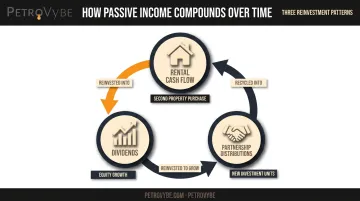
A well-structured passive asset grows without requiring more hours. The investor's time input stays roughly constant while the income base expands. Common compounding patterns include:
- Rental cash flow reinvested to acquire a second property
- Dividends automatically reinvested to grow equity positions
- Partnership distributions recycled into additional investment units
What Is Residual Income — and How Does It Differ from Passive?
Residual income is commonly confused with passive income, but they measure different things entirely.
Passive income describes how money is generated — through assets rather than active work.
Residual income describes what remains after financial obligations are paid — regardless of income source.
A Simple Illustration
If you earn $8,000/month from your W2 salary and carry $5,500 in monthly expenses (housing, debt, living costs), your residual income is $2,500. That $2,500 exists entirely within a linear income structure. Now add a passive income stream — say, $1,500/month from an investment distribution — and your residual income grows to $4,000.
Residual income is a cash flow metric. Passive income is an income type. The two work together: passive income is one of the most reliable ways to increase residual income over time.
That said, "residual income" carries a second meaning worth knowing.
The Secondary Use of "Residual Income"
In investment and MLM contexts, the term describes income that continues after an initial period of effort — book royalties, for example, or recurring commissions from a business network. These examples blur the line with passive income, since both require a period of upfront work before earnings become largely hands-off.
The clearest way to separate them:
- Residual (labor-based): the original input was time and effort — writing a book, building a sales network
- Passive (capital-based): the original input was money deployed into an asset — an investment, a property, a producing well
Knowing which category your income falls into matters for tax treatment, financial planning, and how you structure your portfolio over time.
Linear vs. Passive Income: Key Differences That Change Your Financial Future
Side-by-Side Comparison
| Dimension | Linear Income | Passive Income |
|---|---|---|
| Effort required | Active and continuous | Upfront setup; minimal ongoing |
| Scalability | Capped by personal hours | Can grow independently of time |
| Tax treatment | W2 wages: income tax + payroll taxes | Can qualify for preferential treatment or deductions |
| Income continuity | Stops when work stops | Continues when structured correctly |
The Tax Gap Between Income Types
W2 earners pay federal income tax, state income tax, and FICA payroll taxes. Tax Foundation data for 2023 shows the top 1% of earners — those with AGI of $675,602 or more — paid an average federal income tax rate of 26.3%. Add payroll taxes and state income taxes, and the effective total burden climbs considerably higher.
Passive investment income, by contrast, is generally exempt from FICA taxes. Certain investment vehicles also unlock deductions, depreciation, and other offsets unavailable to W2 earners.
The Fragility of Single-Source Income
High-net-worth individuals consistently maintain multiple income streams. While the "average millionaire has seven income streams" claim lacks a verified IRS or Federal Reserve source, the underlying principle is grounded in sound financial planning: a single income source creates fragility. Any one of these events can cut income to zero overnight:
- Sudden illness or disability
- Job loss or layoff
- Forced or early retirement
The Social Security Administration notes that Social Security retirement benefits replace only about 40% of pre-retirement income for an average earner — and a lower percentage for higher earners.
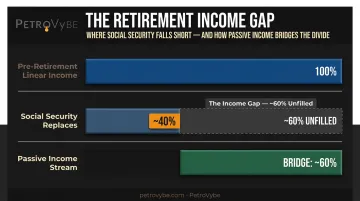
For high-income W2 earners, that gap is brutal. Without passive income established before stopping work, there's no bridge — just a cliff.
Why High-Income Earners Can't Afford to Stay Linear Forever
The High Earner Paradox
The more you earn through linear income, the more you pay in taxes — yet your earning ceiling remains fixed by your personal hours. There's no efficiency gain from working harder in a W2 structure. Gross income rises, the tax rate follows, and net wealth builds slowly relative to gross output.
Real wage growth offers little relief. BLS data shows real average hourly earnings for private nonfarm employees rose from approximately $10.67 in mid-2016 to $11.32 in mid-2026 (in constant 1982–84 dollars) — roughly 6% real growth over a decade. For high earners whose W2 income far outpaces inflation in nominal terms, the relevant problem isn't wage growth. It's the compounding tax burden eating into everything they earn.
The IDC Exception: Where Oil and Gas Changes the Math
Most passive investment deductions are constrained by the passive-loss rules — they offset passive income, not W2 wages. Oil and gas working interest investments structured as direct participation programs operate under a specific IRS exception.
Under IRS Publication 925, an oil or gas working interest held directly or through an entity that does not limit the taxpayer's liability is classified as nonpassive, regardless of material participation. This means Intangible Drilling Cost (IDC) deductions, authorized under IRC 263(c), can be applied against active income — W2 earnings and capital gains included, not just passive income.
That's the structural tax advantage that makes direct-access energy investments relevant for high-income linear earners. PetroVybe structures its partnerships around this framework — partners in PetroVybe ONE received a 91–94% tax deduction against active income across 2024 and 2025 combined.
Key rules that affect IDC deduction outcomes:
- Basis and at-risk limits cap the amount deductible to what you've actually invested and have at risk
- Excess business loss rules may defer deductions beyond annual thresholds for some filers
- AMT exposure can reduce the realized benefit for taxpayers subject to the alternative minimum tax
Always consult a qualified tax professional before making investment decisions.
The Retirement Income Cliff
The tax ceiling problem compounds into a retirement problem. High linear earners who never build passive infrastructure don't retire into financial freedom — they retire into a gap where income used to be.
The Federal Reserve's 2024 household survey found 67% of adults had assets designated for retirement. But designated savings and passive cash flow are fundamentally different things. Savings have a bottom. A well-structured passive income stream — built before retirement, not during it — keeps producing.
How to Start Building Passive Income Alongside Your W2
A Practical Framework
- Audit your current tax exposure — identify your effective tax rate, how much of your income is W2 versus other sources, and what deduction opportunities you're currently missing
- Assess your liquidity and risk tolerance — passive investments range from low-volatility dividend portfolios to direct-participation development projects with longer timelines and higher return potential
- Match the vehicle to your profile — the right passive income structure depends on your tax situation, investment timeline, and available capital

Matching Investment Type to Investor Profile
For accredited investors with $100,000+ in available liquidity and a high W2 income burden, direct-participation investments in oil and gas development can address two challenges simultaneously: immediate tax reduction and long-term passive income generation.
PetroVybe ONE is structured for this profile. Accredited investors take a direct equity position in natural gas development projects in Lavaca County, Texas, with no operational involvement required.
Key metrics for the structure include:
- Target IRR: ~26% over a 10-year hold (projections are forward-looking and subject to material risks)
- Target MOIC: 2.2–5.8x
- Projected distributions: Peak above $10,000/month per unit during production phase
- Hold period before first distributions: Approximately 2–3 years
- Proved reserves valuation: $48MM (PV-09, independently engineered)
That third-party engineering review matters beyond a single data point — it's also the kind of validation you should demand from any passive investment before committing capital.
Due Diligence Standards That Should Be Non-Negotiable
No passive income investment should be evaluated on projected returns alone. Before committing capital, verify:
- Management track record — what specific returns and operational results has this team delivered in prior projects?
- Independent engineering review — has a qualified third-party firm validated reserves, production projections, or asset valuations?
- Transparency of reporting — will you receive regular updates, K-1 tax documents, and access to underlying data?
- Regulatory compliance — is the offering properly structured under SEC Regulation D 506(c) with verified accredited investor requirements?
Frequently Asked Questions
What are the 4 types of income?
The four types commonly referenced are active/linear income, passive income, portfolio income (interest, dividends, capital gains), and residual income. Portfolio income frequently overlaps with passive strategies in practice, which is why most wealth-building frameworks consolidate around three: linear, passive, and residual.
What does linear income mean?
Linear income is earnings tied directly to hours worked — the income exists only when you're actively working. A salaried employee or hourly worker earning $75,000/year earns nothing from that employer the moment they stop working.
What is the most successful passive income?
Rental real estate, dividend portfolios, and direct-participation energy investments consistently rank among the highest-performing options. The most effective choice depends on your tax situation, available capital, and investment timeline — what produces strong cash flow for one investor may be the wrong fit for another.
What is the IRS rule for passive income?
The IRS defines passive income as earnings from activities in which the taxpayer does not materially participate. Passive losses generally can only offset passive income — with a notable exception for certain oil and gas working interests, where IDC deductions can be applied directly against active income.
Can passive income replace linear income entirely?
Yes, but it requires substantial upfront capital and years of consistent build time. Most high earners find passive income works best alongside linear income first — cutting the tax burden near-term while gradually reducing dependence on active work.