

Introduction: Why High Earners Are Leaving Tax Deductions on the Table
Most high-income W2 earners and investors take the same approach to taxes year after year — max out the 401(k), maybe fund an IRA, and call it done. That approach works fine for average incomes. For six-figure earners, it routinely costs tens of thousands in taxes that didn't need to be paid.
The problem isn't effort. It's awareness. Several deductions that once applied to financial planning costs were eliminated or permanently restricted by legislation, while other powerful options — particularly for accredited investors — remain widely underused.
This guide covers what changed under the Tax Cuts and Jobs Act (TCJA) and the One Big Beautiful Act (recently signed into law in 2025), which deductions still exist in 2025, and where high-income earners can find the most meaningful tax relief today. If you're carrying a heavy tax burden from W2 income or capital gains, the strategies in the later sections of this guide deserve close attention.
Key Takeaways:
- Financial advisor fees are no longer deductible for most individuals — permanently
- Above-the-line deductions (401k, IRA, HSA) remain available regardless of itemizing status
- Oil and gas IDC deductions can offset active W2 income directly, an advantage most tax strategies can't match
- Capital loss harvesting and asset location strategies cut your annual tax bill without requiring specialized investments
- Accredited investors have access to deductions unavailable to the general public
What the Tax Cuts and Jobs Act Changed for Financial Planning Deductions
Before 2018, investors could deduct financial advisor fees, IRA custodial fees, and similar investment-related expenses as miscellaneous itemized deductions — subject to a 2% AGI floor. If those costs exceeded 2% of your adjusted gross income, the excess was deductible.
That changed with the TCJA. IRC Section 67(g) suspended these miscellaneous itemized deductions for tax years beginning after December 31, 2017. Investment advisory fees, custodial fees, and related portfolio management expenses became nondeductible for individual taxpayers.
Initially, this suspension was set to expire at the start of 2026. Public Law 119-21 (the One Big Beautiful Act), signed July 4, 2025, removed that sunset provision from Section 67(g). The elimination of these deductions is now permanent for tax years beginning after December 31, 2025.
What Still Qualifies
Not every financial planning expense is blocked. Two exceptions remain:
- Tax preparation fees — still deductible for taxpayers who itemize
- Business-related advisory fees (Schedule C) — self-employed individuals can deduct financial planning fees that are ordinary, necessary, and directly tied to business operations, per IRS Publication 334
Personal investment advisory fees, however, don't get reclassified as business expenses simply because the advisor also discusses business topics. The fee must serve a clear business purpose to qualify on Schedule C.
Tax Deductions Still Available to Investors in 2025
The loss of miscellaneous itemized deductions doesn't mean high earners are out of options. Several above-the-line deductions reduce taxable income directly, regardless of whether you itemize.
Retirement Account Contributions
401(k) and workplace plans remain the most accessible deduction for W2 employees. The 2025 elective deferral limit is $23,500, with a catch-up contribution of $7,500 for those 50 or older. Employees who turn 60–63 in 2025 qualify for a higher catch-up of $11,250 under SECURE 2.0 provisions. These contributions reduce taxable income dollar-for-dollar before the IRS sees them.
Traditional IRA contributions may be deductible depending on income and workplace plan participation. The 2025 contribution limit is $7,000 ($8,000 for those 50+). Phase-out ranges for 2025:
| Filing Status | Phase-Out Range (2025) |
|---|---|
| Single / Head of Household (covered by workplace plan) | $79,000 – $89,000 |
| Married Filing Jointly (contributor covered) | $126,000 – $146,000 |
| Married Filing Jointly (spouse covered, contributor not) | $236,000 – $246,000 |
| Married Filing Separately (either spouse covered) | $0 – $10,000 |
Health Savings Accounts
HSA contributions are deductible above the line for taxpayers enrolled in a qualifying high-deductible health plan. The 2025 limits are $4,300 for self-only coverage and $8,550 for family coverage.
Investment-Specific Deductions
Investment interest expense — interest paid on margin loans used to purchase taxable investments — remains deductible for itemizers under IRC Section 163(d). The deduction is capped at net taxable investment income for the year. Excess interest carries forward indefinitely.
Capital losses offset capital gains dollar-for-dollar. If losses exceed gains, up to $3,000 can offset ordinary income per year ($1,500 if married filing separately). Remaining losses carry forward to future years without expiration.
Tax Deductions for the Self-Employed and Business Owners
Self-employed individuals and business owners have access to deductions that W2 employees don't. The key is that expenses must be ordinary, necessary, and directly tied to operating the business — not managing personal investments.
Schedule C Advisory Fees
A financial planning fee qualifies as a Schedule C deduction when it relates directly to business operations — structuring the business entity, forecasting cash flow, planning for expansion, or evaluating acquisition opportunities. Personal portfolio management fees, even if discussed in the same advisor meeting, don't cross over.
Invoices should clearly describe the business purpose of each service rendered — vague descriptions create audit risk. Keep supporting documentation for every deduction claimed.
Section 199A QBI Deduction
Business structure also determines access to this next deduction. Pass-through business owners can deduct up to 20% of qualified business income (QBI) under Section 199A — a provision made permanent by the One Big Beautiful Bill Act. Phase-out thresholds for 2025:
| Taxable Income (Before QBI Deduction) | Effect |
|---|---|
| At or below $197,300 / $394,600 MFJ | No wage/UBIA limit; SSTB restrictions don't apply |
| $197,300–$247,300 / $394,600–$494,600 MFJ | Phase-in of limitations; SSTB eligibility phases out |
| Over $247,300 / $494,600 MFJ | Full wage/UBIA limitation; no SSTB deduction |
Specified Service Trade or Business (SSTB) owners — consultants, financial advisors, attorneys — face the most restrictive treatment at higher incomes. Non-SSTB pass-through owners above the phase-out threshold can still apply wage and UBIA limitations to preserve part of the deduction, making business classification a meaningful planning decision.
The Most Overlooked Tax Deduction: Oil and Gas Investments
For high-income W2 earners, this is where the conversation changes materially.
Most deductions available to investors — real estate depreciation, passive activity losses — are restricted to passive income. They can't touch a salary. Oil and gas intangible drilling costs (IDCs) are different.
How IDC Deductions Work
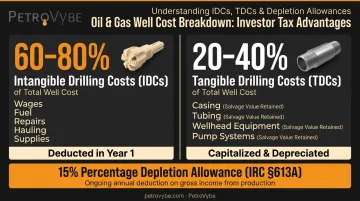
Under IRC Section 263(c), investors in oil and gas development can elect to deduct intangible drilling costs in the year they're incurred — covering wages, fuel, repairs, hauling, supplies, and similar costs with no salvage value per Treasury Regulation 1.612-4. These aren't abstract paper losses. They're real dollars spent drilling real wells, expensed immediately.
That scope matters: industry data from Hanson & Co. CPAs estimates IDCs represent approximately 60–80% of a new well's total expense. The remaining costs are tangible drilling costs (TDCs) — equipment like casing and tubing that has salvage value — which are capitalized and depreciated over time. Investors also benefit from a 15% percentage depletion allowance under IRC Section 613A, which lets qualifying independent producers deduct a fixed percentage of gross income from the property each year.
Why IDCs Matter for W2 Earners
Under IRC Section 469(c)(3), a working interest in oil and gas held directly — or through an entity that doesn't limit the taxpayer's liability — is not subject to passive activity loss rules. That means IDC deductions can offset ordinary income — including wages — not just passive income.
For comparison, a real estate investor generating passive losses can only use them against passive income (unless they qualify as a real estate professional). An oil and gas investor with a qualifying working interest can apply those same-style deductions against their W2 salary.
A Real-World Example
Consider an accredited investor who places $300,000 into a qualifying oil and gas development program. If approximately 70–80% qualifies as IDCs, that portion becomes deductible against ordinary income in Year 1.
PetroVybe, a Texas-based natural gas development company, provides a concrete benchmark: partners who joined in 2024 received a 91% tax deduction against active income; in 2025, partners achieved a 94% deduction. These figures are self-reported through internal performance tracking and supported by K-1 documentation delivered to partners — including one redacted sample showing a $600,000 capital contribution generating $401,772 in deductions (approximately 67% in Year 1). PetroVybe gives accredited investors direct access to this type of tax-advantaged natural gas development in South Texas, with a minimum investment of $100,000.
One verified investor (Nizar A., reviewed on Invest Clearly) reported eliminating a $30,000 tax liability through the investment structure entirely.
If your tax advisor hasn't raised oil and gas working interests as an option, ask directly — this deduction is legal, well-established in the tax code, and largely unknown outside of high-income circles.
Smart Tax Strategies to Reduce Your Overall Tax Burden
Beyond deductions, several portfolio management strategies cut what investors owe each year.
Tax-Loss Harvesting
Selling underperforming investments to realize losses — then using those losses to offset capital gains — is a reliable way to manage tax liability in a taxable brokerage account. The key constraint is the IRS wash sale rule under IRC Section 1091.
The wash sale rule disallows the loss if you buy a substantially identical security within 30 days before or after the sale (61 days total, including the sale date). The disallowed loss isn't gone permanently — it adjusts the replacement asset's cost basis instead.
Asset Location Strategy
Where you hold investments matters as much as what you hold:
- Tax-inefficient assets (high-yield bonds, REITs, actively managed funds) belong inside IRAs or 401(k)s, where distributions aren't taxed annually
- Tax-efficient assets (broad index ETFs with low turnover) work better in taxable accounts, where long-term gains receive preferential rates

Placement strategy reduces your drag before the hold period even begins — which connects directly to the next lever.
Long-Term Capital Gains Rates
Holding assets for more than one year — IRC Section 1222 requires strictly more than one year — qualifies gains for long-term capital gains rates, which run 15–20 percentage points below ordinary income rates for most high earners. The 2025 brackets:
| Filing Status | 0% | 15% | 20% |
|---|---|---|---|
| Single | Up to $48,350 | $48,350 – $533,400 | Over $533,400 |
| Married Filing Jointly | Up to $96,700 | $96,700 – $600,050 | Over $600,050 |
| Head of Household | Up to $64,750 | $64,750 – $566,700 | Over $566,700 |
A high earner in the 37% ordinary income bracket who converts short-term gains to long-term gains saves 17 percentage points per dollar in federal tax alone.
Frequently Asked Questions
Are financial planning expenses tax deductible?
For most individuals, no. The TCJA eliminated miscellaneous itemized deductions — including financial advisory and investment management fees — starting in 2018, and the One Big Beautiful Act made this permanent. Self-employed individuals are the exception: they can deduct business-related planning fees on Schedule C when those fees are directly tied to business operations.
How does the $6,000 tax deduction work?
The $6,000 figure is outdated — it applied through 2022. The current 2025 traditional IRA contribution limit is $7,000, or $8,000 for taxpayers age 50 or older. Deductibility depends on income level and whether you or your spouse participate in a workplace retirement plan.
What is the most overlooked tax deduction?
Oil and gas intangible drilling cost (IDC) deductions. Unlike most investment deductions, IDCs can offset active W2 income under the working interest exception to passive activity rules — and the dollar amounts are often far larger than retirement account contributions alone.
Can I deduct investment interest expenses on my taxes?
Yes, if you itemize. Investment interest expense — such as interest on a margin loan used to purchase taxable investments — is deductible under IRC Section 163(d), capped at your net taxable investment income for the year. Excess interest carries forward to future years.
What tax deductions are available for high-income earners?
High earners phased out of standard options should prioritize maxing tax-advantaged accounts (401k, HSA), harvesting capital losses, and using investment interest expense deductions. For accredited investors, oil and gas IDC deductions are worth a close look — they carry no income phase-out for qualifying working interests.
Are oil and gas investments tax deductible?
Yes. Direct investments in qualifying oil and gas development generate IDC deductions and depletion allowances. These deductions apply against ordinary income — including W2 wages — making them one of the few investment strategies that directly reduce a high earner's salary tax burden.