
For business owners, this distinction drives liquidity decisions. For investors evaluating a company's financial strength, it determines where long-term value actually lives. This guide breaks down what current and noncurrent assets are, how they differ across liquidity, valuation, and tax treatment, and why the balance between them is especially critical in capital-intensive industries like energy and natural resources.
Key Takeaways
- Current assets convert to cash within 12 months; noncurrent assets are held longer and support long-term value
- Common current assets: cash, accounts receivable, inventory, marketable securities
- Common noncurrent assets: PP&E, patents, goodwill, long-term investments, proved reserves
- Tax character is governed by IRS rules and asset type, not accounting classification alone
- In energy development, noncurrent asset quality (proved reserves, PP&E) drives long-term investment value more than cash position
Current vs. Noncurrent Assets: Quick Comparison
The table below maps five key dimensions that shape how each asset category is classified, valued, and taxed — distinctions that matter most when reviewing a balance sheet or evaluating an investment structure.
| Dimension | Current Assets | Noncurrent Assets |
|---|---|---|
| Liquidity Timeline | Convertible within 12 months or one operating cycle | Held beyond 12 months; not readily liquidated |
| Primary Purpose | Fund day-to-day operations and short-term obligations | Generate revenue over multiple years |
| Valuation Method | Mixed: cash at face value, receivables net of credit-loss allowance, inventory at lower of cost or NRV | Recorded at historical cost minus accumulated depreciation, depletion, or amortization |
| Tax Treatment | Proceeds typically taxed as ordinary income | Assets held over one year may qualify for long-term capital gains rates under IRC rules |
| Balance Sheet Order | Listed first; commonly in descending liquidity order | Follow current assets on a classified balance sheet |
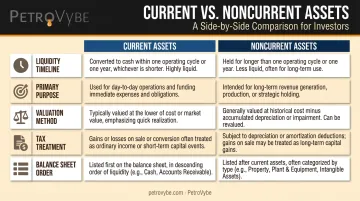
On valuation, the specific accounting standards in play are ASC 326 (credit-loss allowances on receivables) and ASC 330 (lower of cost or net realizable value for inventory). Noncurrent assets follow separate standards depending on asset type — there is no single universal measurement basis for either category.
What Are Current Assets?
Current assets are resources a company expects to sell, consume, or convert into cash within one fiscal year or operating cycle. They represent the liquid layer of the balance sheet and are the primary tool for managing near-term financial obligations.
Under US practice, current assets are typically presented in descending liquidity order — most liquid first — starting with cash and cash equivalents first, followed by marketable securities, accounts receivable, prepaid expenses, and inventory. This ordering signals how quickly each item can be accessed, though US GAAP does not mandate one universal sequence.
Use Cases and Key Metrics
Current assets serve three core operational functions:
- Covering payroll and supplier payments
- Funding short-term debt repayment
- Providing a buffer against unexpected cash flow disruptions
These functions explain why analysts track three primary metrics to assess near-term financial health:
- Current ratio = current assets ÷ current liabilities
- Working capital = current assets − current liabilities
- Quick ratio = (cash + short-term marketable investments + receivables) ÷ current liabilities — this excludes inventory for a more conservative liquidity read
One important caveat: a high current asset total does not automatically signal financial strength. The quality and composition matter. Aging receivables that may not be collectible, or inventory that cannot be sold at recorded cost, can inflate current asset totals without providing real liquidity.
ASC 326 addresses this directly by requiring receivables to be reported net of a credit-loss allowance. That's why the notes to financial statements often tell a more complete story than the headline number alone.
What Are Noncurrent Assets?
Noncurrent assets are long-term investments held for more than one year. They form the operational backbone of a business — the infrastructure, intellectual property, and strategic resources that generate revenue over years or decades.
Two Main Subtypes
Tangible noncurrent assets (PP&E) include land, buildings, machinery, vehicles, and in the energy sector, drilling equipment, wells, and production facilities. These are depreciated over their useful lives — except land, which is not depreciated but remains subject to impairment considerations.
Intangible noncurrent assets include patents, trademarks, copyrights, customer lists, and goodwill from acquisitions. Finite-lived intangibles are amortized over their useful lives. Goodwill and indefinite-lived intangibles are not amortized but tested for impairment.
Depreciation, Depletion, and Amortization
Noncurrent assets are reported at historical cost minus accumulated DD&A (depreciation, depletion, and amortization). These allocate the asset's cost across the periods it generates economic benefit — they don't represent the asset losing market value.
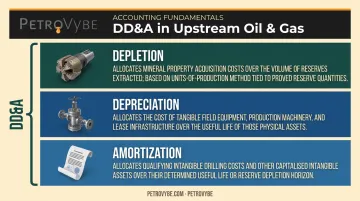
In oil and gas specifically, upstream companies use DD&A as a combined measure because a producing asset base contains all three components:
- Depletion allocates capitalized mineral-property costs over extracted reserves
- Depreciation allocates tangible equipment and facility costs
- Amortization allocates qualifying intangible costs
Under ASC 932, proved reserve quantities are disclosed in supplemental reserve tables rather than carried as separately revalued assets. Capitalized mineral interests, lease acquisition costs, exploration and development expenditures, wells, and production equipment appear as noncurrent PP&E on the balance sheet.
Use Cases in Capital-Intensive Industries
Noncurrent assets serve as the production engine in manufacturing and energy development. In upstream energy, they are the wells, acreage, pipelines, and proved reserves that generate cash flow over a 10-to-30-year horizon.
A large, well-maintained noncurrent asset base signals durability to investors and lenders — it indicates long-term revenue potential and provides collateral for financing. In direct investment structures, the quality and scale of noncurrent assets — proved reserves, production infrastructure, and developed acreage — directly determines projected cash flow and MOIC over the investment window. PetroVybe, for example, backs its accredited investor partnerships with a third-party engineered proved reserves valuation of $48MM, giving partners a concrete asset foundation to evaluate before committing capital.
Key Differences Between Current and Noncurrent Assets: What Investors Should Know
Liquidity and Time Horizon
The 12-month rule is the foundational dividing line — though it is more nuanced than it appears. Under IAS 1.66, assets can remain current even if realization exceeds 12 months, as long as they are held for trading or are expected to be consumed within the operating cycle. US GAAP under ASC 210 uses a similar framework based on the normal operating cycle.
What this means practically: moving assets between categories can signal strategic shifts. A company liquidating noncurrent assets to fund operations may indicate financial pressure — though asset sales are not inherently distress signals. Context from filing disclosures matters.
Valuation Divergence and Hidden Value
Because noncurrent assets are carried at cost minus accumulated depreciation rather than market value, they can be significantly undervalued on the balance sheet. This divergence shows up most sharply in capital-intensive sectors like energy and manufacturing.
Consider: land is typically not depreciated, meaning its book value remains at acquisition cost even as market value rises. Proved reserves and mineral rights can appreciate substantially as commodity prices increase, while their accounting carrying value declines through depletion.
The PV-10 metric — a pre-income-tax, 10%-discounted estimate of future net revenues from proved reserves — is the industry standard for communicating economic value. It is neither the balance sheet carrying amount nor a GAAP fair value measure.
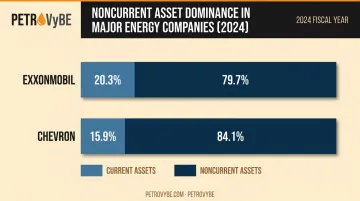
ExxonMobil's 2021 balance sheet illustrates this clearly: $59.154 billion in current assets versus $279.769 billion in noncurrent assets — with noncurrent assets representing 82.5% of total assets. By 2024, ExxonMobil's noncurrent assets grew to $361.485 billion, or 79.7% of total assets. Chevron's noncurrent assets were even more dominant at 84.1% of total assets in 2024. The book value of those assets reflects historical cost and accumulated depletion, depreciation, and amortization (DD&A) — not what those reserves and facilities could command in a transaction.
Tax Treatment in Practice
Tax character in the US follows IRS rules under the Internal Revenue Code — not accounting classification alone. Assets held more than one year qualify for long-term capital gains treatment; one year or less is short-term. For 2025, the 15% long-term capital gains bracket applies up to $533,400 for single filers and $600,050 for married filing jointly.
One critical nuance: inventory and property held primarily for sale to customers are excluded from capital asset treatment. Depreciable business property may receive Section 1231 treatment instead. The accounting label alone — current or noncurrent — does not determine tax character.
For oil and gas specifically, IRC 263(c) permits an election to expense qualifying intangible drilling and development costs (IDCs) rather than capitalize them.
This distinction matters significantly for high-income investors:
- IDC deductions apply against active income — W-2 earnings and capital gains
- Real estate depreciation is typically restricted to passive income only
- The accounting classification (current vs. noncurrent) does not change this treatment
Balance Sheet Signals for Investors
A high ratio of noncurrent to total assets in an energy or manufacturing company reflects capital intensity and long-term revenue commitment. ExxonMobil and Chevron both sit at roughly 80–84% noncurrent. This ratio signals that the overwhelming majority of value is locked in long-term physical and subsurface assets.
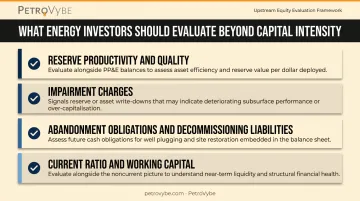
But capital intensity alone does not establish financial health. Investors should evaluate:
- Reserve productivity and quality alongside PP&E balances
- Impairment charges that can signal reserve or asset write-downs
- Abandonment obligations and decommissioning liabilities
- Current ratio and working capital alongside the noncurrent picture
For energy investors specifically, the gap between book value and economic value is often where the real return story lives — or where risk hides in plain sight.
Real-World Example: How Energy Companies Reflect Both Asset Types
The ExxonMobil balance sheet is the clearest public illustration of how capital-intensive energy companies are structured. In fiscal year 2021, ExxonMobil reported $59.154 billion in current assets and $279.769 billion in noncurrent assets — with noncurrent assets representing over 82% of total assets. By 2024, that noncurrent base had grown to $361.485 billion.
This ratio reflects the nature of upstream energy: the vast majority of value lives in long-term, hard physical assets — wells, production facilities, proved reserves, and acreage — not in cash or receivables. Operating cash flow funds day-to-day needs, while the noncurrent asset base is where decades of revenue potential resides.
That's where the production timeline, reserve quality, and capital efficiency either validate or undermine the investment thesis.
Conclusion
Current assets keep the business running today. Noncurrent assets determine what a company — or an investment — is worth over time. The balance between them reflects both operational discipline and long-term strategic vision.
For investors evaluating a public company's balance sheet or deciding where to allocate capital in private markets, understanding how assets are classified, valued, and taxed shapes every capital allocation decision. Whether you're analyzing a public equity position or evaluating a direct stake in a private development project, the asset structure tells you where value is being created — and how long it will take to realize.
Frequently Asked Questions
Is an investment a current or noncurrent asset?
It depends on the holding period. Investments expected to be liquidated within 12 months (such as marketable securities held for trading) are current assets. Bonds, equity stakes, and long-term partnership positions held beyond a year are noncurrent assets.
What are examples of noncurrent assets?
Tangible examples include land, buildings, machinery, and production equipment (PP&E). Intangible examples include patents, trademarks, copyrights, and goodwill from acquisitions. Long-term investments such as bonds and equity holdings also qualify, as do capitalized oil and gas properties under ASC 932.
What is the difference between a fixed asset and a noncurrent asset?
All fixed assets are noncurrent, but not all noncurrent assets are fixed. Fixed assets refer specifically to tangible physical property (PP&E) that cannot be quickly converted to cash. Noncurrent assets is the broader category that also includes intangibles like patents, long-term receivables, and long-term investments.
Why are noncurrent assets depreciated?
Depreciation allocates the cost of a tangible asset across the years it is expected to generate economic benefit, matching the expense to the revenue it produces. This is the systematic recognition of an asset's cost over its useful life, not a measure of declining market value.
Are oil and gas reserves considered current or noncurrent assets?
Proved reserves and associated production infrastructure (wells, equipment, and acreage) are classified as noncurrent assets. These are long-term capital investments generating cash flow over years or decades. Under ASC 932, proved reserve quantities appear as supplemental disclosures, while capitalized costs appear in noncurrent PP&E.
How does asset classification affect an investor's tax exposure?
Assets held longer than one year are generally taxed at long-term capital gains rates, which are typically lower than ordinary income rates applied to short-term positions. Tax character follows IRS rules based on asset type, not accounting classification alone. Consult a qualified tax advisor for guidance specific to your situation.