Making your money work daily doesn't mean cash lands in your account every 24 hours. It means your capital is deployed into assets that accrue interest, generate dividends, or build cash flow continuously — even while you sleep. Some of these systems take five minutes to set up. Others require accredited investor status and a longer time horizon.
The nine strategies below span that full range, from FDIC-insured accounts to direct energy development. Each carries different risk levels, income potential, and tax implications. The most powerful ones are reserved for the end.
Key Takeaways
- Idle money loses purchasing power; money deployed into income-generating assets compounds continuously
- These nine strategies range from low-risk liquid savings to advanced accredited investor opportunities
- For high earners, tax efficiency matters as much as yield — structuring investments correctly can legally reduce your tax bill
- Combining multiple strategies builds a layered system where each layer reinforces the next, compounding returns that consistently beat inflation
Ways 1–3: Stable, Low-Effort Daily Income Strategies
The three strategies below share a common trait: they work without demanding your time. Each carries a different risk-return profile, but all generate income on a rolling basis with minimal active management required.
Way 1: High-Yield Savings Accounts
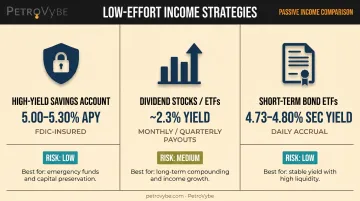
High-yield savings accounts (HYSAs) accrue interest daily, though most credit it monthly. They're FDIC-insured up to $250,000 per depositor and require zero active management. In 2024, some banks launched HYSAs offering 5.00%–5.30% APY — more than ten times the national savings rate at the time.
The limitation is real, though. Rates are variable, and HYSAs rarely outpace inflation over the long run. They're best used as an emergency fund or short-term cash reserve, not a primary wealth-building vehicle.
Best for: Emergency funds, near-term savings goals, cash waiting to be deployed elsewhere.
Way 2: Dividend Stocks and ETFs
Dividend-paying stocks distribute a portion of company profits to shareholders on regular schedules — monthly or quarterly. By holding companies with staggered payout dates, you can engineer near-daily passive income across a portfolio.
The S&P 500 Dividend Aristocrats — companies with 25+ consecutive years of dividend increases — yielded 2.3% as of February 2025, with 69 qualifying securities. Realty Income, for instance, has made its 662nd consecutive monthly dividend payment — a benchmark for reliability.
Dividends provide ongoing cash flow while stock appreciation builds underlying wealth. The trade-off is volatility — stock prices fluctuate, and dividend yields can be cut if company earnings decline.
Best for: Long-term income investors comfortable with price swings, those building a diversified passive income portfolio.
Way 3: Short-Term Bond ETFs
Short-term bond ETFs hold government or corporate debt with maturities under five years. They accrue interest daily and distribute it monthly, offering a predictable income stream with less volatility than equities.
As of December 31, 2024:
- SHY (1–3 year U.S. Treasuries): 4.80% SEC yield
- IGSB (1–5 year investment-grade corporate bonds): 4.73% SEC yield
The risk is straightforward: when interest rates rise, existing bond prices fall. In low-rate environments, returns can also be eroded by inflation. Pairing short-term bond ETFs with equity positions — or laddering maturities across different durations — smooths out cash flow and reduces the whipsaw effect of rate cycles.
Ways 4–6: Growth and Income Strategies
Way 4: Real Estate Investment Trusts (REITs)
REITs own income-producing real estate — apartments, office buildings, retail centers — and by law must distribute at least 90% of taxable income to shareholders. This makes them reliable dividend payers with the added benefit of daily price fluctuation offering entry and exit flexibility.
The FTSE Nareit All Equity REITs index yielded 3.96% at year-end 2024 and 4.07% at year-end 2025. REITs generated positive total returns in 78% of months with rising Treasury yields between 1992 and 2025 — disproving the common assumption that rising rates always hurt REITs.
Risks to know:
- Sensitive to interest rate cycles and property market downturns
- Distributions are taxed as ordinary income, not at the lower qualified dividend rate
- Share prices fluctuate daily like any publicly traded security
Way 5: Index Funds and Compounding
Broad market index funds don't generate "daily income" in the traditional sense. But through price appreciation and reinvested dividends — using a Dividend Reinvestment Plan (DRIP) — they compound wealth continuously.
The Rule of 72 makes this tangible: divide 72 by your expected annual return to estimate how long it takes to double your money. At 7%, your portfolio doubles in roughly 10.3 years — a number that changes dramatically depending on fees, taxes, and whether dividends are reinvested.
The cost of staying out of the market is equally stark. J.P. Morgan's 2025 Guide to Retirement found that missing just the 10 best market days over a 20-year period would have cut portfolio value nearly in half — and many of those best days occurred immediately after the worst days.
That data makes a strong case for staying invested through volatility rather than moving to cash and waiting for a better entry point.
Way 6: Tax-Advantaged Retirement Accounts
Automating contributions to tax-advantaged accounts turns your savings into a compounding machine. Growth that isn't taxed annually stays invested — earning returns on capital that would otherwise go to the IRS.
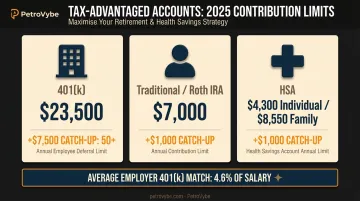
2025 contribution limits:
| Account | Limit | Catch-Up (50+) |
|---|---|---|
| 401(k) | $23,500 | +$7,500 |
| Traditional/Roth IRA | $7,000 | +$1,000 |
| HSA (self/family) | $4,300 / $8,550 | +$1,000 |
Employer 401(k) matching averages 4.6% of pay according to Vanguard's 2025 report — that's free capital that compounds alongside your own contributions.
Which account structure works best depends on where your tax liability sits. For high-income W2 earners, pre-tax traditional 401(k) contributions reduce taxable income now — typically more valuable in a high bracket. Roth accounts make more sense if you expect your tax rate to be higher in retirement.
Ways 7–9: Advanced Strategies for Accredited Investors
Way 7: Direct Real Estate and Rental Income
Owning income-producing rental property generates three income streams simultaneously: monthly cash flow, long-term appreciation, and tax deductions (mortgage interest, depreciation, maintenance). ATTOM projected average gross rental yields of 7.3% for 2025 on three-bedroom single-family properties.
Depreciation adds a paper loss that can offset rental income — residential property depreciates over 27.5 years under IRS Publication 527. However, rental losses are generally passive under IRS rules, meaning they typically can't offset W2 wages unless you qualify as a real estate professional (750+ hours per year in qualifying real estate activities).
Lower-barrier alternatives:
- Fundrise — $10 minimum, open to most investors
- CrowdStreet — $25,000 minimum, requires accredited investor status
Both platforms let investors access income-producing real estate without taking on property management.
Way 8: Direct Investment in Energy Development (Oil and Gas)
Oil and gas direct investment adds a dimension real estate crowdfunding doesn't: income combined with tax efficiency that applies directly against active income.
The core mechanism: IDC deductions
When accredited investors participate in oil and gas development through a working interest, they gain access to Intangible Drilling Cost (IDC) deductions. Under IRC Section 263(c) and Treasury Regulation 1.612-4, qualifying IDCs can be expensed in the year they're incurred.
Unlike real estate depreciation, which is restricted to passive income, qualifying oil and gas working interest deductions can offset W2 wages and capital gains directly.
A $100,000 investment typically generates a $60,000–$80,000 first-year deduction against active income. In practical terms, that can mean eliminating a large share of your annual tax bill in the same year you invest.
PetroVybe's real-world results:
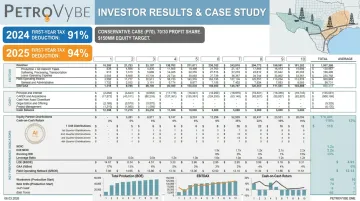
- 2024 partners received a 91% first-year tax deduction against active income
- 2025 partners achieved a 94% first-year tax deduction against active income
- One verified investor eliminated a $30,000 tax liability entirely
PetroVybe is a Texas-based private oil and gas development company focused on natural gas liquids (NGLs) in South Texas and the Gulf Coast Basin, with its flagship project anchored in Lavaca County.
PetroVybe ONE targets a 10-year MOIC of approximately 2.2–5.8x and a forecasted IRR of ~26%, with monthly passive distributions projected to peak above $10,000/month during the production phase. Minimum investment is $100,000.
The AI energy demand tailwind
Natural gas development isn't just a tax play — it's a forward-positioned asset class. The IEA projects data center electricity consumption will grow approximately 15% annually from 2024 to 2030. Goldman Sachs estimates this drives roughly 3.3 Bcf/d of incremental U.S. natural gas demand by 2030. PetroVybe's thesis — "fuel the AI boom today, build legacy wealth tomorrow" — positions natural gas development directly in that structural demand trend.
PetroVybe holds a Texas Railroad Commission operator's license, a $48MM proved reserves valuation (PV-09, third-party verified), and a 5.0/5.0 rating across eight verified reviews on Invest Clearly.
Important caveats: Oil and gas development carries operational, commodity price, and liquidity risk. The hold period before first distributions is typically 2–3 years. IDC deduction eligibility depends on ownership structure, at-risk rules, and individual tax circumstances. Consult a qualified tax advisor before investing.
Way 9: Private Lending
Private lending — lending capital directly to real estate operators, businesses, or individuals through private credit platforms — generates interest income at rates well above savings accounts or investment-grade bonds. Ares reported a 9.3% direct-lending yield at December 31, 2024, compared to 5.3% for leveraged loans and 5.1% for high-yield bonds.
The primary risks:
- Credit/default risk — borrowers may fail to repay; this risk is real and should not be minimized
- Liquidity risk — most private credit positions cannot be sold on a secondary market. Blackstone's BCRED, for example, limits quarterly repurchases to 5% of aggregate shares
- Valuation risk — private loans are valued infrequently, meaning losses may not be visible until they're already substantial
For accredited investors comfortable with these trade-offs, secured private lending (backed by real assets) with diversification across multiple loans reduces — but doesn't eliminate — default risk.
How to Stack These Strategies for Maximum Daily Impact
The most effective daily money system uses a layered approach:
Foundation (Liquid, Low-Risk)
- High-yield savings account for emergency reserves
- Short-term bond ETFs for stable yield
- Tax-advantaged retirement accounts for compounding
Core (Growth-Oriented)
- Index funds with DRIP enabled
- Dividend stocks across staggered payout schedules
- REITs for real estate income exposure
Advanced Layer (High-Yield / Tax-Efficient)
- Direct real estate for cash flow and appreciation
- Direct energy development for production income and IDC deductions
- Private lending for elevated yield (noting the illiquidity trade-off)
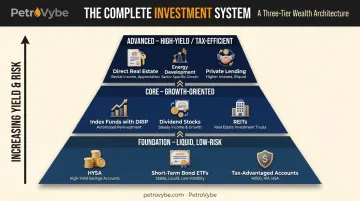
Each layer builds on the one below it. Once the foundation is in place, the advanced positions can work harder — and they don't require daily management.
Automate everything you can. DRIP on dividends, automatic retirement contributions, scheduled fund purchases — automation removes the decision fatigue that pushes investors to buy high, sell low, or simply do nothing.
Higher returns in the advanced layer — direct energy, private lending — come with either higher risk or longer lock-up periods. Both. Know how much capital you can leave untouched for 5–10 years before committing. A financial advisor or CPA is worth a conversation before you enter direct energy investments or private credit positions.
Frequently Asked Questions
Which investments are best for daily income?
It depends on your risk tolerance. HYSAs and dividend stocks are best for low-risk daily accrual. REITs and bond ETFs offer moderate, reliable income. Direct real estate and energy development provide higher yields with tax advantages — but require accredited investor status and longer time horizons.
How much do I need invested to earn $1,000 per month from investments?
At a 4% annual yield, you need roughly $300,000 ($300,000 × 0.04 = $12,000/year). At 8–10% — available through private credit or direct investments — that threshold drops to $120,000–$150,000. Yield and tax efficiency are the two levers that most change the math.
What is the difference between passive income and earned income for tax purposes?
The key distinction is what each type of loss can offset. Passive losses generally can only offset passive income — not your W2 or business earnings. IDC deductions from oil and gas working interests are a notable exception: they apply directly against active income, including wages and capital gains.
Can investment losses offset W2 income for high earners?
Generally, no — passive activity loss rules block that offset. The exception is structure-dependent: a working interest in oil and gas (not a limited partnership interest) qualifies for IDC deductions against active income. That distinction in how the investment is held determines whether the deduction applies to your W2.
What are the biggest risks of daily income strategies?
Three categories matter most: market/volatility risk (dividend cuts, price drops in stocks and REITs), credit/default risk (peer-to-peer and private lending), and liquidity risk (direct investments like real estate or energy development that lock capital up for years).
How should a beginner start making their money work?
Start with a high-yield savings account to build an emergency fund. Then automate contributions to a 401(k) or IRA to capture compounding and employer matching. Once those are running, add dividend stocks or a broad index fund. Only layer in advanced strategies once the foundation is solid.