The benefit principle is the taxation theory that tries to resolve this tension. It argues that individuals should pay taxes proportional to the government benefits they receive — treating taxes more like prices in a private market.
For financially sophisticated individuals, understanding this principle isn't just academic. It explains why the U.S. tax system works the way it does, why high-income earners bear a disproportionate share of the burden, and what legal tools exist to manage that burden strategically.
This guide covers the benefit principle in plain language, how it compares to ability-to-pay taxation, where it actually works in practice, its core limitations, and what it means for high-income earners navigating today's progressive tax system.
Key Takeaways
- The benefit principle holds that individuals should pay taxes proportional to the government benefits they receive, mirroring how prices work in private markets.
- The U.S. tax system runs primarily on the ability-to-pay principle, not on benefit-based taxation.
- The benefit principle works best for excludable services: highway tolls, fuel taxes, and national park fees.
- The free-rider problem and non-excludable public goods make broad implementation nearly impossible.
- High-income earners can legally reduce tax burdens via IDC deductions in direct oil and gas partnerships.
What Is the Benefit Principle in Taxation?
The benefit principle is a theory of taxation stating that individuals should contribute to government funding in proportion to the benefits they derive from public goods and services. Put simply: you pay for what you use, the same way prices work in private markets.
The IMF defines it as taxing people according to the benefits received from tax-financed expenditure programs — a straightforward, market-like logic where tax liability tracks usage rather than income.
Historical Roots
The modern benefit approach traces to two economists:
- Knut Wicksell (1896) — paired proposed government spending with taxes and used unanimity as protection against forcing people to pay more than their perceived benefit
- Erik Lindahl (1919) — developed individualized tax shares ("tax prices") whose sum finances the public good and supports efficient agreement among taxpayers
Paul Samuelson and Richard Musgrave later extended these ideas into the formal public economics framework used today.
Two Distinct Uses of the Term
"Benefit principle" means different things in different contexts:
- Macro-level tax theory — the fairness argument about how governments should design tax systems, assigning liability based on benefit received
- IRS tax benefit rule (IRC §111) — a separate income-tax provision addressing recovery of prior deductions; it affects charitable contributions and other deductions but is not the same concept
This guide focuses on the macro-level theory.
What It Is Not
The benefit principle is neither a flat tax nor a progressive income tax. It's benefit-proportionate — your liability tracks what you actually receive from government services, regardless of your income level. The U.S. system, by contrast, bases liability primarily on income — meaning two people receiving identical government services can owe vastly different amounts in tax.
How the Benefit Principle Works in Practice
The appeal is obvious: if people pay for what they use, government becomes more accountable and taxpayers better understand the cost of public services. The problem is that most government services don't work like private markets. Whether that principle holds depends almost entirely on one question — can you link payment to benefit?
Where It Actually Works
The benefit principle functions well when benefits are excludable — meaning you can prevent non-payers from receiving the service. Clear examples:
- Fuel taxes — the federal gasoline tax is 18.4 cents per gallon, with 15.44 cents directed to the Highway Account. Drivers who buy more gas pay more — directly funding the roads they use.
- National park fees — under FLREA, the NPS collects and retains recreation fees, with at least 80% staying at the collecting park. Visitors pay; non-visitors don't.
- Bridge and highway tolls — usage-based payments with direct attribution
- Public college tuition — students who attend pay; those who don't, don't
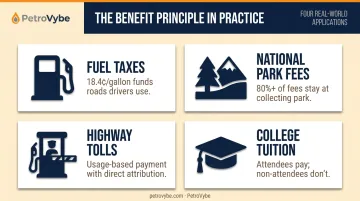
These work because benefit and payment can be individually matched.
Where It Breaks Down
National defense, police protection, courts, and public health systems are non-excludable — citizens benefit regardless of whether they pay. You can't prevent a non-taxpayer from benefiting from the military or a functioning legal system. That makes individual benefit measurement genuinely impossible.
The Free-Rider Problem
When people can benefit from a public good without paying, they have little incentive to honestly disclose how much they value it. This is the preference revelation problem: no one admits what something is worth to them if they can get it for free. A pure benefit-principle system would chronically underfund public goods — everyone waits for someone else to pay.
The Digital Economy Complication
Modern economies make benefit attribution even harder. Digital companies rely heavily on public telecommunications infrastructure, intellectual property enforcement, and educated workforces — all government-provided benefits — but none of it maps neatly to a billing line. The OECD's Pillar One framework attempts to address this by reallocating taxing rights to market jurisdictions based on where users and customers are located. It's a multinational workaround for a problem the benefit principle was never designed to solve.
Benefit Principle vs. Ability-to-Pay Principle
These two principles represent fundamentally different answers to the same question: who should pay how much?
How Each Works
Benefit principle: Tax liability follows usage of public services. Pay more if you use more, regardless of income.
Ability-to-pay principle: Tax liability follows income or wealth. Pay more if you earn more, regardless of how much you use public services.
The U.S. federal income tax is built on ability-to-pay logic. For 2025, the 37% marginal bracket begins at $626,350 for single filers and $751,600 for married filing jointly.
IRS data for 2022 shows the top 1% of earners paid 40.43% of total individual income tax, and the top 10% paid 71.97% — a distribution that reflects income capacity, not government service usage.
A Concrete Comparison
Consider two individuals:
| High-income earner | Lower-income earner | |
|---|---|---|
| Public transit use | Rarely | Daily |
| Government services relied on | Lower direct usage | Higher direct usage |
| Benefit principle tax | Lower | Higher |
| Ability-to-pay tax | Much higher | Lower |
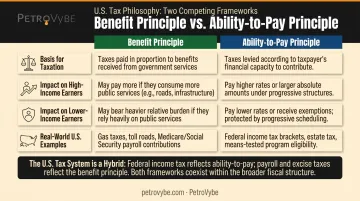
The outcomes are opposite. Under a strict benefit system, the lower-income individual — who relies more heavily on public services — would face a higher relative tax burden. This is the regressive risk (higher burden on lower earners) that makes the benefit principle insufficient as a standalone framework.
The Hybrid Reality
Most governments don't choose one or the other. The U.S. runs a hybrid:
- Ability-to-pay: Progressive income tax funding broad government functions
- Benefit principle: User fees, fuel taxes, toll roads, and park admission for specific, excludable services
In practice, this means high-income earners face the full weight of progressive taxation on the income side — while still paying benefit-linked charges on top. Understanding where each principle applies is essential for anyone structuring a tax strategy around legally available deductions.
Advantages and Limitations of the Benefit Principle
Advantages
- Fiscal transparency — linking tax payments to specific services makes government costs more legible to taxpayers
- Efficiency signals — when funding depends on perceived value delivered, government has incentive to provide services people actually want
- Demand accountability — usage-based pricing reveals actual public preferences rather than relying on central planning estimates
- Reduced over-investment — programs that don't deliver perceived value lose their funding basis
Those advantages, however, only hold where benefits can be clearly identified and measured. In practice, several structural realities limit how far the principle can be applied.
Limitations
- People understate how much they value public goods to lower their tax bill, leaving public goods chronically underfunded (the classic free-rider problem)
- Defense, public health, and courts cannot practically exclude non-payers, making individual benefit measurement impossible
- Lower-income individuals who rely more heavily on government services would face higher relative burdens under strict application — a regressive outcome
- Tracing who benefits from which government services across borders and industries is notoriously difficult, as the ongoing OECD digital taxation debate illustrates
What This Means for High-Income Earners and Investors
Here's the practical takeaway: the U.S. tax system runs on ability-to-pay, not the benefit principle. That means high-income earners bear a disproportionate share of the federal tax burden regardless of how much they personally use public services — and the IRS data makes that distribution explicit.
The tax code does, however, include specific provisions designed for investors who take on real economic risk — and for high-income earners, one of the most consequential is the IDC deduction.
The IDC Deduction: A Legally Sanctioned Tax Efficiency Tool
The U.S. tax code includes specific provisions that can materially reduce taxable income — particularly for investors in energy infrastructure. Under IRC §263(c), investors in qualifying oil and gas development projects can elect to deduct Intangible Drilling Costs (IDCs) in the year they're incurred.
What makes this provision unusual is that for investors holding a qualifying working interest, the IDC deduction is not restricted to passive income. It can be applied against active income — including W-2 wages and ordinary income — subject to at-risk rules, excess business loss limitations, and potential AMT considerations.
This is meaningfully different from most passive investment deductions, which are limited to offsetting passive income only.
PetroVybe's Track Record
PetroVybe, a Texas-based private oil and gas development company operating in Lavaca County's liquids-rich formations, structures its investments as limited partnerships for accredited investors. Partners receive K-1 tax documents that pass through IDC deductions directly to their personal returns.
The results their investor partners have achieved:
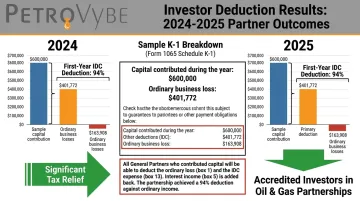
- 2024 partners: 91% tax deduction against active income (W-2 and capital gains)
- 2025 partners: 94% tax deduction against active income
These are first-year deductions, not cumulative figures spread over years. A $600,000 capital contribution in one documented K-1 generated $401,772 in deductions classified as ordinary income loss and IDC deductions.
One verified investor, Nizar A., reported eliminating a $30,000 tax liability entirely through this structure.
Minimum participation requires $100,000 and SEC accredited investor status (net worth over $1M excluding primary residence, or income exceeding $200,000 individually or $300,000 jointly in prior years with reasonable current-year expectation).
The benefit principle helps explain why these mechanisms exist — the tax code acknowledges that direct participation in energy development carries genuine economic risk and delivers real infrastructure value. Whether these structures align with your financial goals is a question for a qualified CPA or tax advisor, but the IRC framework governing them is well-established.
Frequently Asked Questions
What is the tax benefit rule in simple terms?
The benefit principle holds that people should pay taxes proportional to the government benefits they receive — similar to paying a price for a service. In practice, most tax systems use income-based progressive structures instead, with user fees and tolls as limited applications of the benefit logic.
What is an example of the benefit principle of taxation?
The clearest example is the federal fuel tax: drivers who purchase gasoline pay 18.4 cents per gallon, which funds road construction and maintenance through the Highway Trust Fund. Those who drive more pay more — directly linking tax contribution to the benefit received.
How does the benefit principle differ from the ability-to-pay principle?
The benefit principle ties taxation to usage of public services; the ability-to-pay principle ties it to income or wealth. Under the U.S. progressive income tax, top earners pay the most — regardless of how much they personally use government services.
Why is the benefit principle difficult to implement for most public services?
Most public goods — national defense, police protection, public health systems — are non-excludable. Everyone benefits regardless of whether they pay, making it impossible to assign individual benefit levels and enforce payment accordingly.
What are the main criticisms of the benefit principle?
Two criticisms dominate the debate:
- Free-rider problem: People underreport their benefit to lower their tax bill, causing chronic underfunding of public goods.
- Regressive risk: Lower-income individuals who rely more on government services would face higher relative tax burdens under strict application.
Does the United States use the benefit principle for taxation?
The U.S. primarily uses a progressive, ability-to-pay income tax structure. However, specific user-based mechanisms — fuel taxes, highway tolls, Medicare payroll taxes, and national park fees — reflect elements of the benefit principle operating within the broader system.