
Introduction
You sold a business stake, closed on an investment property, or exited a position — and now you're staring at a six-figure capital gain. The question almost every high-income investor asks at this point: does holding assets through an LLC change what you owe?
The short answer is no, not automatically. But the structure does matter — and what you do after gains are realized can change the outcome significantly.
This article covers how capital gains flow through an LLC and land on your personal return, the hidden trap that turns expected capital gains into ordinary income (taxed at nearly double the rate), and what LLC members actually pay under 2025 IRS rates. It also breaks down the most effective legal strategies to reduce that liability — including one investment category that generates deductions across income types most investors don't know are reachable.
One critical starting point: LLCs don't pay federal income tax. That single fact is both the opportunity and the source of complexity that follows.
Key Takeaways
- An LLC doesn't pay capital gains tax — gains pass through to members and are taxed on personal returns
- Gains preserve their character (long-term or short-term) as they flow through
- IRC Section 751 "hot assets" can convert expected capital gains into ordinary income, often at nearly double the tax rate
- High earners face up to 23.8% federal rate on long-term gains (20% + 3.8% NIIT)
- Oil and gas working interest investments offer IDC deductions that can offset capital gains directly
How Are LLCs Taxed on Capital Gains?
Pass-Through Treatment and Character Preservation
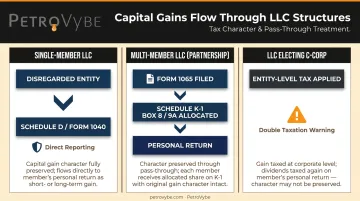
An LLC — whether single-member or multi-member — does not pay federal income tax on capital gains at the entity level. Gains flow to members and are reported on their personal returns. This is the foundational rule everything else builds on.
The character of gains doesn't change in transit. If the LLC sells an asset held more than one year, that long-term capital gain arrives on the member's return as a long-term capital gain. The LLC structure doesn't transform it into ordinary income — and it doesn't eliminate it either.
How Reporting Works by Structure
The mechanics differ depending on how the LLC is classified:
- Single-member LLCs are treated as disregarded entities by the IRS. The member reports gains directly on Schedule C or Schedule D of Form 1040
- Multi-member LLCs taxed as partnerships file Form 1065 and issue each member a Schedule K-1. Box 8 reports net short-term capital gain; Box 9a reports net long-term capital gain — the character is separately stated and preserved
- LLCs electing S-corp or C-corp treatment follow different rules. C-corps face entity-level tax and potential double taxation, making this a structure most capital-focused investors skip
For the vast majority of real estate investors, business owners, and capital allocators using LLCs, the partnership or disregarded-entity treatment applies.
The LLC structure determines how gains flow — not whether they're taxed. Reducing the actual tax owed requires a separate layer of strategy: cost basis management, tax-loss harvesting, or structuring investments that generate deductions against those gains at the personal return level.
When Capital Gains Become Ordinary Income Inside an LLC
This is where many investors get caught off guard. Not all gains from LLC transactions receive long-term capital gains treatment — and the difference in tax rate is substantial.
The Hot Assets Trap (IRC Section 751)
Under IRC Section 751, when an LLC member sells their membership interest, any portion of the gain tied to "hot assets" is taxed as ordinary income, not capital gain. Hot assets include:
- Unrealized receivables — accounts receivable not yet recognized under the LLC's accounting method
- Depreciation recapture — gains on equipment under Section 1245 and real property under Section 1250
- Inventory items — property that would be inventory if held directly by the selling partner
The depreciation recapture piece trips up real estate and equipment-heavy LLCs regularly. When the LLC has taken depreciation deductions over the years, selling the LLC interest forces the recaptured amount back into ordinary income — even if the investor expected a clean capital gains event.
The Blended Basis Problem
The hot assets issue doesn't exist in isolation — it compounds with a structural quirk unique to LLC ownership. Unlike corporate shareholders who have a discrete cost basis per share, LLC members carry a pooled basis across their entire membership interest.
Consider an investor who buys in across two tranches — $100,000 in Year 1, $150,000 in Year 3 — for a total basis of $250,000. When they sell half their interest, they can't selectively attribute the newer (higher) basis to the sold portion. The gain calculation uses the pooled average, which typically produces a larger taxable gain than the investor anticipated.
Why This Distinction Costs Real Money
For 2025, the spread between these two treatments is significant:
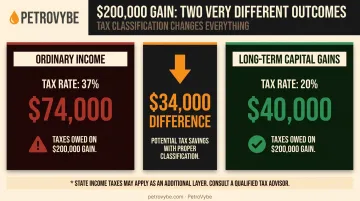
| Tax Treatment | 2025 Federal Rate | Tax on $200K Gain |
|---|---|---|
| Ordinary income | 37% | $74,000 |
| Long-term capital gains | 20% | $40,000 |
| Difference | 17 pts | $34,000 |
That $34,000 gap exists before state taxes are added. Understanding which portion of your LLC gain falls into each category — well before a transaction closes — is what separates a planned exit from an expensive surprise.
Capital Gains Tax Rates: What LLC Members Actually Pay
2025 Long-Term Capital Gains Rate Tiers
Per IRS Revenue Procedure 2024-40, the 2025 thresholds for long-term capital gains rates are:
| Filing Status | 0% Rate | 15% Rate | 20% Rate Begins |
|---|---|---|---|
| Single | Up to $48,350 | $48,351–$533,400 | Above $533,400 |
| Married Filing Jointly | Up to $96,700 | $96,701–$600,050 | Above $600,050 |
| Married Filing Separately | Up to $48,350 | $48,351–$300,000 | Above $300,000 |
| Head of Household | Up to $64,750 | $64,751–$566,700 | Above $566,700 |
Short-term gains — assets held one year or less — are taxed at ordinary income rates, reaching 37% for high earners.
The NIIT Adds Another Layer
High-income LLC members face an additional 3.8% Net Investment Income Tax on investment income including capital gains. It kicks in at $200,000 for single filers and $250,000 for married filing jointly.
Combined, that pushes the maximum federal rate on long-term capital gains to 23.8%. Stack a high-tax state on top and the picture gets worse fast:
- California tops out at 13.3% on capital gains
- New York adds up to 10.9%
- Combined marginal rate for affected investors: 35%+ on long-term gains
A Concrete Dollar Example
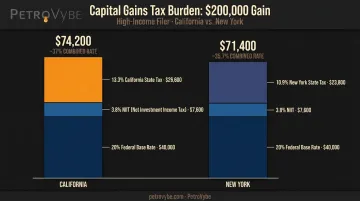
A high-income single filer realizes a $200,000 long-term capital gain in 2025. At 20% plus NIIT:
- Federal tax: $47,600 (23.8% effective federal rate)
- Add California state tax at 13.3%: $26,600
- Total tax on the gain: ~$74,200 — about 37% of the gain gone before any state deductions
For investors with six-figure gains, the question isn't whether the tax burden is significant — it's which structures actually move the number down.
Strategies to Reduce Capital Gains Tax Through Your LLC
Tax-Loss Harvesting
Capital losses from LLC investments offset capital gains dollar for dollar on the member's personal return. Net losses beyond gains are limited to a $3,000 deduction against ordinary income per year ($1,500 for married filing separately), with the remainder carried forward indefinitely.
In years with large gains, proactively realizing losses elsewhere in the portfolio — including losses allocated through other LLCs — is a straightforward and immediate offset.
Qualified Business Income (QBI) Deduction
For eligible pass-through LLCs, members may deduct up to 20% of qualified business income under Section 199A. A few important limits:
- Capital gains are explicitly excluded from QBI — this deduction doesn't reduce the capital gains themselves
- Specified service businesses (law, consulting, financial services, etc.) phase out above $197,300 for single filers and $394,600 for married filing jointly in 2025
- The deduction reduces overall taxable income, which can affect which bracket the gains fall into
Retirement Account Contributions
Maximizing contributions to tax-deferred accounts lowers taxable income and can shift capital gains into a lower rate tier. 2025 limits:
- SEP-IRA: Lesser of 25% of compensation or $70,000 (compensation cap: $350,000)
- Solo 401(k): Employee deferral of $23,500 plus employer contributions, up to $70,000 combined; catch-up of $7,500 for age 50+, and $11,250 for ages 60-63
Oil & Gas Direct Investment Deductions
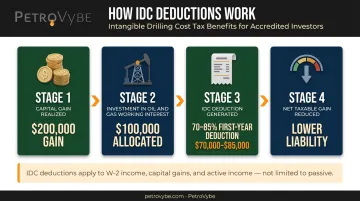
One strategy often overlooked in LLC capital gains planning: direct participation in oil and gas development. Under the U.S. tax code, Intangible Drilling Costs (IDCs) are deductible against active income — including W2 earnings and capital gains — not just passive income.
For accredited investors, allocating a portion of realized gains into a qualifying oil and gas partnership can generate a first-year deduction of 70–91%+ of the invested amount, effectively absorbing the tax liability that would otherwise come due. Unlike QBI or retirement contributions, this deduction is not subject to income phase-outs or contribution caps — making it one of the more aggressive tools available for high-income earners with significant capital gains exposure.
Opportunity Zone Investments
Reinvesting realized gains into a Qualified Opportunity Fund (QOF) within 180 days defers taxation on the original gain. Legacy investments deferred before December 31, 2026 may qualify for a fair-market-value basis election after a 10-year hold.
Post-2026 QOF investments follow amended rules under IRC Section 1400Z-2, with a rolling five-year deferral structure. Consult a tax advisor before December 2026 to determine whether your gains qualify for deferral.
Holding Period Management
The single most straightforward lever: ensure assets are held more than one year before sale to access long-term rates. For LLC membership interests, holding period tracking follows Treasury Regulation 1.1223-3, which can assign different holding periods to portions acquired at different times. This can work for or against the seller, depending on when units were acquired.
None of these strategies works in isolation — the most effective approach combines several, timed to the member's income profile and the year the gains are realized. A tax advisor familiar with pass-through structures should review which combination applies before filing.
Oil and Gas Investments: A Powerful Capital Gains Offset for Accredited Investors
For investors dealing with a substantial capital gains event, most of the strategies above are incremental. Oil and gas working interest investments through a development LLC operate at a different scale — and they reach income categories that most deductions can't touch.
How Intangible Drilling Cost Deductions Work
Under IRC Section 263(c) and Treasury Regulation 1.612-4, accredited investors participating in qualifying oil and gas development projects can deduct Intangible Drilling Costs (IDCs) in the year they're incurred. IDCs cover wages, fuel, drilling services, ground preparation, and similar well-development expenses — costs with no salvage value.
What makes this strategy notable: according to API industry data, IDCs typically represent 60–80% of total well cost, and can reach up to 85% in some development programs. For an investor writing a $100,000 check, that means a $60,000–$80,000 first-year deduction.
More importantly, this deduction is not restricted to passive income. It can offset W-2 wages, capital gains, and other active income — a breadth most deductions simply don't have.
PetroVybe: A Structured Example
PetroVybe is a Texas-based natural gas development company that structures accredited investor participation through limited partnerships. Investors receive annual Schedule K-1 forms documenting their IDC deductions.
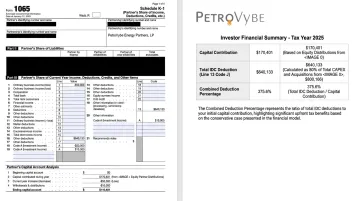
A redacted 2025 K-1 shows what this looks like in practice:
- $600,000 capital contribution generated $401,772 in combined IDC and ordinary income loss deductions (~67% first-year rate)
- 91–94% total tax deductions against active income across PetroVybe's 2024 and 2025 programs
- Additional benefits from depletion allowances and tangible cost depreciation materialize over the project's life
The investment requires a $100,000 minimum and is open exclusively to accredited investors. That eligibility threshold also reflects who leads the operation: PetroVybe's Chief Geophysicist, Michael Stamatedes, brings a 48-year career and a 75.2% well success rate — close to double the industry peer average of below 40%.
Beyond the Tax Benefit
The deduction is only part of the picture. PetroVybe's projects in South Texas target natural gas liquids (NGLs), which command premium pricing across petrochemical, industrial, and heating markets. Their independently verified proved reserves stand at $48MM (PV-09) as assessed by a licensed third-party engineering firm.
The energy demand tailwind reinforces the investment thesis: the IEA projects global data-center electricity consumption growing roughly 15% annually from 2024 to 2030, with natural gas and coal expected to meet more than 40% of that incremental demand. For investors looking to reduce a current-year capital gains liability while gaining long-term exposure to a productive energy asset, the timing matters: IDC deductions apply in the year the costs are incurred, so structuring participation before year-end is critical. Consult a qualified tax advisor to assess fit with your specific situation.
Results vary based on investment size, timing, and structure. Always consult a qualified tax professional.
Frequently Asked Questions
How are LLCs taxed on capital gains?
LLCs are pass-through entities, meaning the LLC itself pays no capital gains tax. Gains flow to members, who report them on personal returns. The long-term or short-term character is preserved as gains pass through and reported on Schedule K-1 or Schedule D.
How much capital gains tax will I pay on $200,000?
It depends on your total taxable income and filing status. A high-income single filer with $200,000 in long-term gains would likely face the 20% federal rate plus the 3.8% NIIT, for an effective federal rate of up to 23.8% before state taxes. At lower income levels, the 15% or even 0% rate may apply.
How can an LLC avoid paying high taxes?
Several strategies can reduce the tax burden on LLC members:
- Maximize business deductions and contribute to SEP-IRAs or Solo 401(k)s
- Claim the QBI deduction if eligible
- Hold assets over one year to qualify for long-term capital gains rates
- Harvest capital losses to offset gains
- Explore investments with large upfront deductions, such as oil and gas working interest IDC deductions
Can LLC losses offset capital gains?
Yes. Capital losses allocated from an LLC to a member offset capital gains dollar for dollar on the personal return. Net losses beyond gains are limited to a $3,000 deduction against ordinary income per year, with excess carried forward indefinitely.
Do I pay capital gains tax when I sell my LLC membership interest?
Generally yes. Selling an LLC interest produces capital gain or loss, though under IRC Section 751, a portion may be recharacterized as ordinary income if the LLC holds "hot assets" such as unrealized receivables, inventory, or depreciable property subject to recapture. The member's blended basis across the entire interest determines the gain amount.