This guide covers clear definitions of all three terms, how they interact on a personal balance sheet, and how high-income earners can strategically build wealth by acquiring the right assets while keeping liabilities in check.
Key Takeaways
- An asset is anything you own or control that is expected to deliver future economic value
- A liability is a financial obligation you owe to another party — loans, mortgages, credit card debt
- An investment is a deliberate asset purchase made with the intent of generating a future return
- Not all investments build real wealth — liquidity, tax treatment, and income generation separate productive assets from dead weight
- True wealth-building means growing the gap between total assets and total liabilities over time
What Is an Asset?
According to the IFRS Conceptual Framework, an asset is "a present economic resource controlled by the entity as a result of past events," where an economic resource is a right with the potential to produce economic benefits. In practice, an asset is worth exactly what someone will pay for it today — its value is market-determined, not intrinsic.
Understanding how assets are categorized helps clarify which ones actually build wealth over time:
- Tangible assets — real property, equipment, commodities, oil and gas reserves. These are physical and often preferred by serious wealth builders because they tend to hold value against inflation.
- Intangible assets — patents, trademarks, goodwill, intellectual property. Real value, but harder to measure and often harder to sell.
Current vs. Long-Term Assets
Current assets (cash, accounts receivable, short-term investments) can be converted to cash within one year. Long-term assets — real estate, producing wells, machinery — are held for extended periods and tend to build lasting wealth. A $50,000 savings account and a $50,000 interest in a producing natural gas field are both assets, but their behavior over 10 years looks nothing alike.
Liquid vs. Illiquid Assets
- Liquid assets (stocks, ETFs, cash) have active markets and can be converted quickly
- Illiquid assets (private investments, real estate, oil and gas interests) cannot be sold on demand — but a CFA Institute review cites research finding an average 2.7% liquidity premium over 25 years for holding illiquid positions
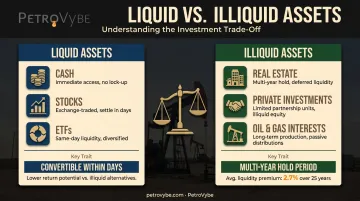
That premium comes with a tradeoff: illiquid assets can lock up capital and often carry wide spreads between purchase price and what you can realistically sell for in any given window.
Assets That Behave Like Liabilities
Robert Kiyosaki's cash-flow test from Rich Dad Poor Dad draws a useful line: an asset puts money in your pocket; a liability takes money out. By that measure, a boat, a vacation home with ongoing carrying costs, or a depreciating vehicle generating no income functions more like a liability — regardless of what it's labeled on paper.
What Is a Liability?
A liability is a present obligation to transfer an economic resource to another party as a result of past events. In plain terms: money you owe, to a bank, a vendor, the government, or anyone else. Liabilities represent spending money before it's been earned, and their true cost compounds over time.
According to the New York Fed's Q1 2026 Household Debt and Credit Report, U.S. household debt reached $18.8 trillion, including $13.19 trillion in mortgages, $1.69 trillion in auto loans, and $1.25 trillion in credit card debt.
Types of Liabilities
| Type | Examples | Key Risk |
|---|---|---|
| Current liabilities | Credit card balances, short-term loans, accrued taxes | Immediate cash flow pressure |
| Long-term liabilities | Mortgages, business loans, deferred tax obligations | Compound cost over time |
Current liabilities carry the most immediate risk — they're due within a year and often carry the highest interest rates. The Federal Reserve's May 2026 G.19 report put average credit card APRs at 20.94% across all accounts and 22.15% for accounts actually carrying a balance. At those rates, an unpaid balance doesn't just sit there — it grows.
When Debt Isn't Destructive
Not all debt erodes wealth. The distinction comes down to what the debt is financing:
- Productive debt — low-interest financing for income-producing assets (a rental property mortgage, a business equipment loan) — acts as leverage. The debt is real, but so is the return it enables.
- Destructive debt — credit card balances at 20%+ APR — is nearly impossible to outrun with investment returns and should be cleared before allocating capital anywhere else.
The Hidden Liability: Future Tax Obligations
Many high-income earners overlook this one entirely. Unrealized capital gains, deferred compensation, and large income events all create future tax bills. While the IRS does not require reporting unrealized gains as a current liability, treating them as one on your personal balance sheet is smart financial discipline — and ignoring them doesn't make them disappear. A surprise tax bill is still a bill.
What Is an Investment?
An investment is the deliberate allocation of money into an asset with the expectation of generating a future return — through income (dividends, interest, royalties), capital appreciation, or both. Spending money on something does not make it an investment. The defining feature is that an investment is expected to pay you back more than you put in.
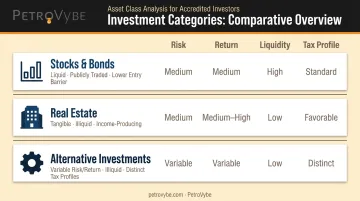
Main Investment Categories
| Category | Examples | Characteristics |
|---|---|---|
| Stocks & bonds | Public equities, Treasuries, ETFs | Liquid, publicly traded, lower barrier to entry |
| Real estate | Rental property, commercial holdings | Tangible, illiquid, income-producing |
| Alternative investments | Private equity, commodities, oil and gas development | Variable risk/return, often illiquid, distinct tax profiles |
Each category carries different combinations of risk, return, liquidity, and tax treatment. An S&P 500 index fund and a direct interest in a natural gas development project are both investments — but they behave nothing alike in terms of how they generate income, how they're taxed, and how quickly you can exit.
What Separates a Strong Investment from a Weak One
Not all investments are created equal. The best ones tend to share a few defining traits:
- Consistent income generation — pays you while you hold it
- Inflation protection — value holds as purchasing power declines
- Principal growth — the underlying asset appreciates over time
Alternative assets like direct participation in natural gas development can check all three boxes. Accredited investors who hold a working interest in an oil and gas project receive commodity-linked income and hold a tangible asset in the ground.
They also benefit from Intangible Drilling Cost (IDC) deductions — a tax treatment that can offset active income, including W-2 wages and capital gains, in the year the costs are incurred. PetroVybe's 2024 partners, for example, received a 91–94% first-year tax deduction against ordinary income through this structure.
Liquidity and Time Horizon
Before committing to any investment, match its liquidity profile to your personal cash flow needs:
- Liquid investments (stocks, ETFs) can be exited quickly but may offer lower long-term returns
- Illiquid investments (private oil and gas participation, real estate partnerships) require a multi-year commitment — sometimes 5 to 10 years — but often carry higher return potential
The SEC cautions that private offerings may have no ready resale market and may need to be held indefinitely. Know this before you commit capital you might need.
Assets, Liabilities, and Investments: Key Differences and How They Work Together
The foundational accounting equation is straightforward:
Assets = Liabilities + Equity (Net Worth)
Every asset on your personal balance sheet is funded either by debt (a liability) or your own capital (equity). When liabilities grow without a matching rise in productive assets, net worth shrinks. That's the warning sign of financial overextension — and it's exactly why the asset side of the equation deserves the same attention.
Where Investments Fit
Investments sit on the asset side of this equation. When you buy a stock, bond, real estate holding, or an interest in a producing well, you add to your assets. Whether that investment is a good asset comes down to three things: does it generate income, does it appreciate, and can you hold it long enough to let it work?
A Simple Side-by-Side Comparison
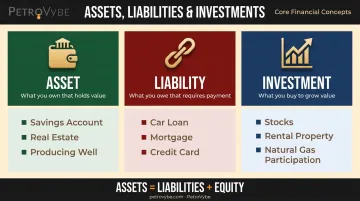
| Concept | Definition | Example |
|---|---|---|
| Asset | What you own that holds value | Savings account, real estate, producing well |
| Liability | What you owe that requires payment | Car loan, mortgage, credit card balance |
| Investment | What you buy to grow value | Stocks, rental property, natural gas development participation |
A natural gas development project is both an investment and an asset — it's something you own (asset), purchased with the intent of generating returns (investment), and it may have been partially financed with leverage (liability). All three concepts apply to a single decision.
The 2022 Survey of Consumer Finances found that real median family net worth reached $192,900, up 37% from 2019. That figure is net worth in the technical sense — assets minus liabilities. The more relevant question for any investor is what those assets are actually doing: sitting idle, generating income, or compounding toward a specific financial outcome.
Building Wealth by Growing Assets and Managing Liabilities
The core formula is simple: grow the gap between total assets and total liabilities over time. The goal is not to eliminate all debt — it's to ensure every liability is matched to a productive asset generating more return than the debt costs.
Practical Strategies
Prioritize income-producing assets:
- Real estate that generates rental income
- Equities with dividend history
- Direct participation in commodity-producing assets
Avoid lifestyle liabilities disguised as assets:
- Depreciating vehicles bought on credit
- Vacation properties with negative cash flow
- Luxury goods financed over time
Maintain adequate liquidity: Keep enough in liquid assets to cover 12 months of obligations before committing capital to illiquid positions.
Consider alternative asset classes with tax advantages: For accredited investors carrying heavy active income tax burdens, direct participation in natural gas development — such as opportunities available through PetroVybe — provides a tangible asset position backed by proved reserves, with passive monthly distributions during production.
PetroVybe ONE carries a third-party verified proved reserves valuation of $48 million (PV-09) and has delivered 94% IDC deductions against active income for 2025 partners and 91% in 2024 — applied directly against W-2 income and capital gains.

Net Worth Is a Starting Point
A high net worth on paper is only useful if:
- Enough assets are liquid to fund near-term goals without a forced sale
- Assets are diversified across classes that don't all move together
- Tax liabilities are managed so future obligations don't quietly erode what you've built
If your portfolio is concentrated in illiquid real estate, or heavily weighted toward assets that generate large capital gains without offsetting deductions, the balance sheet looks better than the financial reality is.
Direct working interests in oil and gas can convert an active tax liability into a long-term, income-producing asset position. Understanding how these structures work — and what they deliver beyond the headline deduction — is a practical next step for any accredited investor managing a concentrated or tax-heavy portfolio.
Frequently Asked Questions
Is an investment considered an asset or a liability?
An investment is classified as an asset on a personal balance sheet because it represents something of value you own with the expectation of future return. Whether it becomes a productive asset depends on whether the income or appreciation it generates exceeds its total cost, including any debt used to fund it.
What is the difference between assets and liabilities of an investment?
The asset side of an investment is your ownership stake and its future income or appreciation potential. The liability side includes any debt used to finance the investment and future tax obligations triggered by gains or distributions. A highly leveraged investment may show a large asset value while carrying nearly equivalent liabilities.
What are examples of assets, liabilities, and investments?
Assets include cash, real estate, stocks, and producing oil and gas wells. Liabilities include mortgages, car loans, credit card balances, and deferred taxes. Investments include stocks, bonds, rental property, and direct oil and gas development participation.
Can liabilities ever help build wealth?
Strategic, low-interest debt used to acquire income-generating assets can amplify returns — this is financial leverage. A mortgage on a rental property or a business loan that funds revenue-generating equipment can produce positive returns when the asset yields more than the debt costs. That same leverage magnifies losses when asset values fall or income stops.
What is the difference between liquid and illiquid assets?
Liquid assets — cash, publicly traded stocks — can be converted to cash at or near market value. Illiquid assets — real estate, private partnerships, oil and gas interests — take time to sell and may carry a significant gap between purchase price and realizable sale price. The trade-off is that illiquid assets often offer higher long-term returns.
How do you calculate net worth using assets and liabilities?
Net Worth = Total Assets − Total Liabilities. A high net worth on paper may still leave limited financial flexibility if most assets are illiquid, heavily concentrated, or tied to large unrealized tax obligations.