
The distinction matters beyond terminology. Choosing between private and public equity affects liquidity, return potential, tax treatment, regulatory exposure, and minimum investment thresholds — factors that can meaningfully change how wealth accumulates over time.
This article breaks down how each works, who qualifies, what historical returns look like, and — critically — which structure fits which type of investor.
Key Takeaways
- Private equity is ownership in non-publicly traded companies, restricted to accredited investors with longer lock-ups and higher minimums
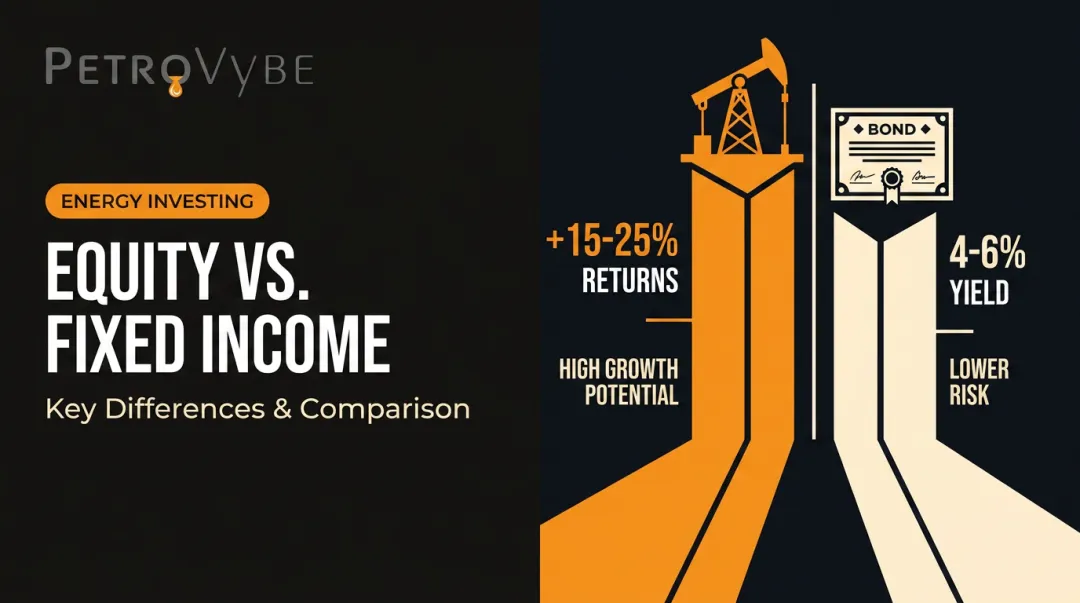
- Public equity offers daily liquidity and broad access but historically lower long-term returns
- Cambridge Associates data shows private equity outperforming public markets by roughly 3 percentage points annually over 25 years, net of fees
- Certain private equity structures, especially direct oil and gas development, allow deductions against W-2 and capital gains income — a tax advantage public equity cannot match
- Most accredited investors benefit from holding both: public equity for liquidity, private equity for return potential and tax efficiency
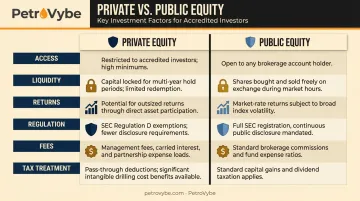
Private Equity vs. Public Equity: Quick Comparison
| Factor | Private Equity | Public Equity |
|---|---|---|
| Access | Accredited investors only (SEC income/net worth thresholds) | Any investor with a brokerage account |
| Liquidity | Illiquid; 5–12 year lock-ups typical | Daily liquidity during market hours |
| Returns | Historically higher; ~2.96 pts above Russell 3000 over 25 years (net) | Market-indexed returns; benchmarked to S&P 500 or Russell 3000 |
| Regulation | Less regulated; disclosures limited to partners via PPM | SEC-mandated quarterly/annual reporting (10-K, 10-Q) |
| Fees | 1.74–1.93% management fee + carried interest | As low as 0.14% (index ETFs) |
| Tax Treatment | Certain structures allow large upfront deductions against ordinary income | Returns taxed as capital gains or dividends; no equivalent deduction mechanism |
What Is Private Equity?
Private equity is ownership in a company not listed on a public stock exchange. Capital is raised through private placements rather than IPOs, and investors receive a Private Placement Memorandum (PPM) — a detailed disclosure document that substitutes for a public prospectus — instead of an SEC-registered filing.
Who Can Invest
Access is gated by the SEC's accredited investor definition. To qualify, an individual must meet at least one of:
- Income threshold: $200,000 annually ($300,000 with a spouse) in each of the prior two years, with reasonable expectation of the same
- Net worth threshold: Over $1 million excluding primary residence
- Professional license: Series 7, 65, or 82 in good standing
SEC research estimates that approximately 18.5 million U.S. households — about 14.7% — qualified as accredited investors in 2022. These restrictions exist because private investments carry higher risk and less regulatory protection than public markets.
How Returns Work
Private equity investors typically receive distributions — actual cash generated by the underlying business — rather than relying on share price appreciation. This structure can produce income throughout the life of the investment, not just at exit.
Main Types of Private Equity
- Venture capital — early-stage startups with high risk and high upside
- Growth equity — scaling companies seeking expansion capital
- Buyouts — acquiring controlling interest in mature businesses
- Direct participation programs (DPPs) — including oil and gas development, which carries distinct tax advantages tied to hard asset development
The Operational Advantage
Private fund managers aren't subject to quarterly earnings pressure from public shareholders. This freedom lets them pursue long-term value creation strategies that public company management often cannot — a structural difference that consistently shows up in long-term return profiles.
Use Cases for Private Equity
That long-term orientation shapes who private equity actually works for. The investor profile best suited to it:
- Accredited investors with $100,000+ in liquid capital
- Long time horizons (5–10+ years)
- High income or capital gains tax burdens actively seeking efficiency
- Interest in tangible asset exposure outside the stock market
Oil and gas development is one specific use case worth examining. Direct working interests in natural gas projects can qualify for Intangible Drilling Cost (IDC) deductions against ordinary and W-2 income — a tax efficiency no public equity investment matches.
Two IRC provisions govern this: under IRC 263(c), qualifying drilling-related costs can be elected for current expensing. Under IRC 469(c)(3), certain working interests held without limited liability are excluded from passive-activity treatment, meaning the deduction can offset active income directly.
PetroVybe, a private Texas-based natural gas development company, offers accredited investors direct access to this type of opportunity in South Texas's Lavaca County. Their 2024 partners achieved a 94% tax deduction against active income through this structure — before any production income is factored in.

What Is Public Equity?
Public equity is ownership in companies listed on exchanges like the NYSE or Nasdaq. Companies access public markets through an Initial Public Offering (IPO), which involves SEC registration, investment bank underwriting, and the issuance of shares available to any investor.
Defining Characteristics
- Daily liquidity: Shares bought or sold any trading day
- Price transparency: Real-time quotes and market data
- SEC-mandated disclosure: Quarterly 10-Q filings, annual 10-K reports, and 8-K filings for material events within four business days
- Diversified access: Mutual funds, ETFs, and index funds allow broad exposure at minimal cost
The Regulatory Trade-Off
The SEC's framework — including Sarbanes-Oxley requirements — protects investors through mandatory disclosure. But it also creates compliance costs and reporting pressure. GAO research found that when companies became nonexempt from SOX auditor-attestation requirements, median audit fees rose $219,000 (13%) in the first nonexempt year. Survey data shows 78% of executives would sacrifice economic value to smooth quarterly earnings — a direct consequence of public market reporting cycles.
Those compliance pressures partly explain why fewer companies choose to go — or stay — public.
A Shrinking Universe
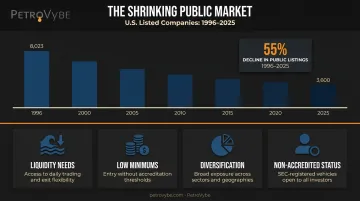
The pool of publicly traded companies has contracted significantly. The SEC counts 3,600 U.S.-domiciled exchange-listed companies in its current 2025 data, down from a World Bank peak of 8,023 domestic listings in 1996. Fewer listed companies means greater market concentration risk for investors relying exclusively on public equity.
Use Cases for Public Equity
Despite that concentration risk, public equity remains the right fit for many investors. It works best for those who:
- Need liquidity or have shorter investment horizons
- Are working with lower capital minimums
- Want broad market diversification without private placement complexity
- Are not yet accredited investors
Common vehicles — 401(k)s, IRAs, index funds, and ETFs — make public equity the default building block of most retirement savings. For accredited investors, however, the question becomes whether liquidity and transparency are worth the earnings-smoothing trade-offs and shrinking opportunity set that public markets increasingly present.
Private Equity vs. Public Equity: Which Is Right for You?
The right answer depends on four investor-specific variables evaluated together, not in isolation:
- Liquidity needs — Can you lock up capital for 5–12 years?
- Time horizon — Are you building wealth over decades or needing returns sooner?
- Tax burden — Do you carry significant W-2 or capital gains income?
- Risk tolerance — Can you absorb illiquidity and performance dispersion?
The Return Question
Cambridge Associates' data, as of March 31, 2025, shows U.S. private equity net returns of 11.64% annually over 25 years, versus Russell 3000 modified PME (cash-flow-matched) returns of 8.68% — a gap of nearly 3 percentage points. These PE figures are reported net of fees, expenses, and carried interest.
That said, the advantage must be evaluated honestly:
- PE fees run 1.74–1.93% for management alone versus 0.14% for index ETFs
- Illiquidity is real; McKinsey reports a 6.6-year average holding period in 2025
- Performance dispersion is wide — top-quartile PE funds dramatically outperform; bottom-quartile funds underperform public markets
- Bain's 2025 analysis notes North American 10-year PE returns had fallen approximately 3 percentage points, cautioning against treating historical outperformance as permanent
The Tax Dimension
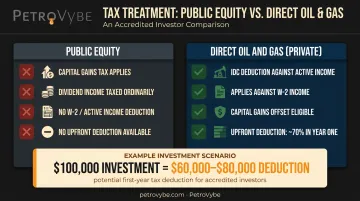
The tax treatment of direct oil and gas development is where the two asset classes diverge most sharply — and most practically for high-income investors.
| Feature | Public Equity | Direct Oil & Gas (Private) |
|---|---|---|
| Tax on returns | Capital gains or dividends | IDC deduction against active income |
| Applies to W-2 income | No | Yes (for qualifying working interests) |
| Applies to capital gains | No additional deduction mechanism | Yes |
| Upfront deduction potential | None | ~70% of invested capital in year one |
For high-income investors, the numbers are specific. A $100,000 investment in a qualifying oil and gas development program can generate a $60,000–$80,000 deduction against W-2 or capital gains income — before any production returns are counted. Unlike real estate, where passive loss deductions are typically restricted to passive income, the IDC deduction under qualifying working interest structures can offset active income directly.
Situational Recommendations
Choose public equity if:
- You need liquidity within the next 1–5 years
- You're building a diversified baseline portfolio
- You're not yet accredited
- You want low-cost, low-complexity exposure to market returns
Choose private equity if:
- You're an accredited investor with $100,000+ in liquid capital
- Your time horizon is 5–10+ years
- You carry a high tax burden and want active income deductions
- You want hard asset exposure and return potential beyond public markets
For accredited investors weighing direct oil and gas development, the return profile combines three layers that don't exist in public equity: MOIC targets (PetroVybe ONE projects a 2.2–5.8x range over 10 years with a target ~26% IRR), monthly passive distributions during production, and substantial upfront tax deductions.
The key variables — geology, commodity pricing, operator execution — are project-specific. Due diligence on the operator's track record matters as much as the structure itself.
Conclusion
Neither private nor public equity is universally superior. Public equity remains the right foundation for most portfolios: liquid, accessible, transparent, and cheap to access through index funds. Private equity is a powerful wealth-building complement for accredited investors who can commit capital long-term and who want returns — and tax efficiency — that public markets cannot offer.
As the number of publicly listed companies continues to shrink and more value creation happens in private markets, accredited investors who ignore private equity risk missing a growing share of where real value is created. For those evaluating where private equity exposure fits — whether through funds, direct deals, or sector-specific opportunities like private energy development — the allocation question deserves more attention than most portfolios currently give it.
Frequently Asked Questions
What is the difference between private equity and public equity?
Private equity is ownership in companies not listed on public exchanges, restricted to accredited investors, with lock-up periods of 5–12 years and no daily price transparency. Public equity is ownership in exchange-listed companies available to any investor, with daily liquidity and SEC-mandated reporting.
Who qualifies as an accredited investor for private equity?
An individual qualifies with $200,000+ in annual income ($300,000 with a spouse), a net worth exceeding $1 million excluding their primary residence, or a valid Series 7, 65, or 82 license. Certain entities with $5M+ in assets also qualify.
Does private equity outperform public equity?
Historically yes. Cambridge Associates reports private equity outperforming the Russell 3000 by roughly 3 percentage points annually over 25 years, net of fees. That edge must be weighed against illiquidity, performance dispersion across funds, and recent compression of returns.
How long do you have to hold a private equity investment?
Typically 5–12 years depending on fund structure. For example, oil and gas development investments like PetroVybe ONE target a 10-year horizon, with initial distributions beginning after a 2–3 year drilling and ramp-up phase.
What are the tax advantages of private equity over public equity?
Certain private equity structures, particularly direct oil and gas development, allow investors to deduct Intangible Drilling Costs (IDCs) against ordinary income, including W-2 wages and capital gains. This deduction has no equivalent in public equity and can equal 70%+ of invested capital in year one.
Can accredited investors hold both private and public equity?
Yes, and most financial advisors recommend both. Public equity provides liquidity and broad market exposure; private equity adds return potential, tax efficiency, and hard asset diversification. The right allocation depends on your liquidity needs, time horizon, and tax situation.