

Introduction
Many high-income earners accumulate corporate passive income without realizing the compliance obligations that come with it. The IRS doesn't just define passive income differently—it taxes it differently, limits what you can deduct against it, and layers on additional surtaxes that compound the burden over time.
Accredited investors and high-W2 earners routinely face passive activity loss (PAL) limitations under IRC Section 469, the 3.8% Net Investment Income Tax, and S-corporation passive income penalties — with no clear strategy in place to address any of them.
This guide covers exactly what corporate passive income is under U.S. tax law, how the IRS classifies it, how it's taxed across entity types, what the PAL rules actually require, and which tax strategies—including one investment category that sidesteps the passive income trap—can meaningfully reduce the burden.
Nothing in this article constitutes tax advice. Consult a qualified CPA or tax attorney before making any decisions.
Key Takeaways
- Corporate passive income includes rental income, dividends, interest, royalties, and limited partnership distributions—each with distinct tax treatment.
- The IRS applies seven material participation tests to determine active vs. passive classification; failing all seven suspends your losses.
- Passive losses cannot offset W2 wages or ordinary business income—only other passive income.
- The 3.8% NIIT applies to net passive income above $200K (single) or $250K (married filing jointly).
- Direct oil and gas development generates IDC deductions applicable against active income, one of the few structures that crosses the passive/active divide.
What Is Corporate Passive Income?
Corporate passive income is income earned from activities in which the owners or shareholders do not materially participate under IRS standards. The IRS draws this line deliberately: Congress enacted Section 469 in 1986 specifically to prevent high earners from sheltering wages behind paper losses from investments they don't genuinely manage.
Active business income, by contrast, comes from operations where the taxpayer is directly and regularly involved. The distinction determines not just how income is taxed, but whether losses from that activity can offset anything else on the return.
Common Sources of Corporate Passive Income
- Rental income – Generally passive regardless of participation, unless the taxpayer meets specific real estate professional criteria. Even incidental rental income from an otherwise non-rental business can trigger passive classification.
- Interest and dividends – Corporations holding investment portfolios generate these as portfolio income. For C-corporations, capital gains enter taxable income at the flat 21% corporate rate—there's no preferential long-term rate as individuals receive. Corporations may also qualify for the Dividends Received Deduction (DRD) under IRC Section 243: 50% for qualifying domestic dividends, 65% for dividends from 20%-owned corporations, and 100% for qualifying affiliated-group dividends.
- Limited partnership distributions – Under IRC Section 469(h)(2), limited partners are generally treated as not materially participating, making their share of partnership income passive by default. Some narrow exceptions exist under Reg. 1.469-5T, but the presumption is passive.
- Royalties – Royalty income not earned in the ordinary course of a trade or business is portfolio income under the passive activity regulations, not passive activity income. That distinction matters: portfolio income cannot offset passive activity losses, so royalty recipients cannot use PAL deductions to shelter it.
Corporate Passive Income vs. Individual Passive Income
The passive activity rules under IRC Section 469 apply to personal service corporations and closely held C-corporations—not every corporate entity. S-corporations face a separate passive income trap with steeper consequences.
Under IRC Section 1375, an S-corp that retains subchapter C earnings and profits and generates passive investment income exceeding 25% of gross receipts owes a corporate-level tax at the 21% Section 11 rate on the excess net passive income. Let that condition persist for three consecutive tax years, and the S-corp election terminates automatically under IRC Section 1362(d)(3). That termination is permanent unless the IRS grants relief—a consequence that catches many owners off guard and one worth flagging well before year three.
How the IRS Classifies Passive vs. Active Income
Material participation is the gating standard. If a taxpayer materially participates in an activity, income from it is active and losses can offset other income. If not, the activity is passive, losses are suspended, and they sit on the shelf until passive income materializes or the investment is fully disposed of.
The Seven IRS Material Participation Tests
Under Treasury Regulation 1.469-5T, meeting any one of the following tests qualifies as material participation:
- 500+ hours in the activity during the year
- Substantially all participation in the activity is by the taxpayer
- 100+ hours, and more than any other individual participant
- Significant participation activities aggregating more than 500 hours across all such activities
- Material participation in any 5 of the prior 10 years
- Personal service activity with material participation in any 3 prior years
- Facts and circumstances—regular, continuous, and substantial participation (100+ hours, no other person participates more)

Documentation matters. The IRS does not require contemporaneous daily logs, but taxpayers must be able to substantiate participation through calendars, appointment books, or narrative summaries. Post-event estimates without supporting records are regularly challenged in audits of high-income filers.
Why Classification Determines Everything
Passive classification means losses from that activity can only offset passive income from other sources—not W2 wages, self-employment income, or active business income.
Unused passive losses carry forward indefinitely under IRC Section 469(b) until one of three things happens:
- Passive income appears in a future year to absorb them
- The activity generates income after becoming nonpassive (under IRC 469(f), old suspended losses can offset current income from that same activity)
- The taxpayer disposes of the entire interest in a fully taxable transaction to an unrelated party under IRC Section 469(g)(1)
That third trigger is where planning gets interesting. When a formerly active business owner steps back from daily operations while retaining ownership, prior passive losses from investment activities can now offset the passive income stream flowing from that business—a transition-period window that often goes unaddressed until it's too late to act on it.
How Corporate Passive Income Is Taxed
For C-corporations, all income—including passive investment income—is taxed at the flat 21% federal corporate rate under the Tax Cuts and Jobs Act. That rate looks manageable in isolation. The effective burden climbs fast once you layer in:
- State corporate income taxes (ranging from 0% to 11.5% depending on jurisdiction)
- The 3.8% NIIT at the shareholder level
- Double taxation on dividend distributions from C-corps
The 3.8% Net Investment Income Tax (NIIT)
Under IRC Section 1411, a 3.8% surtax applies to the lesser of:
- Net investment income, or
- The amount by which MAGI exceeds $200,000 (single/head of household), $250,000 (married filing jointly), or $125,000 (married filing separately)
These thresholds are not inflation-indexed, meaning more taxpayers get pulled in each year without any legislative action.
The NIIT applies at the individual level—C-corporations themselves are not Section 1411 taxpayers. But shareholders receiving dividends from C-corps, or receiving passive income through S-corps and partnerships, face the surtax on that income if they exceed the MAGI thresholds.
The planning incentive is direct: active income from material participation is specifically excluded from NII. A taxpayer who qualifies as materially participating in a business avoids the NIIT on that income stream entirely. This is why certain oil and gas partnerships — structured to pass Intangible Drilling Cost (IDC) deductions against active income — are frequently used by high-income earners to reduce NIIT exposure at the source, rather than trying to reclassify income after the fact.
S-Corporation Passive Income Tax (Section 1375)
S-corporations with accumulated C-corp earnings and profits face a corporate-level tax under Section 1375 when passive investment income exceeds 25% of gross receipts. The tax applies at the 21% Section 11 rate to the excess net passive income, subject to a taxable-income cap.
The bigger risk: if the threshold is breached in three consecutive tax years, the S-corp election terminates automatically on the first day of the following year. This isn't a penalty the IRS imposes—it's statutory termination, and the IRS won't reinstate it quickly. Reinstatement isn't guaranteed.
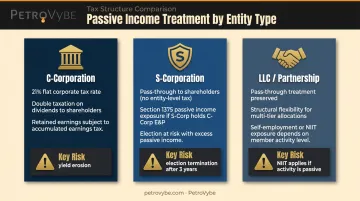
Entity structure comparison:
| Entity Type | Passive Income Treatment | Key Risk |
|---|---|---|
| C-Corporation | 21% corporate tax; shareholder taxed again on dividends | Double taxation erodes yield |
| S-Corporation | Pass-through to shareholders | Section 1375 tax + potential election termination |
| LLC/Partnership | Pass-through; structural flexibility | NIIT applies if activity is passive |
Passive Activity Loss Rules: What Corporations Must Know
Section 469 operates as a wall: passive activity losses cannot reduce active business income, W2 wages, or portfolio income in the year generated. They're suspended and carried forward under IRC 469(b)—no fixed expiration, but also no immediate relief.
Three events release suspended losses:
- Against passive income generated in a future tax year
- Against income from the same formerly passive activity if it converts to nonpassive status (IRC 469(f))
- Upon full, taxable disposition to an unrelated party (IRC 469(g)(1))
One note on transfers: a gift does not release suspended losses—it increases the donee's basis instead. A related-party sale also defers release. Installment sales release losses proportionately as payments are received.
Under IRC Section 469(e)(2) and (j)(1), a closely held C-corp — more than 50% owned by five or fewer individuals during the last half of the tax year, excluding personal service corporations — may apply PALs against net active income, but not portfolio income.
This exception is frequently overlooked. Depending on the corporation's income mix, it can open real planning opportunities worth running by your tax advisor.
Noncorporate taxpayers use IRS Form 8582 to track suspended losses and calculate allowable deductions each year. Corporations subject to Section 469 use Form 8810 instead. Both are among the most audited calculations for high-income filers.
Clean documentation across all passive activities is non-negotiable. That means maintaining records of:
- Adjusted basis in each activity
- At-risk amounts under IRC Section 465
- Participation hours for each tax year
Tax Strategies to Reduce the Corporate Passive Income Burden
Passive Loss Harvesting During Ownership Transitions
When a business owner transitions from active to passive status—stepping back from daily operations while retaining ownership—accumulated passive losses from prior investment activities can now be deployed against the newly passive income stream. The mechanics require careful timing: suspended losses don't automatically release, but they become available to absorb passive income once the owner's role shifts.
This is one of the most powerful and underutilized strategies available during succession or retirement transitions.
Entity Structure Optimization
The choice between C-corp, S-corp, and LLC/partnership treatment has real tax consequences for passive income:
- S-corp election allows passive income to pass through to shareholders, where it may be offset by the shareholder's other passive losses—but triggers Section 1375 exposure if accumulated E&P exists
- C-corp structure permits income retention inside the entity and deferred personal taxation, but creates double taxation on distributions
- LLC taxed as a partnership offers the most structural flexibility for passive income planning, with pass-through treatment and no entity-level passive income tax
Structure should always be evaluated against the owner's exit strategy, income profile, and long-term wealth goals—not optimized in isolation.
Repositioning to Active-Income-Eligible Deductions
High earners with suspended passive losses and no passive income to absorb them face a holding pattern that can last years. The alternative is redirecting capital into investment vehicles that generate deductions applicable against active income—not just passive.
The distinction matters more than most investors realize. Certain direct participation investments—oil and gas development, for example—generate Intangible Drilling Cost (IDC) deductions that apply against W2 income and capital gains, not just passive income. For high earners carrying a heavy tax burden, that difference can translate to six-figure reductions in a single tax year. Your tax advisor can assess which investment categories align with your income profile and deduction strategy.

Why Oil & Gas Investments Offer a Unique Tax Advantage for High Earners
Most investment vehicles are confined by the passive/active wall. Oil and gas development is one of the few exceptions.
Under IRC Section 263(c) and Reg. 1.612-4, qualifying Intangible Drilling Costs (IDCs) can be expensed in the year incurred. Qualifying IDC categories include:
- Labor, fuel, and drilling supplies
- Site preparation costs
- Contractor charges allocable to intangible work
Tangible equipment with salvage value (casing, pipe, tanks) is capitalized separately.
The critical structural point: a working interest in oil and gas held in a way that does not limit the taxpayer's liability is nonpassive under IRC Section 469(c)(3), regardless of material participation. This means the IDC deduction is a business deduction that—subject to basis, at-risk rules under IRC Section 465, and excess business loss rules under IRC Section 461(l)—is not confined to offsetting passive income.
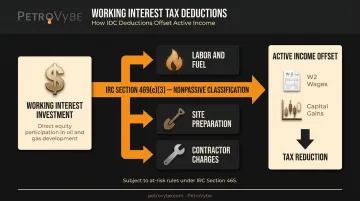
The practical implication for high earners: IDC deductions can reduce W2 wages and capital gains in the year incurred, providing immediate tax relief that passive real estate losses cannot.
The Depletion Allowance as an Ongoing Benefit
Beyond the upfront IDC deduction, oil and gas investors benefit from percentage depletion under IRC Section 613A. For independent producers and royalty owners, the applicable rate on qualified domestic production is generally 15%. Percentage depletion can even exceed the property's adjusted basis—unlike cost depletion—providing a recurring reduction in taxable income that compounds over the life of the asset. (Note: excess percentage depletion can create an AMT preference under IRC Section 57.)
PetroVybe's Performance in Practice
PetroVybe, a Texas-based natural gas development company operating in Lavaca County, structures direct partnership investments that deliver documented first-year IDC deductions against active income. Partners who invested in 2024 received a 91% tax deduction against active income; in 2025, that figure reached 94%—validated through K-1 documentation and independent engineering review.

For high-W2 earners or investors managing a capital gains event, a direct position in natural gas development can substantially cut the tax burden in year one — while building a long-term, production-backed income stream. PetroVybe's minimum investment is $100,000, limited to accredited investors.
This is not tax advice. Consult your CPA or tax attorney to evaluate how oil and gas IDC deductions apply to your specific situation.
Frequently Asked Questions
What is corporate passive income?
Corporate passive income is income earned by a corporation or its shareholders from activities in which they do not materially participate under IRS standards. It includes rental income, interest, dividends, royalties, and limited partnership distributions—each subject to different rules under IRC Section 469 and related regulations.
How can I make $10,000 a month in passive income?
Reaching $10,000/month requires deploying capital into income-producing assets—rental portfolios, dividend holdings, or direct positions in energy development projects. Tax structuring matters as much as the asset itself: passive income rules and the NIIT can claim 23.8% or more of your return before it reaches you, so the vehicle's tax treatment is part of the return calculation.
What is the passive activity loss rule and how does it affect corporations?
Under IRC Section 469, passive activity losses can only offset passive activity income—not active business income or wages. Suspended losses carry forward indefinitely until the investment generates passive income or you dispose of it in a fully taxable transaction. Corporations subject to Section 469 track these on Form 8810.
What is the 3.8% Net Investment Income Tax and who is subject to it?
The NIIT is a surtax under IRC Section 1411 applied to net investment income—including passive income—for individuals whose MAGI exceeds $200,000 (single) or $250,000 (married filing jointly). Active income from material participation is excluded, making participation status a meaningful planning lever.
Can passive losses offset active income like W2 wages?
Under standard rules, no. Passive losses cannot reduce W2 wages or active business income. However, direct oil and gas working interests generate IDC deductions that are specifically not confined to passive income—making them one of the few structures where an investment deduction can reduce active income tax liability in the year incurred.
How does oil and gas investing generate deductions against ordinary income?
Because a qualifying oil and gas working interest is nonpassive under IRC Section 469(c)(3), its deductions can offset W2 wages and capital gains—not just passive income. Those deductions are driven by IDCs (intangible drilling costs: labor, fuel, contractor charges), which are fully deductible in the year incurred under IRC Section 263(c), subject to at-risk rules and other limitations.