
Introduction
Taxes don't announce themselves. For high-income earners, they quietly compound — year after year — until the cumulative drag becomes impossible to ignore. Morningstar reports a 1.26% median tax-cost ratio for U.S. large-blend funds, measuring the percentage-point reduction in annualized returns caused by taxes alone. At the highest federal brackets, that drag is larger and more consistent.
This guide serves two purposes: define what a tax portfolio actually is — both taxable and tax-managed — and give high-income investors a practical framework for keeping more of what they earn.
The themes covered here apply year-round:
- How your portfolio is structured across account types
- Which tax rates apply to which income categories
- Strategies like tax-loss harvesting and asset location
- Where alternative investments like oil and gas development fit in
For investors in the top brackets, each of these decisions compounds — in your favor or against it.
Key Takeaways
- Managing a tax portfolio with intention — not just awareness — increases after-tax wealth
- Holding periods determine your tax rate: short-term gains are taxed up to 37%; long-term gains top out at 20%
- Tax-loss harvesting, wash sale avoidance, and qualified dividends are the foundational tools of taxable portfolio management
- Accredited investors in oil and gas development can deduct IDCs directly against active income, including W2 earnings — a benefit stocks and bonds can't match
- Tax management is a year-round discipline, not a tax-season event
What Is a Tax Portfolio?
A tax portfolio refers to any collection of investment assets held in accounts subject to taxation on income and capital gains — as distinct from tax-advantaged accounts like IRAs or 401(k)s. Nearly every accredited investor has one, whether they manage it deliberately or not.
What Is a Taxable Portfolio?
A taxable portfolio includes brokerage accounts, direct investments, and other holdings where gains, dividends, and interest are taxed in the year they're realized. This contrasts with:
- Tax-deferred accounts (traditional IRA, 401k) — taxes owed on earnings until distribution
- Tax-exempt accounts (Roth IRA) — contributions made after-tax; qualified distributions generally tax-free
Because taxes are assessed annually on realized events — not deferred — taxable portfolios require their own management strategy. High-income W2 earners, investors with significant capital gains, and accredited investors generating meaningful taxable income each year have the most to gain from getting that strategy right.
What Is a Tax-Managed Portfolio?
A tax-managed portfolio is one where investment decisions are made with after-tax outcomes as a primary goal — not just pre-tax returns. Holding periods, income type, asset location, and loss harvesting are all active levers.
Vanguard's 2025 research modeled three approaches for a highest-bracket household. Projected median annualized after-tax returns over 10-year simulations:
| Portfolio Approach | After-Tax Return |
|---|---|
| Tax-agnostic (taxable bonds only) | 5.0% |
| Ad hoc (municipal bonds only) | 5.2% |
| Tax-aware (blend of both) | 5.5% |
On $100,000 compounded over 10 years, the difference between 5.0% and 5.5% is roughly $7,925. That's the arithmetic cost of ignoring tax-aware construction.
Why Tax Efficiency Is a High-Income Investor's Most Powerful Lever
Not all investment income is taxed equally. Understanding which rates apply to which income type is the foundation of any tax-efficient strategy.
2026 Federal Tax Rates at a Glance
| Income Type | 2026 Federal Rate |
|---|---|
| Ordinary income (top bracket) | 37% above $640,600 (single) / $768,700 (MFJ) |
| Short-term capital gains | Same as ordinary income — up to 37% |
| Long-term capital gains | 0% / 15% / 20% depending on taxable income |
| Qualified dividends | Same rate structure as long-term gains |
| Net Investment Income Tax (NIIT) | 3.8% on investment income above MAGI thresholds |
Sources: IRS 2026 inflation adjustments; IRS Topic 409
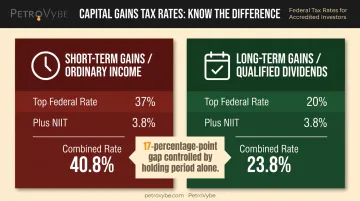
Combined with NIIT, top-bracket investors can face 40.8% on short-term gains and ordinary investment income. Long-term gains and qualified dividends reach 23.8% before state taxes — a 17-percentage-point gap that holding period alone controls.
After-Tax Return: The Metric That Should Drive Decisions
A 10% gross return taxed at 40% yields 6%. A 7% return taxed at a preferential 20% rate yields 5.6%. In some scenarios, the lower-gross-return investment actually puts more money in your pocket. That's the after-tax return lens every high-income investor should apply before making allocation decisions.
Core Strategies for Managing a Tax-Efficient Portfolio
Holding Periods and Capital Gains Rates
The IRS defines long-term treatment as assets held more than one year. The rate difference at the top bracket:
- Short-term: Up to 37% federal (40.8% with NIIT)
- Long-term: 20% federal (23.8% with NIIT)
On a $100,000 gain, that's a $17,000 difference in federal tax owed — driven entirely by whether you hold past the one-year mark. Few decisions in portfolio management are this mechanical and this consequential.
Tax-Loss Harvesting: Turning Market Volatility Into a Tax Asset
Tax-loss harvesting means selling investments at a loss to offset realized gains elsewhere, reducing your net taxable gain. It creates harvesting opportunities that a systematic approach can capture consistently throughout the year.
The wash sale rule: Selling a security at a loss and repurchasing the same or substantially identical security within 30 days before or after the sale disallows the loss. The 61-day window is controlling. To preserve the loss, wait 31+ days or substitute a similar but non-identical security.
Vanguard's July 2024 simulations estimated annualized TLH alpha of 0.47% to 1.27% over a projected 15-year horizon under optimal behavior — but suboptimal behavior (such as December-only harvesting) produced only 0.04% to 0.13%. Systematic, year-round monitoring is what generates meaningful results.
Favoring Qualified Dividends and Tax-Exempt Income
Two income types receive preferential tax treatment worth prioritizing:
- Qualified dividends — taxed at the same 0%/15%/20% structure as long-term gains, rather than as ordinary income. The stock must generally be held more than 60 days during the 121-day period surrounding the ex-dividend date.
- Municipal bond interest — generally excluded from federal gross income under IRC Section 103, making munis particularly attractive in higher brackets.
One caution: Vanguard's tax-aware model still retained a nonzero taxable-bond allocation alongside munis to preserve diversification. Concentrating entirely in munis introduces credit and concentration risk that can offset the tax benefit.
Asset Location Strategy
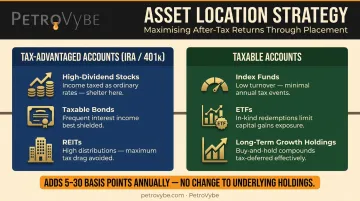
Asset location places tax-inefficient assets in the right accounts:
- Tax-advantaged accounts (IRA, 401k): High-dividend stocks, taxable bonds, REITs
- Taxable accounts: Index funds, ETFs, long-term growth holdings
Vanguard's modeling found thoughtful asset location adds approximately 5 to 30 basis points annually depending on circumstances — without changing the underlying investment allocation. That range of improvement comes with no change to your underlying holdings — making it one of the more efficient levers available.
Tax-Advantaged Alternative Investments for High-Income Earners
Beyond the standard portfolio toolkit, certain alternative investments carry statutory tax advantages that can substantially reduce taxable income — particularly against active income like W2 earnings. These are deliberate policy incentives written directly into the U.S. tax code.
Oil and Gas Development: A Tax Advantage Most Investors Overlook
Under IRC Section 263(c), investors in qualifying oil and gas development projects can elect to deduct Intangible Drilling Costs (IDCs) — wages, fuel, engineering services, drilling, and related expenses — directly against active ordinary income in the year they are incurred.
The critical distinction: this deduction is not restricted to passive income. Unlike real estate depreciation, which is confined to passive income for most investors, oil and gas IDCs can offset:
- W2 wages
- Capital gains
- Other active income sources
This positions oil and gas IDCs as one of the few deductions available directly against primary earned income — a gap that most conventional tax vehicles can't fill.
What real-world execution looks like: PetroVybe, a Texas-based oil and gas development company that offers accredited investors direct equity participation in upstream energy projects, documented that partners achieved a 94% tax deduction against active income in 2024 and 91% in 2025 — both applied via K-1 tax documentation. The company's projected baseline for first-year deductions is approximately 70%, with up to 100% total deduction available over the life of the investment.
On a $100,000 investment, that translates to a $60,000–$80,000 deduction in year one against active income. PetroVybe's documentation shows this can produce a 21% cash-on-cash-equivalent return from the tax benefit alone — before any production income is factored in.
Who benefits most:
- High W2 earners — physicians, executives, business owners — who need to shelter active income
- Investors facing a capital gains event (business sale, equity liquidation, stock portfolio)
- Accredited investors in high-tax states where combined federal and state rates push effective rates above 50%
PetroVybe requires a minimum investment of $100,000 and restricts participation to verified accredited investors — those with net worth exceeding $1M (excluding primary residence) or income above $200,000 individually/$300,000 jointly.
Before investing, note these caveats:
- Basis and at-risk rules limit how much loss can be claimed in a given year
- AMT exposure can reduce or eliminate the deduction for some investors
- Project-specific cost classification affects the final deductible amount
- A qualified CPA or tax attorney should review your situation before committing capital
Common Tax Portfolio Mistakes That Cost Investors Thousands
Most of these errors don't show up as obvious losses. They show up in April, when the tax bill is larger than it needed to be. Three patterns account for a disproportionate share of the damage.
1. Waiting until year-end to think about taxes
The biggest harvesting opportunities tend to surface mid-year — during market dips, rebalancing events, or when a position crosses into long-term territory. Vanguard's tax-loss harvesting research shows that reactive, year-end-only timing can reduce the strategy's value by 90% or more compared to systematic, year-round monitoring. The calendar shouldn't dictate your tax moves; your portfolio should.
2. Treating tax efficiency as the primary goal
Concentrating heavily in municipal bonds to minimize taxable income is a common overcorrection. The tax savings are real, but so is the concentration risk. Tax efficiency should reinforce your investment strategy. When it starts overriding it — when you're turning down better risk-adjusted returns to protect a tax position — that's a portfolio mistake in its own right.
3. Calculating federal rates while ignoring state taxes
Federal rates dominate most tax planning conversations, but state income taxes can shift your combined marginal rate dramatically. According to the Tax Foundation, top statutory state rates for 2026 include:
- California: 13.3%
- Hawaii: 11.0%
- New York: 10.9%
An investor in California earning W2 income in the top federal bracket is looking at a combined marginal rate above 50%. Any investment decision that doesn't account for the full combined rate — federal plus state — is working from an incomplete picture.
How to Build and Monitor Your Tax Portfolio Year-Round
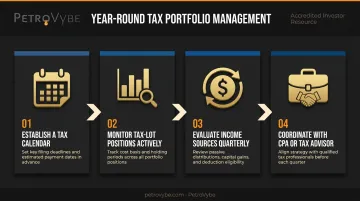
A practical framework for year-round management:
- Establish a tax calendar — set quarterly review checkpoints, not just year-end reviews
- Monitor tax-lot positions actively — track unrealized gains and losses in real time; don't wait for market dislocations to discover opportunities
- Evaluate income sources quarterly — rebalance toward more tax-efficient vehicles as circumstances evolve
- Coordinate with a CPA or tax advisor — especially before entering alternative investments with specific IRS qualification requirements (oil and gas IDC elections, AMT considerations, at-risk rule analysis)
Tax portfolio management is inherently dynamic. Tax laws change. Income situations evolve. Market conditions create new harvesting or repositioning opportunities throughout the year. A strategy set once and ignored is one that costs you — in taxes paid, deductions missed, and positions left unoptimized.
Frequently Asked Questions
What is a taxable portfolio?
A taxable portfolio is a collection of investments held in standard brokerage or direct investment accounts. Gains, dividends, and interest income are taxed in the year they are realized — unlike tax-advantaged retirement accounts, where taxation is deferred or eliminated.
What is a tax-managed portfolio?
A tax-managed portfolio is one where investment decisions (asset selection, holding periods, income type, and rebalancing) are made with after-tax outcomes as a primary goal, not just pre-tax returns. The objective is maximizing what the investor actually keeps.
What are the best tax-advantaged investments for high-income earners?
Common options include municipal bonds, long-term equity holdings, and tax-deferred retirement accounts. Alternative investments such as oil and gas development can also offer first-year deductions against active ordinary income — something most traditional vehicles cannot match.
How does tax-loss harvesting work?
Tax-loss harvesting involves selling underperforming investments at a loss to offset realized capital gains elsewhere in the portfolio, reducing net taxable gain. Investors must avoid the IRS wash sale rule: repurchasing the same or substantially identical security within 30 days before or after the sale disallows the loss.
Can oil and gas investments reduce my ordinary income tax?
Yes. Qualifying oil and gas investments allow investors to deduct Intangible Drilling Costs (IDCs) against active ordinary income — including W2 wages — under IRC Section 263(c). This is a statutory IRS provision, not a loophole, and it distinguishes oil and gas from passive-only deductions available in most other alternative asset classes.
What is the difference between short-term and long-term capital gains for tax purposes?
Short-term gains (assets held one year or less) are taxed at ordinary income rates up to 37% federally, plus 3.8% NIIT for high earners. Long-term gains (held more than one year) qualify for preferential rates of 0%, 15%, or 20%. Holding period is one of the most directly controllable tax levers available to investors.