

For high-income investors and those managing concentrated portfolios, these schemes do something that most investment strategies cannot: they reduce your tax bill before a single penny of return is generated.
But the rules are detailed, the eligibility conditions are strict, and a single misstep can trigger a clawback from HMRC. This guide breaks down how each scheme works, what tax benefits are available, who qualifies, and how to choose the right structure for your goals — in plain English.
Key Takeaways
- EIS provides 30% income tax relief on up to £1 million invested annually, plus full CGT exemption after a three-year hold
- SEIS offers the highest relief rate — 50% on up to £200,000 per year — targeting the earliest-stage companies
- VCT delivers 20% income tax relief (effective April 2026), tax-free dividends, and no CGT on disposal
- All three schemes carry minimum holding periods; selling early or breaching qualifying conditions triggers HMRC clawback
- Investors can use all three schemes within the same tax year, subject to each scheme's individual annual limits
What Are UK Investment Tax Reliefs and Why Do They Matter?
What Are US Energy Investment Tax Reliefs and Why Do They Matter?
US energy investment tax reliefs are IRS-recognized incentives that reduce your income tax liability in the year you invest by directing capital toward domestic oil and natural gas development. The mechanism is direct: qualifying expenditures offset active income — including W2 wages and capital gains — in ways most other investment vehicles cannot match.
Two primary deduction categories apply to direct energy investments:
- Intangible Drilling Cost (IDC) deductions — typically 65–80% of your total investment, deductible against active income in year one
- Tangible cost deductions — the remaining capital costs depreciated over time under standard IRS schedules
Each structure has specific rules governing investor accreditation status, project qualification, and holding period requirements. Consult a qualified tax advisor before committing capital.
Enterprise Investment Scheme (EIS) Explained
EIS is the workhorse of the three schemes. It targets established-but-early-stage companies and offers upfront relief, CGT benefits, and loss protection that make it popular with experienced angel investors.
Income Tax Relief and CGT Benefits
EIS gives investors 30% income tax relief on qualifying investments up to £1 million in a single tax year. That annual limit rises to £2 million if at least £1 million is directed toward HMRC-approved knowledge-intensive companies.
A simple illustration: a £100,000 EIS investment generates £30,000 in income tax relief — reducing your tax bill directly, not just deferring it.
CGT benefits add another layer:
- Shares sold after a minimum three-year hold are completely exempt from CGT, provided income tax relief was claimed and not withdrawn
- EIS deferral relief allows a capital gain from selling any other asset to be reinvested into EIS shares, postponing the CGT liability indefinitely — the investment window runs from one year before to three years after the disposal
- Loss relief lets investors set the net loss (after deducting income tax relief already received) against income rather than only against capital gains, reducing the real cost of a failed investment
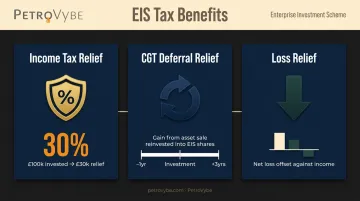
Consider what this means in practice: invest £100,000, receive £30,000 in income tax relief, and your net exposed capital drops to £70,000 before loss relief even applies. If the company fails, that downside shrinks further. EIS is one of the few investment structures where failure still has a tax-sheltered floor.
EIS Eligibility Rules for Investors and Companies
Investor requirements:
- Shares must be newly issued and paid in full in cash
- You cannot be employed by, or hold more than 30%, of the company
- Shares must be held for at least three years
- Directors can qualify under specific unpaid director exceptions
Company requirements (updated from April 2026):
- Gross assets must not exceed £30 million before share issue (raised from £15 million)
- Fewer than 250 full-time equivalent employees
- Company must be within seven years of its first commercial sale
- Annual fundraising cap of £10 million (£20 million for knowledge-intensive companies)
- Lifetime fundraising cap of £24 million (£40 million for knowledge-intensive companies)
Excluded trades include financial services, legal and accountancy services, property development, farming, and certain energy activities. If the target company operates in any of these areas, EIS relief will not be available.
Seed Enterprise Investment Scheme (SEIS) Explained
SEIS offers the highest relief rate of any UK investment scheme: 50% income tax relief on up to £200,000 invested annually. It targets investors willing to back companies at their earliest stage — before revenue, before customers, often before a finished product.
CGT benefits under SEIS work differently from EIS:
- Gains on SEIS shares are exempt from CGT after a three-year hold (subject to conditions)
- Up to 50% of the invested amount can be offset against capital gains arising in the same tax year — so investing the full £200,000 can support up to £100,000 of CGT reinvestment relief on a separate gain in the same year
This CGT reinvestment feature is an exemption, not a deferral — the gain is extinguished, not postponed.
How SEIS Differs from EIS and Who Qualifies
SEIS targets significantly smaller and younger companies than EIS. The eligibility thresholds reflect that difference directly:
| Criteria | SEIS | EIS |
|---|---|---|
| Maximum gross assets | £350,000 | £30 million |
| Maximum employees | 25 FTEs | 250 FTEs |
| Maximum trading age | Under 3 years | Within 7 years of first commercial sale |
| Maximum total raise | £250,000 | £24 million (lifetime) |
| Prior EIS/VCT investment | Not permitted | Permitted |
| Income tax relief rate | 50% | 30% |
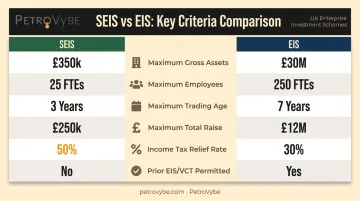
One sequencing rule applies: a company can raise under SEIS first, then progress to EIS for further funding rounds. The reverse is not permitted — a company cannot receive EIS or VCT investment before SEIS.
Investor eligibility mirrors EIS: shares must be fully paid in cash, the three-year minimum hold applies, and the investor cannot be connected with the company. The higher relief rate reflects the elevated failure rate at seed stage. It is a risk premium built directly into the tax structure.
Venture Capital Trusts (VCT) Explained
A VCT is a quoted investment fund — broadly similar to an investment trust — that pools investor capital and deploys it across a portfolio of small, unquoted trading companies. The critical structural difference from EIS and SEIS: you do not pick individual companies. The VCT manager makes every investment decision on your behalf.
This managed approach suits investors who want exposure to the early-stage growth sector without the due diligence burden of direct company selection.
Income Tax Relief, Dividends, and CGT Rules
From 6 April 2026, VCT income tax relief is 20% — reduced from 30% under Finance Act 2026. The relief applies to investments in newly issued VCT shares up to £200,000 per tax year.
The full VCT tax package:
- 20% income tax relief on up to £200,000 of newly issued shares annually
- Tax-free dividends — VCT distributions are received free of income tax
- No CGT on disposal — this exemption applies to both newly issued and second-owner shares
The five-year minimum hold is a condition of retaining the upfront income tax relief, not a condition of the CGT exemption. The CGT-free treatment on disposal applies regardless of how long shares are held.
VCT Eligibility and the April 2026 Rule Changes
The reduction in VCT income tax relief from 30% to 20% is the headline change from April 2026. For investors who relied on the higher rate in their return calculations, this matters. The Association of Investment Companies has called publicly for the 30% rate to be reinstated, though no reversal has been announced.
The same expanded company investment limits introduced for EIS now apply to VCT portfolio companies — the £30 million gross assets threshold, £10 million annual cap, and £24 million lifetime cap. This gives VCT managers scope to invest in a wider range of scaling businesses than was previously possible.
Investor-side requirements:
- Must be 18 or older
- Must hold newly issued shares for at least five years to retain income tax relief
- Relief applies only to newly issued shares — buying VCT shares on the secondary market does not qualify for the 20% income tax relief (though dividend and CGT exemptions still apply to second-owner shares)
- No single holding can exceed 15% of the VCT's total investments by value — corporate groups count as one company for this purpose
Comparing EIS, SEIS, and VCT: Which Scheme Fits Your Investment Goals?
No single scheme is universally superior. The right choice depends on your risk tolerance, tax position, investment timeline, and appetite for hands-on due diligence.
| SEIS | EIS | VCT | |
|---|---|---|---|
| Income tax relief | 50% | 30% | 20% |
| Annual investor limit | £200,000 | £1 million (£2M for KICs) | £200,000 |
| Minimum hold | 3 years | 3 years | 5 years (for relief) |
| CGT on gains | Exempt | Exempt | Exempt |
| CGT deferral | No | Yes (any asset) | No |
| Tax-free dividends | No | No | Yes |
| Investment approach | Direct | Direct | Managed fund |
| Company stage | Pre-revenue / seed | Early-stage | Diversified portfolio |
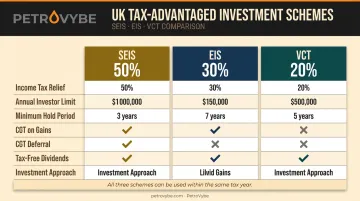
A practical framework:
- SEIS suits investors backing pre-revenue businesses who want maximum upfront relief and accept the highest failure risk
- EIS suits investors who want meaningful relief (30%), CGT deferral flexibility, and the ability to target specific companies or knowledge-intensive sectors
- VCT suits investors who prefer professional management, ongoing tax-free income, and portfolio diversification without individual company exposure
Critically, all three schemes can be used in the same tax year. An investor could claim EIS relief on up to £1 million, SEIS relief on £200,000, and VCT relief on £200,000 simultaneously — HMRC's Self Assessment form has separate boxes for each. There is no combined cap across schemes.
A note for US-based investors: EIS, SEIS, and VCT are UK-specific frameworks with no direct US equivalent. Accredited investors in the United States access comparable tax efficiency through different mechanisms — oil and gas direct participation, for example, allows investors to deduct intangible drilling costs (IDCs) against active income, including W-2 earnings and capital gains, often generating first-year deductions of approximately 70%. Companies like PetroVybe structure these projects specifically for accredited investors seeking that kind of upfront tax advantage.
Frequently Asked Questions
What is tax relief on investments?
Investment tax relief is a government-sanctioned reduction in your income tax or capital gains tax bill, awarded in exchange for investing in qualifying businesses or funds. The specific percentage and conditions vary by scheme — EIS, SEIS, and VCT each have their own rules, limits, and holding requirements.
How can investors legally reduce income tax on investments?
UK investors can reduce income tax through EIS (30% relief), SEIS (50% relief), or VCT (20% relief). US investors can use structures like oil and gas IDC deductions against active income. These are legitimate government incentives — not avoidance — but eligibility conditions must be met in full to retain the benefit.
What is the difference between EIS and SEIS?
SEIS targets the earliest-stage companies (under three years old, gross assets under £350,000, maximum raise of £250,000) and offers 50% income tax relief. EIS covers more established early-stage companies, with 30% relief on investments up to £1 million per year. Within the same company, SEIS must always precede EIS.
How long do I need to hold EIS or SEIS shares to keep the tax relief?
Both EIS and SEIS require a minimum three-year holding period. VCT requires five years to retain the upfront income tax relief. If shares are sold early or the company loses its qualifying status before the minimum period, HMRC can withdraw the tax relief already granted.
Can I invest in EIS and VCT in the same tax year?
Yes. Investors can use multiple schemes simultaneously within the same tax year, subject to each scheme's individual annual limits. HMRC's Self Assessment return has separate boxes for EIS and VCT subscriptions, and no combined cap applies across the two schemes.
What happens to my tax relief if an EIS company fails?
EIS loss relief lets investors set the net loss — after deducting income tax relief already received — against income, not just capital gains. Because income tax rates typically exceed CGT rates, this significantly cuts the real cost of a failed investment versus an unrelieved loss.