Introduction
For investors approaching retirement, the central challenge isn't growth — it's cash flow. Drawing down principal to cover living expenses introduces sequence-of-returns risk; one bad year early in retirement can permanently impair a portfolio. Income funds offer a different path: regular distributions from a diversified pool of assets, without forcing asset sales to generate cash.
For retirees, near-retirement savers, and conservative investors, income funds have become a core portfolio tool. Rather than selling assets to fund living expenses — which introduces sequence-of-returns risk and potential principal erosion — income fund investors receive periodic distributions directly from their holdings.
What follows breaks down the main types of income funds, how they compare, and what to evaluate before committing capital — including how accredited investors can access income-generating alternatives that fall outside traditional fund structures entirely.
Key Takeaways
- Income funds generate regular distributions through interest, dividends, or asset cash flows — not capital appreciation.
- The main types include bond funds, equity income funds, money market funds, and alternative income vehicles like REITs and direct participation programs.
- Risk profile, yield, and tax treatment vary significantly across types — match your selection to your income goals and tax situation.
- Bond and equity income funds carry interest rate and dividend cut risk respectively; income funds are not risk-free.
- Direct participation programs in oil and gas development offer accredited investors both passive income potential and substantial tax deductions against active income.
What Is an Income Fund?
An income fund is an investment vehicle — structured as a mutual fund, ETF, closed-end fund, or unit investment trust — whose primary objective is generating current income rather than long-term capital appreciation. According to Investor.gov, bond and income funds may be organized across all four of these structures.
"Current income" refers to payments received on a recurring basis — monthly or quarterly — generated through interest from bonds, dividends from stocks, or distributions from other income-producing assets. This contrasts with growth funds, which reinvest all earnings to maximize future share price.
Income funds hold a mix of assets depending on their mandate:
- Government and corporate bonds (interest-bearing)
- Dividend-paying equities (consumer staples, utilities, financials)
- Preferred shares and money market instruments
- In some cases, real assets like real estate or energy production
For investors prioritizing regular cash flow over accumulation, the fund's structure determines how reliably — and how much — it pays out.
Why Income Funds Matter for Investors
Income funds serve a specific function: they pay investors regularly, which removes the need to sell holdings to fund expenses.
Without a clear income strategy, investors face a real problem. Selling assets to cover living costs during a market downturn means liquidating positions at depressed prices — locking in losses and leaving fewer assets to participate in any eventual recovery. Morningstar identifies historical multiyear equity-loss sequences — including 1973-1974 and 2000-2002 — as examples of how early-retirement drawdowns can permanently impair a portfolio.
Income funds reduce that pressure by delivering cash flow without requiring asset sales.
Beyond protecting cash flow, income funds also reduce portfolio volatility. Holding income-generating assets alongside equity-heavy growth positions smooths overall swings — so a bad market year doesn't force both portfolio losses and asset sales simultaneously.
That combination matters more than most investors expect. According to the EBRI's 2025 Retirement Confidence Survey, 73% of retirees cited personal savings and investments as an income source — meaning for most people, the portfolio itself has to pull double duty as both a growth engine and a distribution machine. Income funds are one way to structure that without selling into weakness.
Types of Income Funds
Income funds span multiple distinct categories, each differentiated by the assets they hold, the yield they offer, the risk they carry, and the investor they suit best.
Bond Funds
Bond funds pool capital to buy a diversified portfolio of fixed-income securities (Treasuries, municipal bonds, or corporate bonds) and pass interest coupon payments through to investors regularly.
Current yield context (July 2026 examples):
| Fund | 30-Day SEC Yield | Effective Duration | Expense Ratio |
|---|---|---|---|
| iShares 1-3 Yr Treasury (SHY) | 4.03% | 1.87 years | 0.15% |
| iShares IG Corporate (LQD) | 5.33% | 7.87 years | 0.14% |
| iShares High Yield (HYG) | 6.49% | 2.99 years | 0.49% |
| iShares National Muni (MUB) | 3.35% | 6.33 years | 0.05% |
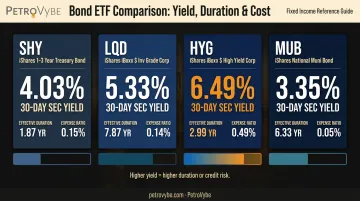
These are fund-specific examples, not category averages — yields change frequently.
Interest rate risk is the core concern here. FINRA explains that a one-percentage-point rate increase produces an approximate price decline equal to the fund's duration, so a duration-8 fund loses roughly 8% in NAV.
Bond funds suit conservative investors prioritizing capital preservation and predictable income. Municipal bond funds are particularly relevant for high-income earners: IRS Publication 550 confirms that interest on state and local government obligations is generally exempt from federal income tax.
Limitations to weigh: credit risk in lower-rated corporate bond funds, and the real possibility that yields don't outpace inflation over long periods.
Equity Income Funds
Equity income funds invest in stocks of companies with consistent dividend-paying histories — utilities, consumer staples, healthcare, financials — targeting regular dividend income alongside modest capital growth.
Current yield examples (June 2026):
- Vanguard VYM: 2.25% (30-day SEC yield)
- iShares HDV: 3.14% (30-day SEC yield)
- iShares DVY: 3.56% (30-day SEC yield)
Dividends are not guaranteed. S&P Dow Jones Indices reported a $42.5 billion net decrease in U.S. indicated dividend payments during Q2 2020 — the worst quarter since Q1 2009. Equity income funds also experience drawdowns during broad market sell-offs, reducing both income and capital value simultaneously.
These funds work best for investors with moderate risk tolerance who want income with some upside participation — popular among retirement-age investors seeking mild capital growth alongside regular distributions.
One limitation to keep in mind: dividend income is less predictable than bond coupon payments, and total return depends on both yield and share price movement.
Money Market Funds
Money market funds invest in very short-term, high-quality instruments — Treasury bills, certificates of deposit, commercial paper — maintaining a stable $1 NAV while generating modest interest income.
SEC-reported category yields (May 2026, gross):
- Government money market: 3.68%
- Prime institutional: 3.79%
- Prime retail: 3.80%
Net yields are lower after fees. These are also uninsured: FINRA confirms money market funds carry no FDIC or NCUA deposit insurance. In extreme stress scenarios, NAV can fall below $1 per share — known as "breaking the buck," which occurred with the Reserve Primary Fund during the 2008 financial crisis.
Money market funds serve a specific purpose: emergency reserves, short-term capital awaiting deployment, or the most conservative slice of a portfolio. Yields are the lowest among income fund types, and these are cash management tools rather than wealth-building strategies.
Alternative Income Funds and Direct Income Investments
This category includes REITs, MLP funds, preferred stock funds, and direct participation programs — income vehicles tied to real asset cash flows rather than corporate earnings or interest rates.
REIT yield context (July 9, 2026):
- FTSE Nareit All Equity REITs: 3.64% dividend yield
- All Equity REITs: 6.66% compound annual total return over 20 years
IRS rules require REITs to distribute at least 90% of taxable income to shareholders. Ordinary REIT dividends are taxed as ordinary income, though eligible investors may deduct up to 20% of qualified REIT dividends under the QBI rules.
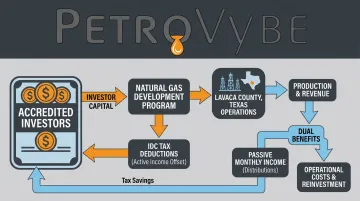
Direct participation programs — structured as limited partnerships — go further than any registered fund structure can. Oil and gas development investments in this category can deliver income from real energy production alongside substantial tax deductions unavailable through ETFs, REITs, or MLPs.
PetroVybe's natural gas development program in Lavaca County, Texas, for example, provides accredited investors with monthly passive distributions and Intangible Drilling Cost (IDC) deductions that partners have applied against active income, including W-2 wages and capital gains. In 2024, PetroVybe partners achieved a 94% tax deduction against active income, up from 91% in 2025.
That deduction comes from IRC Section 263(c) and IRS Publication 535, which permit qualifying oil and gas working interest investors to deduct drilling costs in the year they're incurred — a treatment not available through mutual funds, ETFs, REITs, or MLPs.
Alternative income investments carry higher complexity, lower liquidity, and greater concentration risk than diversified funds. Direct participation programs require accredited investor status, higher minimum commitments, and a longer time horizon before distributions begin.
How to Choose the Right Income Fund for Your Goals
The right income fund isn't determined by which fund is most popular — it's determined by your specific financial priorities.
Match Purpose to Fund Type
- Supplementing retirement expenses: Stable, predictable distributions favor bond funds or equity income funds.
- Building long-term passive income: Higher-yield or alternative income vehicles may justify accepting more complexity.
- Parking short-term capital: Money market funds prioritize liquidity and capital stability over yield.
Consider Tax Efficiency
How income is taxed matters as much as the yield itself. For 2025:
- Top ordinary income rate: 37% (above $626,350 single / $751,600 married filing jointly)
- Qualified dividends: Taxed at 0%, 15%, or 20% — significantly lower than ordinary income rates
- Municipal bond interest: Generally exempt from federal income tax
- Direct oil and gas IDC deductions: Can offset active income including W-2 earnings — an advantage no conventional income fund structure can replicate
A high-income earner paying a 37% marginal rate who receives qualified dividends instead of ordinary interest income keeps meaningfully more of each dollar distributed.
Compare Costs Carefully
Expense ratios compound into significant differences over time. ICI's 2024 data shows:
| Fund Category | Average Expense Ratio |
|---|---|
| Active bond mutual funds | 0.47% |
| Index bond mutual funds | 0.05% |
| Active bond ETFs | 0.22% |
| Index bond ETFs | 0.10% |
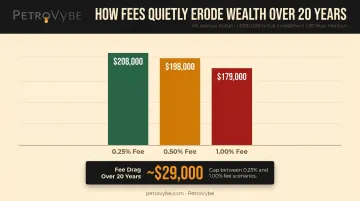
Investor.gov illustrates the impact: $100,000 earning 4% annually over 20 years results in approximately $208,000 at a 0.25% fee, $198,000 at 0.50%, and $179,000 at a 1.00% fee. A 0.75% difference in annual fees quietly erases nearly $29,000 in wealth — before taxes.
Determine Distribution Needs
- Need spendable cash flow now? Prioritize funds with monthly or quarterly distribution schedules.
- Reinvesting to compound? Many funds offer DRIPs (dividend reinvestment programs) that automatically redeploy distributions.
- Investing in direct participation programs? Confirm the distribution schedule upfront — payments are often tied to production cycles rather than calendar quarters, which affects cash flow planning.
What to Check Before Finalizing Your Income Fund Choice
Before committing to any income fund, three factors separate investors who keep what they earn from those who chase numbers that look better on paper than they are in practice.
Yield without context is a red flag. A fund advertising 8%+ when comparable funds yield 4–5% is typically achieving it through lower-credit bonds, concentrated sector exposure, or return-of-capital distributions. HYG's 6.49% yield comes alongside Moody's-reported speculative-grade default rates — these numbers coexist for a reason. High distribution rates mean little when NAV erodes steadily underneath them.
Net return is the only number that matters. Gross yield minus expense ratio minus tax drag minus any management fees or carried interest gives you what you actually keep. Most investors fixate on the top-line yield and overlook the gap between what a fund pays and what they pocket.
Match fund type to your actual situation — not to what's most familiar or most widely held. The right choice depends on your tax bracket, income timeline, and liquidity needs:
- A municipal bond fund with a lower gross yield may deliver more after-tax income to a high-earner than a higher-yielding corporate fund taxed at ordinary rates
- A direct participation program with a 2–3 year ramp-up before distributions begin is the wrong fit for an investor who needs income next month
- The most popular income fund in a given category is not automatically the most appropriate one for your situation
Conclusion
Income funds span a wide range of vehicles — bond funds, equity income funds, money market funds, and alternative income investments — each built around the same core goal of generating current income, but through different assets, with different risk-return profiles and tax implications.
Understanding those differences is what separates investors who build durable income streams from those who select funds based on yield alone. That means honestly assessing your income goals, risk tolerance, tax situation, and time horizon before you ever look at a fund. The right vehicle becomes clear once you know what you actually need from it.
Frequently Asked Questions
Are income funds a good investment?
Income funds can be a solid choice for investors prioritizing regular cash flow — particularly retirees or those in capital preservation mode. Suitability depends entirely on the individual's risk tolerance, tax situation, and income needs. They are not risk-free and may underperform growth-oriented funds over long time horizons.
What are examples of income funds?
Examples by type: Vanguard Total Bond Market Index Fund (VBTLX) for bonds, T. Rowe Price Equity Income Fund (PRFDX) for equity income, Fidelity Government Money Market Fund (SPAXX) for cash management, and Vanguard Real Estate ETF (VNQ) for REIT exposure. Accredited investors may also access direct participation programs — such as oil and gas development projects — as income-generating alternatives outside conventional fund structures.
How do income funds differ from growth funds?
Income funds distribute earnings — interest, dividends, or production cash flows — to investors on a regular basis for spending or reinvestment. Growth funds reinvest all earnings internally to maximize long-term share price appreciation. The distinction is whether the investor needs current income or is focused on accumulating wealth over time.
What are the main risks of investing in income funds?
Primary risks include interest rate risk (bond prices fall when rates rise), credit risk (bond issuers may default — Moody's reported a 3.3% U.S. speculative-grade issuer default rate in late 2025), dividend cut risk in equity income funds, and inflation risk if distributions don't keep pace with rising living costs.
Are income fund distributions taxable?
Most distributions are taxable in the year received. Bond fund interest is taxed as ordinary income; qualified dividends may qualify for lower capital gains rates; municipal bond interest is generally federal tax-exempt. Direct participation investments operate differently — they can generate deductions that offset active income, including W2 earnings.
Can income funds lose money?
Yes. Bond funds lose NAV when interest rates rise; equity income funds lose value during market sell-offs. The common assumption that bonds and bond funds carry no principal risk is inaccurate. Review each fund's prospectus for a clear disclosure of all applicable risks before investing.