Introduction
Oil and gas production technology used to mean bigger rigs and more horsepower. Today, it means sensors, algorithms, and data pipelines working alongside drill bits. Reservoir characterization, seismic interpretation, and well optimization are increasingly engineering and data problems.
The stakes have changed too. AI data centers and electrification are reshaping electricity demand at a pace the grid hasn't seen in over two decades. The U.S. Energy Information Administration forecasts the strongest four-year growth in electricity demand since 2000.
That shift puts a premium on speed-to-market and production efficiency for natural gas developers.
This article covers the five innovations driving results today, the forces accelerating adoption, and what it means for operators and investors deciding where to put capital next.
Key Takeaways
- AI, IoT, and advanced drilling are boosting exploration accuracy, productivity, and cost efficiency
- Data center electricity demand is pushing gas developers to bring production online faster
- Digital tools are shifting operations from reactive fixes to predictive workflows
- CCUS and methane monitoring are becoming commercial necessities, not just compliance checkboxes
- Early technology adopters gain a measurable edge in well success rates and capital efficiency
Top Oil and Gas Production Technology Innovations
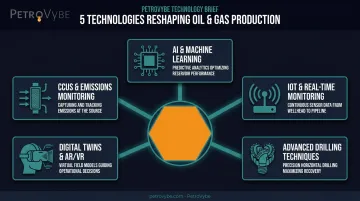
Five categories of technology are doing the most to reshape upstream production right now. Some are mature and fieldwide. Others are still in pilot stages. Here's where each one stands.
Artificial Intelligence and Machine Learning
AI and machine learning are being applied to reservoir characterization, seismic interpretation, and drilling plan optimization across U.S. shale basins. Researchers have used random forest and deep neural network models to predict six-month cumulative oil production from Eagle Ford horizontal wells, ranking which geological and completion variables matter most. In the Permian, operators have trained ML models on data from over 190 electric submersible pump-operated wells to generate autonomous set-point recommendations.
Why this matters: these tools narrow the gap between raw geological data and commercially viable well locations. That gap is where project economics live or die. Human expertise still drives the sharpest results, though. PetroVybe's Chief Geophysicist, Michael Stamatedes, has posted a 75.2% career hit rate on profitable well locations over 48 years , nearly double the industry peer average of below 40%. Technology sharpens judgment; it doesn't replace it.
Internet of Things (IoT) and Real-Time Monitoring
IoT sensors mounted on wellheads, pipelines, and compression equipment now track pressure, temperature, and corrosion continuously, feeding data straight into control rooms instead of waiting for a field technician's next visit. Chevron's Permian pilot from 2020-2021 showed what this can do at scale.
- 80% lower upset flaring and venting volumes
- 40% fewer unplanned well shutdowns
That result came from sensor-to-control loops documented by the American Petroleum Institute, not from dashboards alone. Sensor quality still varies widely, however: a 2023 controlled-release study found detection rates for low-cost methane sensors ranging from 0.3% to 87.7%, with the highest-detecting unit also producing a 79.1% false-positive rate. Coverage isn't the same as reliability.
The impact: fewer surprise shutdowns and faster leak detection translate directly into lower downtime costs and fewer safety incidents.
Advanced Drilling Techniques
Horizontal and extended-reach drilling, paired with multi-well pad development, let operators contact more reservoir from fewer surface locations. Average Permian lateral length grew from under 4,000 feet in 2010 to over 10,000 feet in 2022, according to EIA data. By mid-2021, horizontal wells made up 84-86% of producing wells in the Delaware and Midland basins, and a quarter of new pads held nine wells or more.
The trade-off: fewer pads, roads, and pipelines mean lower surface disturbance and lower per-well development cost, a direct win for both economics and environmental footprint. Automated drilling systems are extending this trend further, though fieldwide adoption data remains limited compared to the well-documented lateral-length gains.
Digital Twins and AR/VR for Operations and Training
Digital twins create virtual replicas of oilfield or refinery assets for simulation, maintenance planning, and training without touching physical equipment. One documented case applied predictive-maintenance digital twin modeling to a U.S. onshore fracturing-truck fleet and cut overall costs by $10 million, according to JPT reporting.
VR training is gaining traction for repeatable, risk-free simulation of hazardous scenarios such as well control incidents, confined-space entry, and equipment failures. Quantified U.S.-onshore cost savings for AR/VR specifically remain harder to pin down than the maintenance numbers above.
Why this matters: simulating a scenario before it happens in the field reduces costly trial-and-error and shortens the runway to get new hires production-ready.
Carbon Capture, Utilization and Storage (CCUS) and Emissions Monitoring
CCUS technology captures CO2 from operations for storage or reuse, often paired with enhanced oil recovery. The Department of Energy committed $17.2 million in 2023 to four projects studying CO2-enhanced recovery from unconventional reservoirs combined with permanent storage: pilot-stage funding, not proof of commercial-scale economics yet.
On the monitoring side, optical gas imaging is now a formal EPA compliance pathway, requiring semiannual surveys at covered facilities, treating 500 ppm as a leak threshold, and mandating repair attempts within 30 days.
The stakes: regulatory pressure and ESG-linked capital access are pushing CCUS and emissions monitoring from optional to expected, especially for operators courting institutional capital.
What's Driving These Oil and Gas Technology Trends
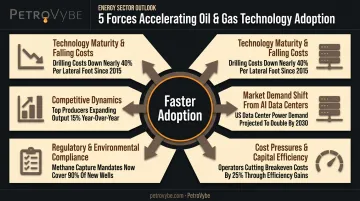
A handful of forces are converging to push adoption faster than in previous decades.
- Technology maturity and falling costs: The U.S. digital oilfield market is projected to grow from $7.62 billion in 2023 to $10.73 billion by 2029, a 5.7% CAGR (ResearchAndMarkets estimate, not audited spending).
- Market demand shift: AI data centers are reshaping gas demand. S&P Global projects data centers will add 3-6 Bcf/d of U.S. gas demand by 2030, with 55-65 GW of new gas-fired capacity expected — roughly double pre-AI estimates.
- Cost pressures and capital efficiency: Operators need the same reserves with fewer wells and lower breakeven costs, which is exactly what longer laterals and multi-well pads deliver.
- Regulatory and environmental compliance: EPA's expanded methane reporting rules, finalized in May 2024, keep pushing monitoring technology adoption forward, even as some compliance deadlines have shifted.
- Competitive dynamics: Operators on the sidelines risk falling behind on cost curves and investor appeal, as capital increasingly flows toward data-validated, de-risked assets.
As PetroVybe CEO Peter Snell puts it: "AI requires data centers, and data centers require one thing above all else: energy."
How These Trends Are Impacting the Oil and Gas Industry
These technologies are reshaping the oil and gas operating model itself, from maintenance schedules to capital allocation decisions.
Operational Impact
Manual, reactive maintenance is giving way to predictive, sensor-driven workflows. Fewer wells and pads are now needed to access comparable reserves, which lowers surface footprint alongside per-barrel development costs. This is the operational logic behind consolidated pad development across the Permian and similar basins.
Business Impact
Tech-enabled operators can demonstrate higher well success rates and stronger project economics, which matters directly to capital partners evaluating development opportunities. Geophysical expertise paired with third-party validated data reduces investment risk in practice.
PetroVybe's model illustrates this: Stamatedes' 75.2% career hit rate combines with independent engineering validation, including a $48 million proved reserves assessment (PV-09) from a licensed third-party firm.
Capital allocation is shifting accordingly:
- Toward digitally mature, data-validated assets
- Away from speculative exploration with unverified projections
- Toward operators who can show real operational metrics, not just growth stories
Workforce Impact
Field roles aren't disappearing, but the skill mix is changing. Demand is rising for data scientists, automation specialists, and remote operations talent alongside traditional drilling and production roles.
Automation and remote monitoring are also reducing on-site headcount needs for routine tasks. This shift shows up in newer leadership titles, like PetroVybe's VP of Asset Intelligence & Performance, a role built around translating operational data into performance decisions rather than pure field execution.
Future Outlook: What to Watch in Oil and Gas Technology
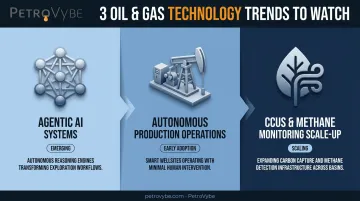
Adoption isn't slowing down. AI infrastructure and data center buildout will keep pushing electricity and natural gas demand for years, and that pressure trickles straight into upstream development timelines. A few things worth tracking:
- Agentic AI systems: Early commentary from the Society of Petroleum Engineers (SPE) describes AI that reasons across operational data and acts on decisions autonomously, with prospective use cases in methane detection and flare optimization. This is expert outlook territory right now, not measured fleetwide adoption.
- Autonomous production operations: Bounded examples already exist, such as ML-driven electric submersible pump (ESP) set-point recommendations in the Permian, though disclosed performance uplifts remain sparse.
- Carbon capture, utilization, and storage (CCUS) and methane-monitoring scale-up: Expect continued growth as compliance requirements and ESG capital expectations tighten further, even amid shifting federal deadlines.
Conclusion
AI, IoT, advanced drilling, digital twins, and CCUS aren't isolated trends. Together, they're changing how oil and gas gets found, produced, and monitored, and the pace is accelerating as AI-driven electricity demand adds urgency to natural gas development.
Operators and investors who understand and back technologically advanced, data-validated development strategies are best positioned to capture value as this shift plays out. PetroVybe applies this same data-first approach to every South Texas and Gulf Coast Basin project, backed by third-party reserve engineering and a chief geophysicist with a 75.2% success rate, well above the industry's sub-40% average.
For accredited investors ready to fuel the AI boom while building legacy wealth, PetroVybe offers direct access to natural gas development projects built on this same technology-driven approach.
Frequently Asked Questions
What are the new technologies in the oil and gas industry?
The leading innovation categories are AI and machine learning, IoT sensors and real-time monitoring, advanced drilling techniques, digital twins, and carbon capture and emissions monitoring (CCUS). Each targets a different part of the production lifecycle, from exploration to environmental compliance.
What is the role of AI in oil and gas production?
AI supports reservoir modeling, seismic interpretation, and predictive maintenance by identifying patterns in geological and production data faster than manual analysis alone. It sharpens decision-making but works best paired with experienced geological judgment.
How does horizontal drilling improve oil and gas recovery?
Horizontal and extended-reach drilling increase reservoir contact per well, letting operators access more resource volume from fewer surface locations. This reduces both the number of wells needed and the associated surface footprint.
What is carbon capture and storage (CCUS) in oil and gas?
CCUS captures CO2 generated during operations and either stores it underground or reuses it, often for enhanced oil recovery. It's increasingly tied to regulatory compliance and ESG-linked capital access rather than treated as optional.
How are digital twins used in the oil and gas industry?
Digital twins create virtual replicas of oilfield or refinery assets for simulation, maintenance planning, and workforce training. One widely cited U.S. onshore case reportedly saved $10 million in maintenance costs on a fracturing-truck fleet using this approach.
Do these new technologies make oil and gas a more attractive investment?
Tech-driven efficiency and higher well success rates can reduce risk and strengthen return potential, particularly when paired with independent, third-party validated data. That combination of proven expertise and verified performance data is what capital partners look for in private development opportunities.