
Get the method wrong and the consequences aren't academic. A misapplied cap rate can inflate a business sale price by millions. An unsupported DCF forecast can unravel under scrutiny in litigation or a tax dispute. In oil and gas, using the wrong approach to value a depleting reserve can mislead investors about how much cash flow actually remains in the ground.
This guide breaks down both methods: how each one works, when to use which, and how professionals apply DCF in practice to value real assets like proved oil and gas reserves.
Key Takeaways
- Income Capitalization divides one normalized earnings period by a cap rate for stable assets
- DCF discounts multiple future cash flows to present value, fitting volatile or growing assets
- Cap rate equals discount rate minus growth; methods converge only with constant growth
- Asset life and stability determine the method: declining assets like oil wells often need DCF
- Choosing correctly prevents under- or overvaluation in deals, tax filings, and litigation
Income Capitalization vs DCF: Quick Comparison
Before diving into mechanics, here's how the two methods stack up side by side:
| Factor | Income Capitalization | DCF |
|---|---|---|
| Complexity | Single-period calculation, straightforward math | Multi-year forecast model, more computationally intensive |
| Time Horizon | Assumes perpetuity based on one representative period | Finite discrete projection plus a terminal value |
| Best Fit | Stable, mature businesses or assets | Volatile, high-growth, or depleting assets |
| Data Requirements | One normalized year of earnings or cash flow | Detailed multi-year projections, including capex and working capital changes |
| Common Applications | Mature small businesses, stabilized income-producing real estate | Startups, litigation damages, natural resource/reserve valuation |
The pattern is simple. Income Capitalization compresses continuing economics into one number, while DCF preserves the differences between year one and year ten. Oil and gas reserve valuations use this same DCF logic, since production volumes decline predictably over a well's life. Which method fits depends entirely on whether those differences actually matter for the asset in front of you.
What is the Income Capitalization Approach?
The Income Capitalization Approach converts a single representative period of normalized income into present value by dividing it by a capitalization rate. In business valuation circles, it's often used interchangeably with "Capitalization of Earnings." It's also a foundational method in real estate appraisal.
The Math Behind It
The logic borrows from the Gordon Growth Model:
Cap Rate = Discount Rate − Expected Long-Term Growth Rate
This assumes the business or asset grows at a steady, perpetual rate forever. Divide one year's normalized cash flow by that cap rate, and you get an estimate of total value. That simplicity is precisely the point.
Core benefit: fewer assumptions mean fewer places for a valuation to be challenged. That makes it easier to defend in negotiations, tax filings, or litigation, where every input gets scrutinized.
Core limitation: the constant-growth assumption is rigid, and it breaks down fast for businesses or assets with fluctuating, seasonal, or declining income streams, such as an oil and gas well following a production decline curve instead of steady growth.
In real estate, this same concept goes by "Direct Capitalization." An appraiser takes stabilized net operating income and divides it by a market-derived cap rate. The math is identical to the business valuation version, just applied to rent rolls instead of earnings.
Use Cases of the Income Capitalization Approach
This method fits best when the numbers are already boring, in the good sense:
- Mature, stable businesses, such as a family-owned company with 15+ years of steady revenue and consistent margins
- Stabilized income-producing real estate, where rent rolls are predictable and vacancy stays low
- Normalized earning power that genuinely reflects the asset's ongoing performance, not just a single strong year
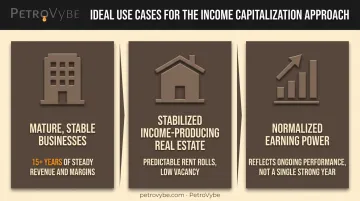
Appraisers typically reserve this approach for assets where next year looks a lot like last year. The moment that assumption breaks, the math stops working.
What is Discounted Cash Flow (DCF)?
DCF takes a different approach entirely. It projects cash flows over a discrete period, commonly five years, and calculates a terminal value for everything beyond that horizon. Each year's cash flow, plus that terminal value, then gets discounted back to present value using a discount rate.
Two Steps That Drive Everything
DCF comes down to two core decisions:
- Forecasting future cash flows year by year, accounting for changing growth, margins, and capital needs
- Selecting an appropriate discount rate that reflects the investment's risk
That second step matters more than most people realize. CFA Institute's framework for free cash flow valuation pairs free cash flow to the firm with the weighted average cost of capital (WACC). Free cash flow to equity, by contrast, gets discounted at the required return on equity. Mixing these up produces a distorted value every time.
Core benefit: flexibility. DCF can model changing growth rates, capital needs, and risk on a year-by-year basis, making it far more precise for anything that isn't a stable, steady-state business.
Core limitation: it requires reliable multi-year forecasts. Errors in early-year assumptions compound across the entire projection period, and a shaky terminal value assumption can swing the whole conclusion.
Use Cases of DCF
DCF earns its keep in situations where a single period simply can't tell the whole story:
- Startups and high-growth companies, or businesses undergoing material change like new contracts, expansions, or product launches
- Litigation and damages calculations, where courts want to see explicit, defensible year-by-year assumptions
- Depleting natural resource assets, where production and cash flow decline predictably over time rather than growing at a constant rate
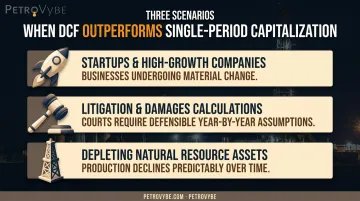
In oil and gas, this plays out directly: reserve engineers discount projected production revenue year by year to reach a PV-09 or PV-10 value. PetroVybe's own proved reserves, for example, were valued at $48 million using this same discounted cash flow approach, engineered by an independent third party.
That last use case deserves its own deep dive, because depleting reserves require exactly the kind of year-by-year modeling DCF was built for.
Income Capitalization vs DCF: Which Approach is Better?
Neither method is inherently superior. The right choice comes down to four factors:
- Earnings or cash flow stability — is next year likely to look like this year?
- Growth trajectory — steady and constant, or lumpy and unpredictable?
- Finite vs. perpetual asset life — does the asset deplete, expire, or wind down?
- Purpose of the valuation — transaction pricing, tax reporting, or litigation support?
Choose Income Capitalization when the business or asset has a long track record of stable, predictable earnings with minimal near-term change expected. Think an established regional service business or a fully-leased office building with a stable tenant base.
Choose DCF when cash flows are expected to fluctuate, the asset has a finite or depleting life, or a known operational change is on the horizon.
A biotech company awaiting FDA approval and an oil well three years into production have almost nothing in common operationally. Both require DCF for the same reason: one representative period can't capture what's coming.
At a glance:
| Factor | Income Capitalization | DCF |
|---|---|---|
| Earnings stability | Stable, predictable | Variable, fluctuating |
| Growth trajectory | Steady, constant | Lumpy, uneven |
| Asset life | Perpetual | Finite or depleting |
| Valuation purpose | Ongoing operations | Transaction, litigation, or major change |
One rule applies regardless of which method fits: Income Capitalization and DCF are mutually exclusive within a single engagement.
Professional appraisal standards call for informed judgment in selecting or weighting methods, but they don't support averaging the two together as if splitting the difference makes the answer more accurate. You pick the method that matches the underlying economic reality, period.
Real-World Application: Valuing Oil and Gas Reserves
Oil and gas reserves are a textbook case for DCF. Production volumes from a well don't stay flat. They decline over the well's productive life, following a predictable curve that engineers model using historical production data extrapolated to an economic limit. A single-period capitalization approach simply can't capture that trajectory.
PV-10 and PV-9: DCF in Practice
This is exactly why the industry standardized on PV-10 as a reporting metric. PV-10 discounts future net revenue from proved reserves at a fixed 10% annual rate over the reserve's productive life.
The SEC's own guidance on the standardized measure of discounted future net cash flows confirms the same structure. Production and cost estimates are period-specific, discounted year by year rather than divided by a single cap rate. Some engineering reports use a 9% variant, PV-9, depending on the specific engagement.
The underlying reserve engineering itself follows the same period-by-period logic. Petroleum reserve evaluation guidelines call for forecasting production through decline-curve extrapolation to an economic limit, not a static representative year.
How PetroVybe Applies This
PetroVybe engaged a licensed third-party engineering firm to produce a PV-09 proved reserves valuation of $48MM for its South Texas and Gulf Coast Basin development assets. That figure didn't come from an internal spreadsheet estimate.
It came from an independent engineering firm modeling production decline, development costs, and net cash flow year by year across the reserves' productive life. That's the exact DCF discipline this guide has walked through.
For accredited investors evaluating a natural gas development opportunity, this distinction is a genuine due-diligence marker. A reserve value built on defensible, engineer-validated DCF methodology carries a different weight than a rough single-period projection. It means someone outside the company modeled the decline curve, checked the assumptions, and put their engineering license behind the number.

If you're exploring passive oil and gas investment opportunities, review how a project's reserve valuation was built before evaluating the return projections. PetroVybe's ONE program pairs independently engineered reserve valuations with a tax-advantaged development structure, including IDC deductions that applied against active income at 91-94% for 2024 partners. Reach out to PetroVybe to review the underlying engineering reports and see how the numbers were built.
Frequently Asked Questions
How does the discounted future earnings approach differ from the capitalized earnings approach?
DCF (discounted future earnings) projects multiple years of varying cash flows, each discounted individually, plus a terminal value. Capitalized earnings applies one normalized period divided by a cap rate, assuming constant perpetual growth.
When to use direct cap vs DCF?
Direct cap fits stable, predictable income with modest steady growth, like a fully-leased office building. DCF fits widely varying cash flows, high-growth businesses, or assets with a finite or declining life, like an oil well.
What is a good capitalization rate to use in a valuation?
Cap rate equals discount rate minus long-term growth rate. There's no universal number; the appropriate rate depends on company- or asset-specific risk factors, industry conditions, and earnings stability.
Can the income capitalization approach and DCF be used together in one valuation?
No. These methods are mutually exclusive under professional valuation standards. Analysts select one approach based on the cash flow pattern rather than averaging both together.
Is the income capitalization approach used in real estate the same as in business valuation?
Real estate typically calls this "direct capitalization." It applies the same single-period income divided by cap rate logic used in business valuation, just applied to net operating income instead of earnings.
Why is DCF the preferred method for valuing oil and gas reserves?
Reserve production and cash flow decline predictably over a well's life rather than growing at a steady rate. DCF, as used in PV-10 and PV-9 calculations, captures that decline far better than single-period capitalization. PetroVybe's own proved reserves, for instance, carry a $48MM PV-09 valuation from an independent third-party engineering firm.