But not all cash flow metrics tell the same story. Operating Cash Flow (OCF) and Free Cash Flow (FCF) come from the same statement, yet they answer different questions. Confuse the two, and you might mistake a company in aggressive growth mode for one in financial distress — or the reverse.
This guide breaks down what separates OCF from FCF, how to calculate each, when to use which, and how a real-world natural gas development scenario shows why sophisticated investors track both instead of picking a favorite.
TL;DR
- OCF measures cash from core operations — whether day-to-day activities can sustain the business on their own.
- FCF = OCF minus capital expenditures, showing what's left for debt repayment, dividends, or reinvestment.
- OCF reflects operational efficiency, while FCF reveals financial flexibility and growth capacity.
- Capital-intensive sectors like oil and gas often show a wide gap between the two due to heavy CapEx.
- Neither metric works well alone: use them together for the full picture.
OCF vs FCF: Quick Comparison
Here's the fast version, side by side:
| Factor | Operating Cash Flow (OCF) | Free Cash Flow (FCF) |
|---|---|---|
| Scope | Cash from core operating activities only | OCF minus capital expenditures |
| Formula | Net Income + Non-Cash Expenses ± Working Capital Changes | OCF minus Capital Expenditures |
| What it reveals | Whether operations cover day-to-day costs | Cash available for dividends, debt paydown, and growth |
| Best used by | Operations managers, analysts tracking efficiency | Investors, lenders, executives weighing capital allocation |
OCF tells you whether the engine runs. FCF tells you how much is left over once you've paid to keep that engine maintained. Both figures live on the same cash flow statement, but investors who check only one risk missing half the story.
For investors weighing a passive-income deal, FCF is the number that shows what actually lands in your account each month.
What is Operating Cash Flow (OCF)?
Operating Cash Flow measures cash a company generates purely from running its core business: collecting from customers, paying suppliers, covering payroll. It excludes anything tied to investing (buying equipment) or financing (borrowing, issuing stock). A business that can't generate positive OCF depends on outside capital just to keep the lights on, making OCF the first checkpoint for financial viability.
The standard indirect-method formula:
OCF = Net Income + Non-Cash Expenses ± Changes in Working Capital
A few things drive that adjustment:
- Depreciation and amortization get added back because they reduce net income without using any actual cash
- Rising accounts receivable or inventory balances subtract from OCF, since that revenue hasn't converted to cash yet
- Rising accounts payable adds back, because payment has effectively been deferred
OCF appears on the cash flow statement and gets reported quarterly and annually, right alongside investing and financing cash flow.
Use Cases of OCF
OCF is the day-to-day pulse check. It answers a blunt question: can operations alone, without loans or new equity, cover payroll, rent, and vendor payments? This makes it especially critical in retail and service businesses, where capital expenditure needs are low and operating cash tells nearly the whole story.
It's also a warning system for the gap between reported profit and actual cash conversion. Consider Jabil's fiscal Q1 2020 filing: the electronics manufacturer reported $7.5 billion in revenue and $40.7 million in net income, both positive signals. But net cash from operating activities came in at just $20.9 million, roughly half of net income, because an $850.9 million jump in accounts receivable ate into cash conversion.
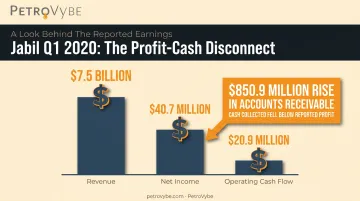
Sales were real. Profit was real. The cash just hadn't arrived yet — exactly the kind of gap OCF is built to expose.
What is Free Cash Flow (FCF)?
Free Cash Flow is what's left after a company pays for both its operations and the capital expenditures needed to sustain or grow them. It's the money that's truly "free" for discretionary use : dividends, debt paydown, acquisitions, or expansion.
The basic formula:
FCF = Operating Cash Flow − Capital Expenditures
A more detailed version arrives at the same number from scratch: net income, plus non-cash expenses, minus the increase in working capital, minus CapEx. FCF is a non-GAAP metric, meaning companies define and reconcile it differently, so it's worth reading the fine print before comparing two companies' numbers directly.
FCF's real value is what it signals: whether a business can self-fund growth, service debt, or weather a downturn without tapping outside capital. Lenders and investors lean on it heavily to judge dividend sustainability and loan risk.
Use Cases of FCF
FCF drives strategic decisions: funding expansions, evaluating acquisition targets, or determining whether a dividend is actually sustainable rather than borrowed against future cash.
It swings hardest in capital-heavy sectors like oil and gas exploration and drilling. Diamondback Energy's FY2024 annual report shows the mechanics clearly:
- Operating cash flow: $6.4 billion
- Capital expenditures (excluding acquisitions): $2.9 billion, about 45% of OCF
- Free cash flow: roughly $3.5 billion
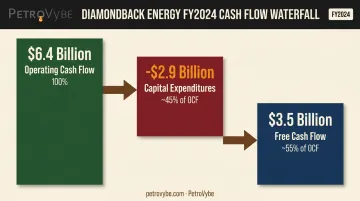
That reinvestment rate is fairly disciplined by industry standards. Some operators plow back 100% or more of OCF into new development, which is exactly how a company can post strong operating results and still show negative free cash flow.
Which Metric Should You Use—And a Real-World Example
The right metric depends on what question you're actually asking:
- Choose OCF if you're evaluating short-term operational health: can the business cover this month's bills from its own sales?
- Choose FCF if you're assessing long-term investment potential, dividend sustainability, or debt-servicing ability.
- Use both together when a business is capital-intensive, since CapEx timing can distort either metric read in isolation.
Why Capital-Intensive Sectors Complicate the Picture
Public U.S. oil and gas producers have plowed back a substantial share of operating cash into the ground during recent growth cycles. The EIA reported that 40 publicly traded oil E&P companies reinvested roughly 64% of Q1 2023 operating cash flow into capital expenditures, with S&P Global noting upstream reinvestment rates that occasionally topped 100% during aggressive drilling cycles.
In periods like that, FCF can look thin or even negative. That's not a sign operations are struggling; it's a sign cash is pouring into new wells and infrastructure that pays off for years.
This is precisely the dynamic PetroVybe navigates in its South Texas and Gulf Coast Basin projects. Operating cash flow gets funneled back into new wells, acreage, and infrastructure under a deliberate reinvestment strategy that blends partner equity, credit facilities, and reinvested cash flow to expand the asset base rather than distribute cash immediately.
A near-term dip in free cash flow during the first years of a 10-year hold isn't a red flag. It's the expected shape of a compounding production strategy, designed to build toward monthly distributions projected north of $10,000 per unit once wells reach peak production.
The takeaway: a 50-64% reinvestment rate, common among public upstream operators, reflects discipline rather than distress. Anyone evaluating a natural gas or oil investment should look past a single quarter's free cash flow and check it against third-party reserve reports and full financial modeling.
PetroVybe provides accredited investors that kind of transparency, including a $48 million PV-09 proved reserves valuation from an independent, licensed engineering firm. This lets the reinvestment story be checked against verified numbers rather than one quarter's snapshot.
Conclusion
OCF and FCF answer two different questions about the same business. OCF confirms whether operations can stand on their own, generating cash without outside funding. FCF goes a step further, showing how much flexibility remains for growth, debt repayment, and dividends after reinvestment is accounted for.
Investors and business owners who track both metrics make sharper calls on capital allocation and risk. That's especially true in capital-intensive industries like oil and gas development, where PetroVybe operates. A thin quarterly FCF number often signals a company reinvesting in future production, not running out of cash.
Frequently Asked Questions
How do you calculate free cash flow from operating cash flow?
FCF = OCF - Capital Expenditures. The more detailed version starts with net income, adds back non-cash expenses, adjusts for working capital changes, then subtracts CapEx to land on the same result.
What is the difference between free cash flow and operating cash flow?
OCF measures cash generated purely from core operations — collections, payments, payroll. FCF takes that number and subtracts capital expenditures, showing what's actually left for debt repayment, dividends, or reinvestment.
What does operating cash flow mean?
Operating cash flow is the cash a business generates from its everyday activities, excluding anything from investing or financing. It shows whether sales and collections alone can cover operating costs.
What are the three types of cash flow?
A cash flow statement breaks activity into three buckets: operating (day-to-day business), investing (buying or selling long-term assets), and financing (debt and equity movements). Together they show where cash comes from and where it goes.
Can a business have positive operating cash flow but negative free cash flow?
Yes. If capital expenditures exceed operating cash flow in a given period, FCF turns negative even though OCF stays positive. This happens often in oil and gas, where drilling and completion costs can outpace current-period cash generation.
Why is free cash flow especially important for evaluating oil and gas investments?
Drilling and development are capital-intensive, so FCF shows whether a company can fund new wells, cover distributions, and service debt without piling on more borrowing. It's the clearest signal of financial flexibility in a reinvestment-driven business.