But there's a version of compounding that gets far less attention. Instead of reinvesting stock dividends, you buy physical, income-producing assets and use the cash flow they generate to buy more of them. Think producing oil wells, rental properties, or small businesses, not just ticker symbols.
Compound asset acquisition means purchasing cash-flowing assets and systematically reinvesting the proceeds into additional assets. Unlike passive dividend reinvestment, it builds real productive capacity: more wells, more units, more physical output.
This guide covers what a compound asset actually is, how the acquisition flywheel works, the best practices that separate disciplined operators from speculators, and the mistakes that stall the whole engine. We'll use real oil and gas development examples along the way.
Key Takeaways
- Compound asset acquisition reinvests cash flow into new assets, growing income and total asset value.
- Private asset acquisition can expand without the capacity limits that constrain public stock compounding.
- Winning strategies prioritize cash-flowing assets, third-party validation, and disciplined reinvestment over speculation.
- Intangible drilling cost (IDC) deductions can accelerate the reinvestment loop for oil and gas investors.
What Is a Compound Asset?
A compound asset is a tangible, income-producing holding whose returns can be reinvested to acquire more of the same asset type. Oil and gas wells, rental real estate, and private operating businesses all qualify. Compound interest, by contrast, only describes interest accruing inside a bank account or bond.
That distinction matters: reinvesting stock dividends compounds returns on paper, while reinvesting cash flow from a producing well into a new well compounds physical, productive capacity. One builds a bigger number on a statement; the other builds more barrels, more acreage, more defensible value in the ground.
The Math Behind Compounding
Fidelity's compound interest formula is A = P(1 + r/n)^(nt), where P is your starting principal, r is the rate of return, n is how often returns compound, and t is time in years. Each return gets added back to the base, which is what makes growth accelerate rather than stay flat. That's the engine. Applying it to physical assets just changes what P actually represents.
A Working Example: PetroVybe's NGL Development Model
PetroVybe's natural gas liquids development strategy is a straightforward illustration. The approach starts by acquiring producing wells and acreage, then reinvests cash flow into workovers, optimization, and new drilling to compound daily output.
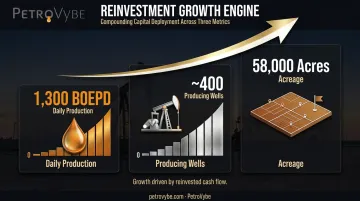
That reinvestment model has driven growth from zero to approximately 1,300 barrels of oil equivalent per day (BOEPD) across roughly 400 producing wells and 58,000 acres. Every dollar of new production became fuel for the next acquisition or workover.
Why Accredited Investors Look Here
Stocks, bonds, and REITs all have their place. But accredited investors increasingly want:
- Tangible ownership that isn't just a line on a brokerage statement
- Inflation-resistant income tied to real commodities, not paper valuations
- Tax-advantaged structures unavailable through public markets
- Diversification that doesn't move in lockstep with equity indices
Compound assets check all four boxes at once.
How the Compound Asset Acquisition Strategy Works
The mechanics follow a simple flywheel:
- Acquire an underpriced or off-market producing asset
- Generate cash flow from existing production
- Reinvest that cash flow into workovers and optimization
- Watch production and reserve value climb
- Use the larger cash flow pool to fund the next acquisition
Repeat.
Sourcing and Optimizing the Right Assets
Assets that hit the open market get competitively bid, which compresses returns for everyone. Operators with deep industry relationships can find producing wells and leaseholds before they're shopped around. PetroVybe's President & COO, Blaine Yeary, built exactly this kind of network while scaling a $5 billion asset from zero to 35,000 BOEPD over eight years. That relationship-driven approach gives the company access to deal flow that never reaches a public listing.
Once an asset is acquired, the clock starts on optimization. Natural production decline is slow and passive, but targeted workovers, re-completions, and optimization projects can restore or increase output on a timeline measured in months, not years. Under PetroVybe's "PROTECT" strategy, legacy wells get worked over and optimized before new drilling capital gets deployed elsewhere, keeping the reinvestment loop funded from day one.
The IDC Tax Loop
Intangible drilling costs (IDCs), meaning the labor, fuel, and non-salvageable materials used to drill a well, can qualify for a first-year deduction under IRC Section 263(c). PetroVybe's structure is built around up to 100% total deduction on qualifying costs, with roughly 70% typically deductible in year one against active income. In practice, 2024 partners received a 94% deduction against active income, and 2025 partners received 91%. Reinvesting that tax savings back into development accelerates the whole flywheel.
Case Study: Compounding in Practice
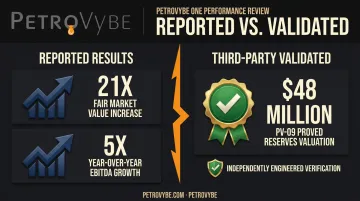
PetroVybe points to a 21x fair market value increase on one project and 5x year-over-year EBITDA growth as evidence the model works when acquisition discipline and reinvestment stay consistent. These are company-reported figures, not third-party audited averages, but they illustrate what disciplined compounding can produce.
None of those numbers mean much without independent validation. A PV-09 or similar reserve valuation from a licensed, independent engineering firm confirms that projected compounding is grounded in proved reserves, not speculative production forecasts. PetroVybe's projects carry a $48 million proved reserves valuation, engineered by a third party rather than modeled in-house.
Best Practices for Compound Asset Acquisition
Not every acquisition strategy compounds successfully. The ones that do share a handful of habits.
- Prioritize cash-flowing assets first. Legacy producing wells fund the reinvestment engine immediately. Purely speculative undeveloped acreage doesn't generate cash to reinvest, which stalls the flywheel before it starts.
- Partner with proven operators. PetroVybe's Chief Geophysicist, Michael Stamatedes, has a 75.2% well-success rate over a 48-year career, well above the industry average of below 40%. Track record like that reduces the odds of paying for reserves that never materialize.
- Reinvest before distributing. Taking every dollar out as a distribution in early years caps long-term Multiple on Invested Capital (MOIC) and Internal Rate of Return (IRR). Discipline in years one through three compounds into materially larger outcomes by year ten.
- Diversify within the basin. Spreading capital across multiple wells, formations, or acreage blocks reduces single-asset risk without sacrificing portfolio-level compounding.
- Use tax-efficient structures. IDC deductions against active W-2 income or capital gains maximize the after-tax cash available for reinvestment.
- Monitor performance continuously. Underperforming assets need to be optimized or divested quickly. The underlying asset base has to stay healthy for the compounding to continue.
Private development companies like PetroVybe give accredited investors direct access to this exact model. They pair cash-flowing acquisitions with reinvestment discipline and third-party validated reserves, rather than asking investors to build the operation themselves.
Why Real Assets Escape the Capacity Constraint That Limits Stock Market Compounding
Here's something most compounding content skips entirely. Acadian Asset Management's research on the "illusion of compound returns" shows that reinvesting stock dividends indefinitely is mathematically impossible for all investors at once.
Someone starting with 20% of the U.S. stock market in 1926, mechanically reinvesting dividends, would appear to own more than 100% of the market by 2013. That's obviously not possible; the market has a fixed capacity to absorb reinvested capital, and every buyer needs a seller.
Private real asset acquisition escapes this ceiling in three ways:
- Skips the seller requirement: acquiring a well, lease, or acreage block doesn't need another investor to give up their share
- Adds new productive capacity through direct development or purchase, independent of broader market activity
- Compounds actual barrels and units, not paper valuations dependent on someone else's willingness to sell
That's why sophisticated, accredited investors increasingly look past public equities toward private strategies built on genuine production growth, not exits controlled by other shareholders.
Common Mistakes to Avoid in Compound Asset Acquisition
Even experienced investors trip over the same three errors.
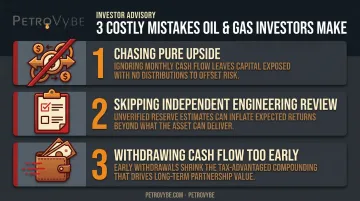
- Chasing pure upside with no near-term cash flow. Speculative acreage with zero current production can't fund reinvestment. The flywheel never turns.
- Skipping independent engineering review. Without third-party validation, it's easy to overpay for reserves that look great on paper but never materialize in production. PetroVybe's own $48MM PV-09 reserve report shows why that validation matters.
- Withdrawing all cash flow too early. This is the same mistake as spending dividends instead of reinvesting them. It feels good in year one and costs you compounding in years five through ten.
Frequently Asked Questions
What is a compound asset?
A compound asset is a tangible, cash-flow-generating holding, such as an oil well or rental property, whose returns can be reinvested to acquire additional similar assets. It's distinct from purely financial compounding like bank interest or stock dividends.
What did Warren Buffett say about compounding?
In Berkshire Hathaway's 1988 shareholder letter, Buffett wrote that when he owns "portions of outstanding businesses with outstanding managements," his favorite holding period is "forever." The takeaway: patience with quality assets is what makes compounding work.
What is the 7-5-3-1 rule of compounding?
It's an informal heuristic from Indian mutual fund investing: hold for 7+ years, diversify across 5 strategies, prepare for 3 common investor challenges, and increase contributions annually. Treat it as a rough mental model, not a precise formula.
How does compound asset acquisition differ from compounding stock returns?
Stock compounding relies on reinvested dividends within a public market that has a fixed capacity for absorbing capital. Compound asset acquisition builds new productive capacity directly, through owning additional wells, units, or acreage.
What tax advantages come with a compound asset acquisition strategy in oil and gas?
Intangible drilling cost deductions can offset a large share of active income in year one. PetroVybe's structure targets up to 100% total deduction over time, with 2024 and 2025 partners receiving 94% and 91% deductions, respectively.
How long does it typically take to see returns from a compound asset acquisition strategy?
Timelines vary by asset type, but oil and gas development strategies often target a 10-year window for full compounding benefits. PetroVybe, for example, targets a 10-year MOIC of roughly 2.2x to 5.8x and an IRR near 26%.