

Contributing pre-tax means money goes into an account before income tax is withheld, lowering your taxable income today while deferring the tax bill until you withdraw funds later. This guide covers what pre-tax investing is, which accounts qualify, how the mechanics work, how it stacks up against Roth contributions, and when high earners should look at strategies beyond standard retirement accounts.
Key Takeaways
- Pre-tax contributions reduce taxable income now; you pay taxes upon withdrawal
- Common pre-tax vehicles include traditional 401(k), traditional IRA, SEP/SIMPLE IRA, and HSA accounts
- Your expected retirement tax bracket determines whether pre-tax or Roth suits you best
- Contribution limits, RMDs at 73, and a 10% early withdrawal penalty all apply
- High earners can explore added tax strategies, like direct energy development partnerships
What Is Pre-Tax Investing?
Pre-tax investing means directing income into a qualifying account before federal income tax is withheld. That contribution reduces your taxable income dollar-for-dollar in the year you make it. Contribute $5,000 pre-tax, and your taxable income for that year drops by $5,000.
Here's the trade-off: the money isn't tax-free forever. It grows tax-deferred, meaning you don't pay taxes on gains year to year, but distributions in retirement are taxed as ordinary income. According to IRS Publication 525, traditional elective deferrals are excluded from your federal taxable wages when contributed, though they still count toward Social Security and Medicare taxes.
This differs from Roth (after-tax) contributions in one key way: Roth money is taxed upfront, but qualified withdrawals later are tax-free. Pre-tax reverses that sequence, shown below:
| Feature | Pre-Tax (Traditional) | Roth (After-Tax) |
|---|---|---|
| Contribution | Reduces taxable income now | Taxed before contributing |
| Withdrawals | Taxed as ordinary income | Tax-free if qualified |
| Best fit | Expect lower taxes in retirement | Expect higher taxes in retirement |
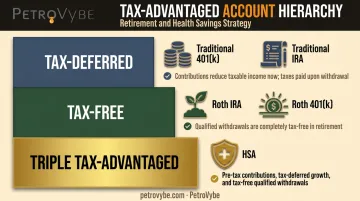
Where pre-tax fits under the "tax-advantaged" umbrella:
- Tax-deferred: pre-tax accounts like traditional 401(k)s and IRAs
- Tax-free: Roth accounts, once distribution rules are met
- Triple tax-advantaged: HSAs, which combine pre-tax contributions with tax-free qualified withdrawals
Beyond these differences, one detail surprises new investors: the investment menu inside a pre-tax account looks almost identical to a taxable brokerage account. Stocks, bonds, mutual funds, and ETFs are all fair game. The tax treatment changes; the investment options largely don't.
How Pre-Tax Investing Works and Where It's Applied
The mechanics follow a simple path. You deduct income pre-tax from your paycheck (or contribute directly if you're self-employed), the account invests those funds, and they grow tax-deferred. Eventually, you withdraw the money and pay ordinary income tax on it in retirement.
What determines how much you can contribute? Three factors:
- Employer plan availability — not every employer offers every plan type
- IRA income phase-outs — deductibility can shrink or disappear at higher incomes
- Annual IRS contribution caps — these change yearly, so verify current limits before contributing
One constraint worth flagging early: withdrawals before age 59½ generally trigger a 10% penalty on top of ordinary income tax. That makes pre-tax accounts poorly suited for near-term liquidity needs.
Employer-Sponsored Plans
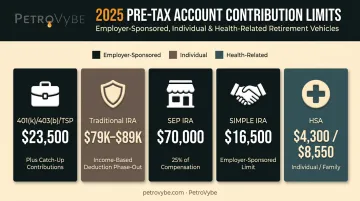
401(k), 403(b), 457(b), and Thrift Savings Plan (TSP) accounts are the most common pre-tax vehicles for employees. For 2025, the employee contribution limit is $23,500, with a $7,500 catch-up for those 50 and older, and a new $11,250 catch-up for ages 60–63, per the IRS's 2025 cost-of-living adjustments.
Employer matching contributions used to be automatically pre-tax. That changed under SECURE 2.0: plans can now let employees designate employer matches as Roth instead, though the employer must fully vest that contribution and count it as taxable income in the year it's allocated.
Individual Retirement Accounts (IRAs)
Traditional IRAs let you deduct contributions, but that deduction phases out at certain income levels if you or your spouse are covered by a workplace plan. For 2025, single filers see the deduction phase out between $79,000 and $89,000 in modified adjusted gross income.
Business owners have additional IRA options built for their situations:
- SEP IRA: self-employed individuals can contribute up to the lesser of 25% of compensation or $70,000 for 2025
- SIMPLE IRA: designed for small business owners, with a $16,500 salary-reduction limit for 2025
Health Savings Accounts (HSA)
HSAs offer something no other pre-tax account can match: a triple tax advantage. Contributions are pre-tax (or deductible), growth is tax-deferred, and qualified medical withdrawals are completely tax-free. To qualify, you need coverage under a high-deductible health plan. For 2025, individual contribution limits sit at $4,300, with family coverage at $8,550.
Pre-Tax vs. Roth: Which Should You Choose?
The core question isn't complicated, even if the math sometimes feels that way: will your tax rate be higher or lower when you withdraw the money compared to today?
General rule of thumb:
- Pre-tax favors those who expect a lower tax bracket in retirement
- Roth favors those who expect a higher bracket later, or who have decades left for tax-free growth to compound
- Splitting contributions works for those hedging against future rate uncertainty rather than betting everything on one outcome
Here's a simplified comparison. Assume a $10,000 contribution, a hypothetical 7% annual return, and a 20-year time horizon:
| Account Type | Contribution | Balance After 20 Years | Tax at Withdrawal | After-Tax Value |
|---|---|---|---|---|
| Traditional (Pre-Tax) | $10,000 | $38,697 | 22% | $30,184 |
| Roth | $10,000 (after-tax) | $38,697 | 0% | $38,697 |
This example assumes equal dollar contributions to both accounts. In reality, the pre-tax contribution costs you less out-of-pocket today since you skip the upfront tax bill. That's why the "same marginal rate" scenario often nets out similarly, once you factor in what you do with those tax savings.
Required minimum distributions (RMDs) apply to pre-tax accounts starting at age 73, forcing withdrawals whether you need the income or not. Roth IRAs have no RMDs during the original owner's lifetime, according to IRS guidance on RMDs, which matters a great deal for long-term estate planning.
Key Factors, Common Misconceptions, and When Pre-Tax May Not Fit
Before defaulting to pre-tax contributions, weigh these factors:
- Current vs. projected tax bracket: the single biggest variable in the decision
- Employer match availability: free money often outweighs tax-treatment preferences
- Time horizon: longer horizons favor Roth's tax-free compounding
- State tax treatment: some states don't tax retirement withdrawals at all
- Near-term liquidity needs: pre-tax accounts penalize early access
Misconception #1: Pre-tax savings eliminate taxes. They don't. They defer taxes. You'll pay ordinary income tax on every dollar withdrawn, including growth.
Misconception #2: Pre-tax always beats Roth. Not true. The outcome depends entirely on your future tax rate assumption, which nobody can predict with certainty.
When pre-tax may not fit:
- High-net-worth individuals facing large future RMDs and potential estate tax exposure
- Anyone expecting significantly higher income in retirement than today
- Investors with shorter-term goals, since the 10% early withdrawal penalty before 59½ limits flexibility

For investors in this position, direct investments offering upfront deductions, such as intangible drilling cost (IDC) deductions available through oil and gas partnerships, can complement traditional pre-tax vehicles without triggering future RMDs.
Beyond Retirement Accounts: Tax-Advantaged Alternatives for High-Income Investors
Standard pre-tax retirement accounts have annual caps. A 401(k) tops out at $23,500 for most contributors in 2025. For high-income earners with substantial W-2 wages or capital gains, that ceiling limits how much active income can actually be sheltered each year.
This is where alternative tax-advantaged investments enter the picture. Oil and gas drilling programs allow investors to claim Intangible Drilling Cost (IDC) deductions directly against active income, including W-2 wages and capital gains, a structural advantage that most retirement account deductions simply don't offer.
PetroVybe, a private natural gas development company operating in South Texas's Gulf Coast Basin, illustrates how this works in practice. Partners who joined in 2024 received a 94% tax deduction against active income, and 2025 partners achieved a 91% deduction, according to the company's published performance milestones.
On a $100,000 investment, that translates to roughly $60,000–$80,000 in first-year IDC deductions, with the remainder coming from additional oil and gas tax benefits like depletion allowances.
A few things to understand about this category of investing:
- These opportunities are generally reserved for accredited investors: those with $1M+ net worth (excluding primary residence) or $200K+ individual income ($300K+ joint) in the prior two years, per SEC accredited investor rules
- Risk, liquidity, and holding-period profiles differ significantly from retirement accounts. PetroVybe's structure, for example, involves a multi-year hold period before distributions begin
- These strategies warrant guidance from a qualified tax professional before committing capital
For investors with significant active income or capital gains exposure who've already maxed out 401(k) and IRA contributions, diversifying beyond standard contribution limits is worth exploring with a tax advisor. If oil and gas development fits your risk profile, PetroVybe can walk you through how the structure works.
Frequently Asked Questions
What can I invest in pre-tax?
Common pre-tax vehicles include 401(k), 403(b), traditional IRA, SEP/SIMPLE IRA, and HSA accounts. Investment options inside these accounts (stocks, bonds, mutual funds, ETFs) mirror what's available in standard taxable accounts.
How much will $10,000 in a 401(k) be worth in 20 years?
Using a hypothetical 7% annual return, $10,000 grows to roughly $38,697 before taxes. Actual results depend on contribution amounts, fees, and market performance, so treat this as an illustration, not a guarantee.
Is it better to invest in pre-tax or Roth accounts?
It depends on whether you expect a higher or lower tax bracket in retirement compared to today. Many investors split contributions between both account types for tax diversification.
What happens when I withdraw money from a pre-tax account?
Withdrawals are taxed as ordinary income in the year you take them. Required minimum distributions (RMDs) kick in starting at age 73, forcing withdrawals whether or not you need the money.
Are there penalties for early withdrawal from pre-tax accounts?
Generally, yes: a 10% additional tax applies to withdrawals before age 59½, on top of regular income tax. Limited exceptions exist for situations like disability, certain medical expenses, or a qualifying first home purchase.
Can high-income earners get additional tax deductions beyond retirement accounts?
Yes. Accredited investors can access alternative vehicles like PetroVybe's oil and gas development partnerships, which use intangible drilling cost (IDC) deductions to offset active income beyond standard 401(k) and IRA contribution limits.