The trouble starts when those numbers don't match reality. Natixis surveyed 7,050 investors across 21 countries and found individual investors expected 15.6% annual returns above inflation in 2023, while financial professionals pegged realistic returns closer to 7.1% — a gap wide enough to breed disappointment before a single dollar moves. In private, illiquid markets like oil and gas development, where information is scarcer and exits take years, that gap gets even more dangerous.
This guide breaks down how investor beliefs actually form, the biases that quietly distort them, and how to calibrate realistic expectations before committing capital to alternative assets.
Key Takeaways
- Expectations form through information processing, anchoring, and social proof
- Transparency and third-party validation close the gap between promises and delivered results
- Loss aversion, recency bias, and overconfidence skew even seasoned investors' forecasts
- Illiquid assets like oil and gas demand different calibration than public equities
- Scenario-based projections beat single-point promises for building lasting trust
What Are Investor Beliefs and Expectations?
A belief is the story an investor tells themselves about an asset's future. An expectation is that story converted into a number.
Beliefs are subjective. They form from whatever data is on hand, past experience, and mental shortcuts that help investors decide without analyzing every variable. Expectations translate that belief into a specific IRR target, hold period, or exit multiple.
Quick way to tell them apart:
- Belief: "This operator knows how to pick productive wells."
- Expectation: "This project should return 3x invested capital in 10 years."
- Belief: "Rates will stay elevated for another year."
- Expectation: "A 12% coupon looks attractive relative to today's risk-free rate."
This distinction matters because beliefs drive behavior, while expectations get measured against reality later.
Public and private markets handle that gap differently:
- Public markets: Stock prices reflect the collective belief about future earnings. A guidance miss reprices the stock immediately.
- Private markets: Oil and gas partnerships have no daily price signal, so expectations stay unchanged for months until a distribution report, reserve update, or capital call forces a recalibration.
That lag is exactly why expectation gaps hit harder in illiquid alternatives. A public equity investor gets constant feedback. A private partner in a 10-year drilling program does not, which is why the due diligence question matters twice as much here: ask what a sponsor believes, then ask them to quantify it.
How Investor Expectations Are Formed: The Psychology and Process
Expectation formation isn't a purely rational calculation. Investors blend genuine information analysis with mental shortcuts that let them decide quickly under uncertainty, useful most of the time, but dangerous when the shortcut replaces the analysis entirely.
Information-Based Expectation Formation
Rational expectation-building starts with data: financial statements, sponsor track records, engineering or audit reports, and comparable deal performance. Investors weigh this evidence to form a baseline return expectation before any capital moves.
Private and alternative markets complicate this process. Public companies file standardized disclosures on a fixed schedule; private sponsors don't share that obligation.
A 2025 SEC Investor Advisory Committee draft notes that Rule 506 issuers generally aren't required to provide prescribed information to accredited investors, and whatever they do share often lacks a standard format. Two oil and gas sponsors can hand investors wildly different quality of documentation, which means the investor carries more of the verification burden.
Anchoring, Track Record, and Social Proof
Anchoring bias explains why a single number can dominate an investor's thinking for years. Tversky and Kahneman's original research on anchoring and adjustment found that people's numerical judgments stay biased toward whatever initial figure they were given, even after new information arrives.
In investing terms: an investor hears a headline IRR in a pitch meeting, and every later data point gets measured against that anchor rather than evaluated on its own.
Track records and independent validation pull expectations back toward reality. A reserve engineering report, an audited statement, or a documented history of realized returns gives investors something firmer to anchor to than a sponsor's forecast alone.
Social proof plays a role too:
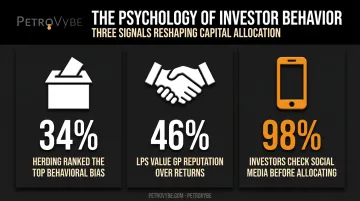
- A CFA Institute reader poll ranked herding first among behavioral biases affecting investment decisions, capturing 34% of votes
- A survey of 405 limited partners found 46% valued a general partner's reputation more than the investment's actual returns
- The same survey found 98% checked social media before finalizing an allocation
Investors don't just calculate. They also copy what people around them seem to believe.
Key Factors That Shape Investor Expectations
Five inputs consistently move the needle on what investors consider a reasonable target.
Financial performance and track record. Realized IRR carries more weight than any other single metric because it reflects actual cash paid to actual investors, not a model.
A Harvard Business School study of 79 private-equity firms managing more than $750 billion found median deal targets of 25% gross IRR and 2.5x MOIC. That's useful context for what sophisticated capital allocators consider achievable in private structures, even though the study covers buyouts rather than oil and gas specifically.
Transparency and governance. Regular reporting cadence and independent oversight shrink the distance between what a sponsor promises and what actually shows up in an investor's account. Investors who receive consistent updates recalibrate gradually. Investors who hear nothing for a year, then get one number, tend to anchor hard to whatever that number is.
Risk profile and macro conditions. Inflation, interest rates, and commodity price cycles all shift what counts as an acceptable return threshold. A 10% target looked generous when risk-free rates sat near zero. It looks a lot less exciting once short-term Treasuries pay 5%. Commodity-linked assets like natural gas add another layer, since price cycles change the risk premium investors demand almost every quarter.
Tax efficiency and net-return calculations. Sophisticated investors increasingly anchor to after-tax, inflation-adjusted returns instead of headline pre-tax numbers. IRS Publication 535 confirms that qualifying intangible drilling costs can be expensed or capitalized, which materially changes an investor's net return math depending on their personal tax situation.
Sponsor and operator credibility. Technical expertise directly shapes how much confidence investors extend to stated targets. An operator with a documented, verifiable success rate earns more benefit of the doubt than one relying purely on a slide deck of projections.
Common Behavioral Biases That Distort Investor Expectations
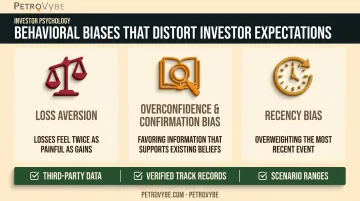
Even sophisticated investors run on instinct as much as analysis. Three biases show up again and again in how people set and defend their expectations.
Loss aversion. Investors weigh potential losses more heavily than equivalent gains, which pushes them toward overly conservative expectations one moment and panic-driven reactions to short-term volatility the next.
A 2024 meta-analysis in the Journal of Economic Literature pooled the evidence and landed on a mean loss-aversion coefficient of 1.955, meaning losses feel roughly twice as painful as equivalent gains feel good. That asymmetry explains why one bad quarter can erase months of patient expectation-setting.
Overconfidence and confirmation bias. Investors often over-trust their own read on a deal, then go looking for information that confirms it while discounting anything that doesn't. This shows up in oil and gas as investors fixating on a sponsor's best-case slide while skimming past the risk factors in the offering memo.
Correcting for it means deliberately seeking out the case against your own thesis, not accumulating more confidence.
Recency bias. Whatever happened most recently gets weighted as though it's the most predictive, even when it isn't. A commodity price spike or a hot exit in the news cycle can send expectations climbing well past what the underlying fundamentals support. The opposite happens too: a rough stretch convinces investors the good years are gone for good.
These biases represent default mental settings common to every investor, not personal failings. The antidote is structural, built from checks that sit outside gut feel:
- Third-party data that removes emotional interpretation from asset valuation
- Documented track records verified by independent engineers or auditors
- Scenario ranges that pressure-test optimistic assumptions against downside cases
Calibrating Expectations for Alternative Investments Like Oil and Gas Development
Public equities trade every second, so mispriced expectations correct fast. Oil and gas partnerships don't offer that luxury. The SEC's investor alert on private oil and gas offerings warns that these securities may carry so little liquidity that an investor should be prepared to hold indefinitely. Multi-year hold periods, asset-specific risk drivers, and no daily price signal mean expectations have to be calibrated differently from the start.
Anchor to Verified Data, Not Just Projections
Independent third-party validation matters more here than almost anywhere else in investing. Reserve valuations and engineering assessments give investors a number they didn't have to take on faith. PetroVybe's approach illustrates the point:
| Metric | PetroVybe ONE |
|---|---|
| 10-year MOIC target | ~2.2x – 5.8x |
| 10-year IRR target | ~26% |
| Reserve valuation | $48MM (PV-09, third-party engineered) |
| EBITDAX growth | 5x year-over-year |
| Well-success rate (Chief Geophysicist) | 75.2% vs. an industry peer average below 40% |
That last figure belongs to Michael Stamatedes, PetroVybe's Chief Geophysicist, whose 48-year track record gives investors a real basis for calibration instead of a bare promise. None of it guarantees future results, but it's independently verifiable in a way that a headline number alone never is.
Model Both Pre-Tax and After-Tax Scenarios
Tax-advantaged structures change the math meaningfully. Intangible Drilling Cost deductions can offset active income, including W-2 wages and capital gains, which is unusual for a passive investment. PetroVybe partners realized 94% deductions against active income in 2024 and 91% in 2025, historical results, not forecasts. Even so, investors should model both pre-tax and after-tax MOIC and IRR, since the deduction's value depends on each person's own tax situation.
Ask for Scenarios, Not Promises
Before committing capital to any sponsor, request base, upside, and downside projections rather than accepting a single-point IRR. A range built on conservative pricing assumptions tells you more than a headline number ever will.
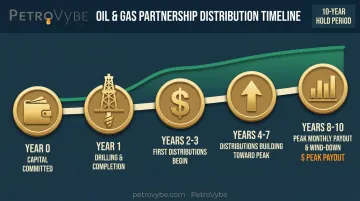
Set the timeline honestly, too. Production ramps take years, not months. Distributions in projects like PetroVybe ONE typically don't begin until roughly two to three years after the initial investment, building toward peak monthly figures rather than starting there. Investors weighing long-term passive income against near-term liquidity needs should be honest about which one they actually need first.
Frequently Asked Questions
What are investor expectations?
Investor expectations are the specific outcomes, returns, timelines, and transparency that investors anticipate based on available information and a sponsor's communicated targets. They're the measurable output of an underlying belief.
What is the investor expectation score?
It's a survey- or perception-based metric that measures how closely investor sentiment aligns with a company's or sponsor's stated performance and messaging. It's used to flag gaps before they turn into dissatisfaction.
What causes investors to have unrealistic expectations?
Behavioral biases, thin transparency, and single-point return promises without downside scenarios are the usual culprits. Anchoring to an early headline number without updating for new data makes it worse.
How can investors set realistic expectations for alternative investments like oil and gas?
Lean on independent third-party engineering reports, request base/upside/downside projections instead of one number, and factor in illiquidity and multi-year timelines before committing capital.
What is an "expectation gap" in investing?
It's the divergence between what investors or the market project and what a company or asset actually delivers. Wide gaps are a common source of investor dissatisfaction and volatility.
How does transparency affect investor expectation formation?
Regular reporting and independent third-party validation give investors verified data points to recalibrate against, rather than relying on a sponsor's initial pitch. Consistent transparency builds trust that survives a rough quarter.