This matters well beyond facilities managers. Anyone evaluating a company that manages physical, income-producing assets, including an energy development partner, benefits from understanding how a well-built AMP protects value and drives returns. A sloppy plan means missed production targets and eroding cash flow. A rigorous one means predictable performance over the life of the investment.
This article covers the definition, twofold objectives, core contents, and step-by-step process for building an AMP, with direct application to natural gas development assets.
Key Takeaways
- An AMP translates strategy into asset-specific actions on cost, risk, and performance.
- An AMP's two objectives, justification and optimization, work only when service standards are measurable.
- A complete AMP typically has six to seven sections, from inventory through continuous improvement.
- Building one follows four steps: inventory, lifecycle costing, condition assessment, and financial planning.
- For oil and gas investors, an operator's AMP quality affects production, cash flow, and tax outcomes.
What Is an Asset Management Plan?
The International Infrastructure Management Manual (IIMM) defines an Asset Management Plan as "a plan developed for the management of one or more infrastructure assets that combines multi-disciplinary management techniques (including technical & financial) over the life cycle of the asset in the most cost effective manner to provide a specific level of service."
That definition matters because an AMP functions as an implementation document, translating strategy into specific technical and financial actions.
AMP vs. SAMP
Organizations that take asset management seriously usually maintain two tiers of planning:
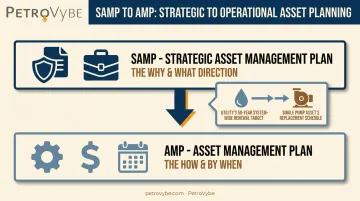
- Strategic Asset Management Plan (SAMP) – sets organization-wide policy, objectives, and strategy for the entire asset portfolio.
- Asset Management Plan (AMP) – sits beneath the SAMP and translates that strategy into specific activities, resources, costs, and timelines for a particular asset or group of assets.
Think of the SAMP as the "why" and the "what direction," while the AMP is the "how" and the "by when." A water utility's SAMP might target infrastructure renewal within 50 years, while the AMP for a single water main sets the exact replacement schedule and budget to meet that goal.
Why AMPs Cover Systems, Not Single Assets
Most AMPs govern a system of interdependent assets rather than one isolated item. A road AMP might cover pavement, drainage, and signage together because they must function as a unit to deliver a safe driving surface. The ISO 55000 standard provides the framework many organizations use to structure these systems, even without pursuing formal certification.
Applied to oil and gas: an AMP for a natural gas development defines how the operator manages a producing well as part of a larger system. That system includes wellhead equipment, gathering lines, and leasehold acreage, managed together as one asset system. The goal is straightforward: maximize production life and protect investor value across every interconnected piece, not just the wellbore itself.
Objectives of an Asset Management Plan
Every AMP exists to accomplish two things: justify the spend and optimize the outcome.
Justification
Justification gives stakeholders visibility into the costs and benefits tied to maintaining an agreed standard of service. This is critical for internal budgeting decisions and equally important for external stakeholders such as investors or regulators who need to see that spending aligns with expected performance.
Without justification, a maintenance budget is just a number on a spreadsheet. With it, that number connects to a specific, defensible outcome.
Optimization
Optimization aims to minimize whole-life cost across operation, maintenance, replacement, and disposal, rather than chasing the lowest upfront acquisition price. A cheaper wellhead component that fails twice as often isn't actually cheaper once downtime and replacement labor are factored in.
Both objectives only function correctly when the standard of service is defined in a measurable way for each asset. In oil and gas, that might look like:
- Target production volumes per well, tracked against decline curve forecasts
- Safety compliance thresholds tied to regulatory inspection standards
- Environmental performance limits on emissions or water handling
For investors, this connects directly to returns: an optimized AMP reduces unplanned downtime and surprise costs, supporting MOIC and IRR metrics on a development project.
Research backs this up. The U.S. Department of Energy's operations and maintenance guide found that predictive maintenance strategies cost roughly $9 per horsepower annually versus $18 for reactive maintenance, roughly half the cost.
The same guide reported that functional predictive maintenance programs deliver 25-30% lower maintenance costs and 35-45% less downtime than reactive approaches.
Key Components of an Asset Management Plan
A comprehensive AMP is typically built from five core sections, each addressing a different stage of managing the asset system.
Asset Inventory & System Description
This section documents what exists: location, value, acquisition date, and how assets depend on one another. In oil and gas, that means the well inventory, leasehold acreage, and the production and gathering equipment tied to each producing property.
Standard of Service & Condition Assessment
Organizations set measurable performance specifications and condition grades, then assess current asset condition against those standards to identify gaps. A well producing below its forecasted decline curve, for example, signals a gap worth investigating.
Lifecycle Management, Risk & Costs
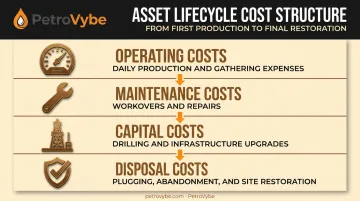
This is the planned-actions section. It covers risk mitigation strategies and forward-looking cost forecasts across four phases:
- Operating costs – day-to-day production and gathering expenses
- Maintenance costs – workovers, repairs, and equipment servicing
- Capital costs – new drilling, recompletions, and infrastructure upgrades
- Disposal costs – plugging, abandonment, and site restoration
Benefits & Financial Summary
The AMP must translate the standard of service into quantifiable benefits, paired with a financial summary and cash flow forecast that justifies the ongoing investment in the asset system.
Continuous Improvement
The final component identifies potential improvements, service level changes, or divestment opportunities. This feeds back into a loop that raises the plan's maturity over time rather than treating the AMP as a static, one-and-done document.
How to Create an Asset Management Plan
Building an AMP follows a repeatable four-step process, regardless of industry.
- Conduct a full asset inventory. Document each asset's value, location, quantity, acquisition date, and expected lifecycle. Skipping this step undermines everything that follows.
- Calculate life-cycle costs and define the standard of service. Factor in acquisition, maintenance, and disposal costs for each asset, then set measurable performance targets.
- Assess current condition and performance. Compare actual condition against the defined standards to pinpoint gaps that need action.
- Build the financial and risk management plan. Use those findings to forecast costs and mitigate risk over the asset's remaining lifecycle.
Once complete, the AMP becomes a living document rather than a one-time report. Review it on a set schedule, updating cost projections and risk assessments as conditions change.
Why Asset Management Plans Matter for Oil & Gas Investors
For passive investors, the quality of an operator's AMP determines whether wells, leaseholds, and gathering infrastructure actually deliver the projected production, cash flow, and tax benefits over the life of the investment. A weak plan means surprises. A strong one means the numbers in the offering documents hold up.
PetroVybe structures its approach around this exact principle. The company maintains a dedicated VP of Asset Intelligence & Performance role, held by Luke McIntosh. His job is to turn operational and production data into asset management decisions that protect legacy production and compound investor returns over time.
PetroVybe also pairs internal asset management with independent third-party engineering validation, including third-party reserves valuations that produced its $48MM proved reserves figure across its South Texas development portfolio. That external check matters because it means asset value isn't just an internal estimate.

If you're evaluating any oil and gas development partner, ask specifically how that operator handles:
- Asset inventory and system interdependencies
- Lifecycle cost forecasting across operating, maintenance, and capital phases
- Risk management and third-party validation practices
These are the same core components covered above. Confirm each one before committing capital to any operator's plan.
Frequently Asked Questions
How do you create an asset management plan?
Start with a full inventory of assets, then calculate lifecycle costs and define measurable standards of service. Next, assess current condition against those standards, and build a financial and risk plan around the gaps you find.
What is included in an asset management plan?
A complete AMP covers asset inventory, standard of service, current performance, planned actions, cost forecasts, expected benefits, and a continuous improvement section. Each addresses a different stage of the asset's lifecycle.
What is the difference between an AMP and a SAMP?
A Strategic Asset Management Plan sets high-level organizational objectives and policy across the whole portfolio. An Asset Management Plan translates those objectives into specific, asset-level activities, costs, and timelines.
Who is responsible for developing an asset management plan?
Asset managers or subject matter experts across departments typically develop AMPs, coordinated by a single accountable owner. The broader team then reviews the plan before it's finalized.
How often should an asset management plan be updated?
Most organizations review AMPs at least annually, with near-term cost figures updated more frequently. Teams should revisit longer-term forecasts whenever conditions, such as regulations or market pricing, change materially.
What industries use asset management plans?
Public infrastructure, utilities, IT, manufacturing, and natural resource industries like oil and gas rely on AMPs wherever physical or system assets must deliver a defined level of service.