

"Just invest it" sounds simple enough. But outcomes vary wildly depending on timing, risk tolerance, tax treatment, and where the money actually lands. Many people who receive a windfall either freeze and let it sit in cash for years, or rush in and make an emotional decision they later regret.
This guide walks through the exact steps for investing a lump sum the smart way: when investing it all at once beats spreading it out, the factors that matter most to your results, mistakes to avoid, and where to allocate funds, including options beyond traditional stocks and bonds.
Key Takeaways
- Pay off high-interest debt and build your emergency fund before investing a single dollar.
- A lump-sum investment beats phased investing in most historical periods.
- Diversifying across traditional and tax-advantaged assets shrinks risk and protects purchasing power.
- Fees and tax treatment compound over time, sometimes as powerfully as your investment picks.
- Watch for market-timing traps and "guaranteed-return" pitches aimed at windfall recipients.
A Step-by-Step Framework for Investing Your Lump Sum
Step 1: Secure Your Financial Foundation First
Before you think about a single stock ticker, clean up your balance sheet.
- Pay off high-interest debt. Credit card balances often run 18% or higher. According to Investor.gov, no investment strategy pays off as reliably or with less risk as eliminating high-interest debt first.
- Build (or confirm) your emergency fund. FINRA recommends 3-6 months of living expenses in a liquid, low-risk account like a savings account, money market fund, or CD.
- Set aside known tax liability. If your windfall triggers inheritance tax, capital gains, or retirement withholding, carve that money out now. It's easy to accidentally invest funds you'll owe the IRS in April.
Skip this step and you risk pulling money out of the market at the worst possible time to cover an emergency or a tax bill.
Step 2: Define Your Time Horizon and Investment Goals
Not every dollar of your lump sum needs the same treatment. Money you'll need within roughly 3 years belongs in safer, liquid holdings, not the stock market. Fidelity draws that line clearly for short-term goals, while the 3-5 year range is more of a gray zone depending on your loss tolerance.
A simple bucket approach helps here:
- Near-term bucket - Cash, CDs, or short-term bonds for anything you'll spend within a few years.
- Long-term growth bucket - Diversified stocks and bonds for goals 5+ years out.
- Legacy bucket - Assets meant to outlast you, where you can afford more illiquidity and volatility.
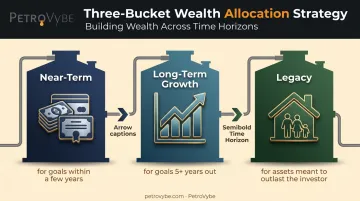
Matching each dollar to its purpose keeps you from panic-selling long-term money just because short-term needs feel urgent.
Step 3: Decide Between Investing All at Once or Phasing In
This is where most people get stuck. Vanguard's 2023 study of global equity returns from 1976 to 2022 found that investing a lump sum immediately beat phasing it in over three months about 68% of the time. The logic is simple: markets tend to rise over time, so more time invested usually means more growth.
But statistics don't account for how you'll feel if markets drop the week after you invest everything. Phasing in over 6-12 months can lower regret risk, even though it statistically underperforms on average.
A practical hybrid many wealth managers use:
- Deploy the low-volatility portion (bonds, cash equivalents) immediately.
- Phase the equity portion in on a set schedule.
- Accelerate that schedule if markets dip meaningfully during the window.
Step 4: Build and Maintain a Diversified Portfolio
Once your foundation is set and you've settled on a deployment strategy, build the actual portfolio:
- Allocate across equities, bonds, and cash equivalents based on your documented risk tolerance and time horizon, not a gut feeling.
- Max out tax-advantaged accounts first, including IRA contributions, HSA funding, and any available 401(k) rollover space, before adding money to a taxable brokerage account.
- Add tangible, income-producing alternatives like private natural gas or real estate development programs for extra diversification.
- Target inflation protection that traditional stock-and-bond portfolios can't offer on their own.
This tangible-asset allocation deserves a closer look once your portfolio passes six figures, and we'll dig into it later in this guide.
Lump Sum vs. Dollar-Cost Averaging: When Each Approach Works Best
Neither approach is universally "correct." Each fits a different investor profile.
Lump sum investing tends to suit you if:
- You have a long time horizon (5+ years)
- Your risk tolerance is genuinely high, not just on paper
- You're confident you won't panic-sell if markets drop shortly after investing
Dollar-cost averaging tends to suit you if:
- The windfall is very large relative to your existing net worth
- You're nearing retirement with less time to recover from a downturn
- You know from experience that you're highly loss-averse
The data leans toward lump sum. Charles Schwab's research across 80 rolling 20-year periods from 1926 to 2024 found that investing immediately beat monthly investing in 70 of 80 periods. That's a strong statistical edge, even if it's not a guarantee for any single year.
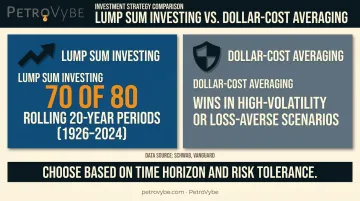
Here's the part investors often get wrong: waiting for a "better entry point" isn't a real strategy. Vanguard's research on all-time-high entry points shows they don't reliably predict an imminent pullback.
Morningstar's regime analysis found DCA won during the 2000s "lost decade" for stocks alone, yet lump sum still led in a 60/40 portfolio during that same stretch. Market conditions at the moment you invest simply aren't a reliable signal for which method will win.
This same logic applies beyond the stock market. Accredited investors with large windfalls often direct a portion into vehicles like oil and gas development partnerships, where the lump sum is mandatory by design, not optional.
The hybrid approach from Step 3 remains the practical middle ground: invest bonds and cash-like assets immediately, then phase equities in on a schedule that speeds up after a defined dip.
Key Factors That Affect Your Results (and Mistakes to Avoid)
Key Parameters to Watch
Risk tolerance and asset allocation. A mismatch between your stated risk tolerance and your actual portfolio increases the odds you'll panic-sell during volatility. Selling during a downturn doesn't just hurt in the moment, it locks in losses and cuts off the compounding you were counting on.
Fees and expense ratios. Management fees compound against a large sum for decades, eating into returns more than most investors expect. The SEC's own example illustrates this well: on a $100,000 investment growing at 4% annually over 20 years, a 0.25% annual fee ends near $208,000, while a 1.00% fee ends near $179,000.
That's roughly $29,000 lost to a fee difference of less than one percentage point.
Tax treatment of the investment vehicle. Taxable, tax-deferred, and tax-advantaged structures produce very different net returns on the same gross performance. Vehicle choice can matter as much as asset selection.
Some private investments push tax efficiency further. Oil and gas development programs, for example, offer upfront intangible drilling cost (IDC) deductions that can offset active income, including W-2 wages and capital gains, not just passive income.
These programs typically require accredited investor status and a six-figure minimum, so they fit a specific slice of portfolios rather than every lump sum.
Common Mistakes That Derail Lump Sum Investors
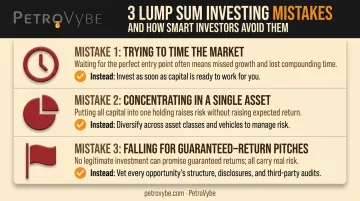
- Trying to time the market perfectly instead of following a written investment plan. Nobody consistently calls tops and bottoms, including professionals.
- Concentrating the entire lump sum in a single stock, employer equity, or one asset class. A settlement or bonus feels like "extra" money, which tempts people into bets they'd never make with their core savings.
- Falling for high-return, low-risk pitches that specifically target windfall recipients. FINRA's windfall guidance flags "guaranteed" returns and pressure to act immediately as classic red flags of investment fraud.
Where to Invest Your Lump Sum: Diversifying Beyond Stocks and Bonds
A smart lump sum strategy rarely lives in one asset class. Here's how the pieces typically fit together.
Traditional Core Holdings and Tax-Advantaged Accounts
- Index funds and ETFs for broad, low-cost market exposure
- Individual equities for investors comfortable with company-specific risk
- Bonds and fixed income for stability and income
- CDs or high-yield savings for near-term needs identified in Step 2
Before adding to a taxable brokerage account, max out IRA contributions and other available retirement vehicles. That space is limited and resets annually, so it's worth using before it expires.
Real Assets for Inflation Protection
Direct real estate, REITs, or fractional real estate ownership can hedge against inflation. Nareit's research found REIT dividends grew 9.4% annually on average over a 20-year sample, well above the 2.1% average CPI growth over the same period.
That said, Morningstar notes much of REITs' historical inflation advantage traces back to the late 1970s, and they remain exposed to normal equity market risk.
Alternative Investments for Accredited Investors
For investors with $100,000+ in liquidity and a genuinely high tax burden, private natural gas development programs are worth understanding, even if they're not the right fit for every portfolio.
At PetroVybe, for example, accredited investors participate directly in natural gas development projects across South Texas's Gulf Coast Basin through limited partnership units. The structure combines a few things you don't typically get from a stock or a REIT:
- Upfront tax deductions against active income, unlike most real estate write-offs limited to passive income. PetroVybe partners received a 94% deduction in 2024 and 91% in 2025.
- Monthly passive distributions during the production phase, projected to reach $10,000+ per month at peak.
- Third-party engineering validation, including a $48MM PV-09 proved reserves valuation and a clean 2025 audit from Weaver.
This is a genuine diversification tool, not a replacement for your core portfolio, and it comes with real illiquidity and risk that stocks don't carry.
**Before committing lump sum capital to any alternative investment**, vet it the way you'd vet a business partner:
- Ask for a verifiable track record on delivering the tax deductions they project.
- Request third-party engineering or reserve validation, not just internal projections.
- Check independent reviews and confirm the operator holds proper licensing.
- Get a full multi-year financial forecast, not a one-page pitch deck.

Turning a Windfall Into Lasting Wealth
Investing a lump sum smartly starts with securing your financial foundation before chasing returns. Skip that step and even the best portfolio can't save you from an emergency that forces you to sell at the wrong time.
Most poor outcomes trace back to emotional decisions, high fees, or a lack of diversification, not the underlying investing strategy itself. The right mix of traditional holdings and tax-efficient alternatives like PetroVybe's energy partnerships offering IDC deductions, matched to your time horizon and tax situation, is what actually turns a windfall into wealth that lasts.
Frequently Asked Questions
What is the smartest thing to do with a lump sum of money?
Pay off high-interest debt first, then build a 3-6 month emergency fund, then invest the remainder according to your time horizon and goals. This sequence protects you from having to sell investments at a bad time.
Is it better to invest a lump sum all at once or gradually?
Historical market data, including well-known research from Vanguard, shows lump sum investing beating dollar-cost averaging in roughly two out of three periods over the long term. Gradual investing can still make sense if you're highly loss-averse and worried about regret.
How much of a lump sum should I keep in cash?
Keep 3-6 months of living expenses plus any spending you'll need within the next 3-5 years in cash or cash equivalents. Everything beyond that can go toward longer-term investments.
What is the biggest risk of lump sum investing?
The biggest risk is investing right before a market downturn and then panic-selling, which locks in losses permanently. A written investment plan helps you stay the course instead of reacting emotionally.
Can I invest a lump sum tax-efficiently?
Yes. Start by maxing out tax-advantaged accounts like IRAs and HSAs, then explore tax-deductible alternatives such as oil and gas development programs, which can offer significant upfront deductions against active income for accredited investors who meet the required minimums.
How do I choose between stocks, bonds, and alternative investments for a lump sum?
Base the mix on your risk tolerance, time horizon, liquidity needs, and how much diversification you want beyond public markets. Most investors benefit from combining all three rather than choosing just one.