

Unlike an IPO, where you can sell shares gradually and spread out your tax exposure, a cash acquisition is a single event. Everything vests, everything gets valued, and everything becomes taxable on one date. For many tech employees, this closing date produces the largest tax bill of their lives, whether they saw it coming or not.
This guide breaks down how each equity type gets taxed, exactly when your tax liability actually kicks in, and legitimate strategies (including some most employees have never heard of) to reduce what you owe.
Key Takeaways
- A cash acquisition converts every equity type into one taxable event, with zero timing flexibility.
- Tax rates vary sharply by equity type and holding period, from QSBS to ordinary income.
- Your tax bill triggers at closing, not when you withdraw the cash, so plan estimated payments now.
- High earners can offset the windfall using active-income strategies like oil & gas development deductions.
Taxable or Tax-Free? Understanding How Your Acquisition Deal Is Structured
Not every acquisition is taxed the same way, and the structure your company's board negotiated determines a lot about your personal tax bill.
At the corporate level, deals typically fall into two buckets:
- Asset purchases - the acquirer buys specific assets and liabilities, often used when only part of a business is being sold
- Stock or equity purchases - the acquirer buys the target company's shares outright, the far more common structure in tech M&A
Here's the part that actually matters to you as an employee-shareholder: the form of consideration determines whether your gain is taxable. If you're being paid in cash (or a mix of cash and debt), the transaction is a taxable event.
If a meaningful chunk of the deal is paid in acquirer stock, roughly 40% or more, the transaction may qualify for tax-deferred treatment under IRC Section 368 reorganization rules.
That 40% figure comes from a regulatory example establishing when continuity of shareholder interest exists, not a guaranteed universal threshold. In practice, though, federal tax regulations make clear that an all-cash transaction does not preserve a shareholder's proprietary interest in the business, which is exactly why nearly every all-cash tech acquisition is fully taxable to shareholders.
One question that comes up constantly: do deal costs reduce my personal tax bill? Not really. Legal fees, banker fees, and other transaction costs are generally handled at the corporate level. They reduce the company's proceeds, not your individual taxable gain on your shares or options.
How Your Equity Compensation Gets Taxed in an All-Cash Deal
Your tax rate depends entirely on two things: what type of equity you hold, and how long you've held it before the closing date. A five-year-old ISO grant and a three-month-old RSU tranche can be taxed at completely different rates, even though both are being cashed out on the same day.
Qualified Small Business Stock (QSBS): The Best-Case Scenario
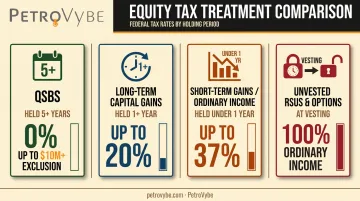
If you hold Qualified Small Business Stock for more than five years, you may be able to exclude a significant portion of your gain from federal tax under IRC Section 1202. In some cases, the exclusion covers the entire amount.
- Stock acquired after September 27, 2010 generally qualifies for a 100% exclusion
- The exclusion is capped at the greater of $10 million or 10x your adjusted basis (legacy stock)
- Stock acquired after July 4, 2025 now qualifies on a faster tiered schedule: 50% after three years, 75% after four, and 100% after five
Here's the catch most people miss: this exclusion isn't automatic. You have to actively claim it on Form 8949 using code "Q," or you lose it entirely. If your equity might qualify, this is worth confirming with a tax professional before you file, not after.
Long-Term Capital Gains: Shares Held Over One Year
Shares held more than one year before closing get taxed at long-term capital gains rates, which top out at 20% federally versus up to 37% for ordinary income. That's a substantial difference on a large payout.
Knowing your exact cost basis matters enormously here, especially for exercised ISOs. If you paid $2 per share to exercise and the deal values shares at $40, your basis is $2, not zero, and getting this wrong means overpaying.
There's also a credit worth checking: if you previously paid Alternative Minimum Tax on ISO exercises, Form 8801 lets you claim a minimum tax credit that can offset some of your current-year liability. Don't leave this money on the table.
Short-Term Capital Gains & Ordinary Income: Shares Held Under a Year
Shares held a year or less get taxed at ordinary income rates, the same brackets as your salary. For high earners, that can mean paying 32%, 35%, or 37% on gains that would have been taxed at 15-20% with just a few more months of holding.
There's a silver lining, though. If you exercise ISOs and sell within the same calendar year, you eliminate the AMT exposure on that exercise entirely. A same-year disqualifying disposition gets taxed as ordinary income instead of triggering the AMT preference item.
Unvested RSUs and Stock Options: Where the Biggest Tax Hit Often Hides
This is where employees get blindsided. Unvested RSUs and unexercised options don't get capital gains treatment at all. They're taxed as 100% ordinary income the moment they're cashed out.
Most acquisitions include "double-trigger" vesting provisions requiring both time-based vesting and a liquidity event (like this acquisition) before shares release. When the deal closes, both triggers fire simultaneously, and every outstanding RSU vests and pays out at once, all as W-2 income in a single tax year.
Here's the withholding gap that catches people off guard:
| Equity Type | Typical Withholding | Risk |
|---|---|---|
| NSOs | Some mandatory federal withholding | Usually closer, but often still short |
| ISOs | Often no withholding at all | You may owe far more than what's withheld |
| Double-trigger RSUs | Standard W-2 withholding (often 22% flat) | Frequently insufficient for high earners |
If your payout pushes you into the 37% bracket but only 22% was withheld, that gap comes due when you file, plus potential underpayment penalties if you don't plan ahead.
Managing the Cash Flow and Timing of Your Payout
Here's a detail that surprises almost everyone: your tax liability is triggered by the acquisition's closing date, not by when you actually access the cash. If the deal closes in November but you don't see funds until January, you may still owe tax for the year the deal closed.
This gets more complicated with escrow holdbacks. According to SRS Acquiom's 2026 M&A deal terms study, 91% of M&A deals include escrow arrangements, with a median holdback of 10% of transaction value held for 12 to 18 months to cover post-closing claims.
That means:
- A portion of your payout may be locked up in escrow for over a year
- Depending on how the deal is structured, you may still owe tax on the full amount at closing, including the escrowed portion
- You need cash on hand to cover taxes on money you haven't fully received yet
The fix: treat a chunk of your payout as already spent the moment it hits your account. Earmark it for taxes immediately, and don't let it get absorbed into everyday spending or a house down payment before you've set aside what the IRS is owed.
To avoid underpayment penalties while you're waiting on final numbers, use the IRS safe harbor rule. It lets you pay the smaller of 90% of your expected current-year tax, or 110% of last year's liability if your prior-year AGI exceeded $150,000. Meeting that threshold protects you from penalties even if your final tax bill isn't settled until you file.
Smart Strategies to Reduce Your Cash Acquisition Tax Bill
Cash acquisitions offer less flexibility than an IPO ramp-up, but you still have real planning levers before year-end.
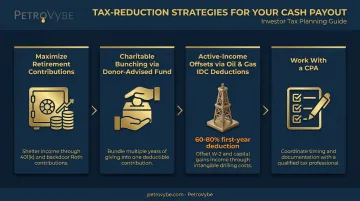
Maximize pre-tax retirement contributions. Front-loading your 401(k) contribution in the acquisition year shelters a slice of ordinary income. If you're eligible, a backdoor Roth strategy can add tax-advantaged capacity beyond standard limits, though watch the pro-rata rule if you hold other traditional IRA balances.
Use charitable giving strategically. A donor-advised fund lets you "bunch" several years of planned donations into one high-income year, claiming the full itemized deduction now while distributing grants to charities over time. This is one of the more underused tools for smoothing a windfall year.
Consider active-income-offsetting alternative investments. This is the strategy most tech employees have never heard of. Most tax shelters only offset passive income. Oil & gas development investments are a notable exception: working interests generate Intangible Drilling Cost (IDC) deductions that apply against active income, including W-2 wages and capital gains, not just passive income.
This is where a firm like PetroVybe becomes relevant to acquisition planning, provided you meet the SEC's accredited investor requirements. PetroVybe structures accredited investor partnerships in Texas natural gas development projects where IDC deductions typically represent 60-80% of invested capital in the first year. PetroVybe's own partners saw a 94% deduction against active income in 2024 and a 91% deduction in 2025:
- A $100,000 investment can generate roughly $60,000-$94,000 in same-year deductions
- Deductions apply directly against W-2 income and capital gains, unlike most real estate losses, which are typically restricted to passive income
- The deduction can be taken in full the first year or spread over five years, depending on your planning needs
For an employee facing a seven-figure payout, this offset can meaningfully reduce the tax hit in the exact year the acquisition closes.
Work with a CPA before year-end. Every one of these strategies interacts with the others, and with your specific payout timing. Model the combinations against your actual numbers before you file, not after.
After the Tax Bill: Making Your Windfall Work for You
Once the tax bill is handled, the real question becomes: what do you do with what's left?
Start with the boring but essential moves:
- Pay down high-interest debt first. Credit cards, personal loans, anything above 7-8% interest should go before any investment decision.
- Diversify out of concentrated positions. If a chunk of your net worth was just tied up in one company's stock, don't recreate that risk by dumping it all into a handful of new tech names.
- Fund major goals. Many employees use post-tax proceeds for a home purchase, while others look toward longer-term passive income vehicles for building legacy wealth. Some accredited investors allocate a portion to tax-advantaged energy partnerships, such as PetroVybe, pairing upfront IDC deductions with monthly passive distributions.
A windfall that isn't diversified is just a different version of the concentration risk you were exposed to before the acquisition. Spread it across asset classes, timelines, and risk profiles that actually match your goals.
Frequently Asked Questions
What are the tax implications of a cash acquisition?
All your equity, including options, RSUs, and shares, gets cashed out in one taxable event. Rates depend on holding period and equity type, often creating a large, unavoidable one-time tax bill.
What determines if an acquisition is taxable or tax-free?
The form of consideration is the key factor. Deals paid mostly in cash are fully taxable, while deals with a significant portion of acquirer stock may qualify for tax deferral.
How are acquisition costs treated for tax purposes?
Deal-related costs like legal and banker fees are generally handled at the corporate level. They don't reduce your personal taxable gain as an individual shareholder.
Do I have to pay taxes on RSUs that vest during an acquisition?
Yes. Double-trigger RSUs typically vest and settle at closing, and the full value is taxed as ordinary W-2 income at that time.
Can I reduce taxes on a cash acquisition using alternative investments?
Yes. Alternative investments, such as oil and gas development partnerships offered by firms like PetroVybe, provide substantial tax deductions that can offset both capital gains and ordinary income from your payout.
When exactly do I owe taxes, at deal closing or when I receive the cash?
Tax liability is triggered at the acquisition's closing date, regardless of escrow holdbacks or when you actually access the funds.