This guide is written for accredited investors evaluating oil and natural gas development opportunities, and for operators managing producing assets. Rigorous assessment protects capital, keeps return projections grounded in reality, and satisfies regulatory obligations that don't bend for optimism.
Here's the problem: "asset risk assessment" gets thrown around as a buzzword, often reduced to a checklist exercise. In high-uncertainty industries like oil and gas, that checklist mentality can be dangerous. This article breaks down what the process actually is, why it matters for oil and gas capital specifically, how it works step-by-step, which factors swing the outcome, and where it falls short.
Key Takeaways
- Asset risk assessment evaluates geological, operational, and financial risk before and after capital deployment
- Dry holes, overestimated reserves, and price volatility are the primary threats to investor capital
- The process moves through data collection, threat analysis, prioritization, and ongoing monitoring
- Third-party engineering validation and experienced technical teams cut uncertainty significantly
- Treating it as a one-time checklist, rather than an ongoing practice, is the most common and costly mistake operators make
What Is Asset Risk Assessment in Oil and Gas Development?
Asset risk assessment, in this context, is the evaluation of geological, operational, and financial risks tied to producing wells, undeveloped acreage, and booked reserves. It answers a simple question: how confident should capital be in this asset's projected performance?
Done well, it enables informed capital allocation and realistic MOIC and IRR projections while protecting the money already committed. Done poorly, it produces reserve reports that look great on paper and fall apart in the field.
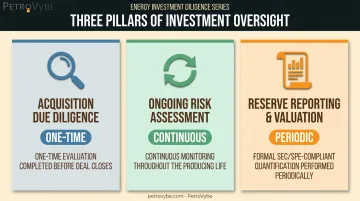
This evaluation differs from three adjacent processes that serve distinct purposes:
- Acquisition due diligence: a one-time evaluation before a deal closes
- Ongoing risk assessment: continuous monitoring throughout the asset's producing life
- Reserve reporting and valuation: the formal accounting and engineering exercise that quantifies value under SEC or SPE standards
Each one answers a different question at a different point in the investment lifecycle. Confusing them is how gaps in oversight open up.
Why Asset Risk Assessment Is Critical in Oil and Gas Development
Drilling is expensive, geology is uncertain, and commodity prices swing hard. Those three facts alone justify rigorous assessment.
Brent crude, for example, averaged $85 per barrel in June 2026, down $22 from May and $32 from the April peak in the same year, according to EIA's Short-Term Energy Outlook. That kind of swing can turn a marginal well economic, or uneconomic, inside a single quarter.
Volatility like that exposes weak assumptions fast. Oil and gas investing demands accurate reserve estimates, a working understanding of decline curve behavior, and well economics grounded in real production data rather than optimistic type curves. Without that discipline, reserves get overestimated and capital gets lost.
What Happens Without Rigorous Assessment
A 2009 SEC complaint illustrates the risk starkly. The agency alleged that Hartmut Rose and James Reedy raised more than $10 million from over 300 investors for onshore drilling projects, according to the SEC's complaint.
They continued soliciting completion funds without disclosing that their own geologists had advised against further spending, while portraying dry holes as successful wells. That's alleged conduct, not an adjudicated loss figure, but it's a clear picture of what inadequate geological risk evaluation can enable.
Regulatory Minimum vs Best Practice
Reserve reporting isn't optional for public companies. SEC Regulation S-X Rule 4-10 defines proved reserves, and disclosure requirements sit in Regulation S-K Subpart 1200. In Texas, operators need a current Form P-5 organizational filing and an approved Form W-1 before drilling.
Private partnerships aren't always bound by the same public-company disclosure rules. That's exactly why independent, third-party engineering validation matters even more.
PetroVybe's own producing assets carry a $48MM proved reserves valuation, determined on a PV-09 basis by a licensed third-party engineering firm. That's a step beyond the regulatory minimum, not a substitute for it.
Pairing that valuation with technical oversight adds another layer of confidence. PetroVybe's Chief Geophysicist holds a 75.2% career hit rate on profitable well locations, against an industry peer average below 40%. That track record reduces assessment uncertainty in a way generic industry assumptions never will.
Where Asset Risk Assessment Fits in the Investment Lifecycle
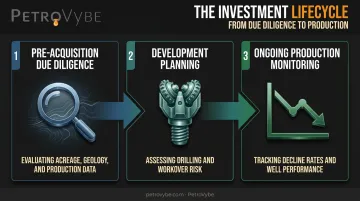
Risk assessment isn't a single event. It shows up at three distinct stages:
- Pre-acquisition due diligence: evaluating acreage, geology, and existing production data before any capital moves
- Development planning: assessing drilling and workover risk before deploying capital into new wells
- Ongoing production monitoring: tracking decline rates, well performance, and emerging risks throughout the asset's producing life
Skipping any one of these stages leaves a blind spot the others can't cover.
How Asset Risk Assessment Works (Conceptual Flow)
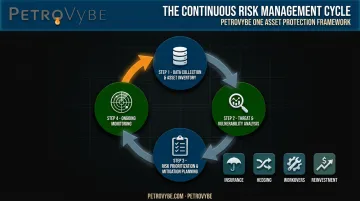
At a high level, the process moves from data gathering to threat and vulnerability analysis, then to risk prioritization, then to mitigation and ongoing monitoring. It's a loop: new production data feeds back into every prior stage.
The inputs are specific: geological and seismic data, historical production records, financial models, and third-party engineering reports. The core analysis identifies threats such as mechanical failure, price volatility, and dry holes, alongside vulnerabilities like aging infrastructure or unproven acreage.
Experienced technical oversight changes the reliability of the whole exercise. Independent geological review, combined with a CFO who understands both the engineering and financial sides, closes the gap that usually opens between subsurface reality and financial projections.
PetroVybe's CFO, Clayton Riddle, is a working example: a petroleum engineer by training who has modeled financial outcomes on more than 70 upstream and midstream acquisition opportunities. That means engineering assumptions translate directly into financial models without a lost-in-translation step.
The result of a properly run process: a risk-ranked asset list, adjusted capital allocation, and clearer go/no-go decisions on new development.
Step 1: Data Collection and Asset Inventory
Every well or asset needs a baseline. That means gathering geological data, production history, financial performance, and infrastructure details before applying any judgment. For a well site, that baseline might include casing depth, current lease operating expenses, and remaining reserve estimates. Skipping this step means every later conclusion rests on incomplete information.
Step 2: Threat and Vulnerability Analysis
This step evaluates geological uncertainty, mechanical risk, market risk, and regulatory risk for each asset individually. A well with strong production history but aging surface equipment carries a different risk profile than a new drill on unproven acreage, even if both sit on the same lease. The first calls for tighter mechanical monitoring; the second calls for conservative reserve estimates until production data accumulates.
Step 3: Risk Prioritization and Mitigation Planning
Once the team identifies a risk, it ranks that risk by probability and impact, assigns ownership, and matches it to a response:
- Insurance for mechanical and casualty risk
- Hedging programs for commodity price exposure
- Workovers for declining or underperforming wells
- Reinvestment discipline to compound output rather than chase exits
This is also where PetroVybe's PROTECT and SCALE framework operates in practice: PROTECT covers legacy asset workovers and optimization, while SCALE directs capital toward new drilling identified through geological and production data analysis.
Key Factors That Affect Asset Risk Assessment in Oil and Gas Development
Several variables determine how reliable an assessment actually is:
- Geological and reservoir data quality: Seismic resolution and well log accuracy shape confidence in reserve estimates. Per PRMS (Petroleum Resources Management System) guidance, seismic data alone can be insufficient to define fluid contacts for proved reserves
- Operating conditions: Commodity price environment, decline curve behavior, and mechanical integrity of producing wells all shift month to month
- Equipment and system dependencies: Drilling rig availability, gathering systems, and pipeline access can delay or derail development timelines
- Scale, frequency, and pace of development: A portfolio of 400 wells across 58,000 acres carries far more monitoring complexity than a handful of wells on one lease
- Regulatory and safety constraints: Texas Railroad Commission compliance and SEC reserve reporting rules set the floor every operator has to clear
Decline curve modeling deserves a specific callout. EIA's own shale and tight-oil model shifts from hyperbolic to exponential decline at 0.8% monthly (roughly 10% annually), but that's a modeling convention, not a guaranteed rate for any individual well.
Applying a generic decline assumption to a specific asset without validating it against nearby producing wells is one of the more common ways reserve estimates go wrong.
Common Misconceptions and When Asset Risk Assessment Isn't Enough
The biggest misconception: a single point-in-time assessment is sufficient for a multi-year development project. It isn't. Prices move, wells decline, and new data changes conclusions constantly.
A few other traps worth naming:
- Checklist thinking: completing a risk register form without applying real technical geological or engineering judgment to the results
- Confusing documentation with risk reduction: a filled-out risk register doesn't lower actual exposure unless teams execute the mitigation steps
- Asset-only tunnel vision: teams focus entirely on well-level risk while missing enterprise-level exposure like governance, capital markets access, or broader commodity cycles
An asset-only approach works best when paired with a portfolio-level risk framework that captures what individual well assessments can't. Rigorous, data-anchored asset risk assessment, paired with experienced technical teams and third-party validation, is what separates protected capital from expensive surprises in oil and gas development.
Frequently Asked Questions
What is an asset risk assessment?
Asset risk assessment is the structured process of identifying and evaluating threats to an organization's assets (in oil and gas, that means wells, reserves, and infrastructure) to inform protective and investment decisions.
What are the 5 things a risk assessment should include?
Asset identification, threat and vulnerability analysis, risk prioritization, mitigation planning, and ongoing monitoring. Skipping any one leaves gaps that surface later, usually at the worst time.
What are the 4 types of risk assessment?
Common approaches include qualitative, quantitative, asset-based, and threat-based methods. None of these is a universal industry standard; they're practical labels for different ways of framing the same underlying analysis.
How do oil and gas companies assess investment risk before drilling?
Through geological review, historical production data analysis, and independent engineering validation of reserve estimates. Comparing a new location's projected decline curve against nearby producing wells adds another layer of confidence.
What is a risk matrix and how is it used in asset management?
A risk matrix plots likelihood against impact to help teams prioritize which risks need immediate attention versus ongoing monitoring. It's a visualization tool, not a substitute for technical judgment.
How often should an asset risk assessment be updated for producing wells?
Reviews should happen periodically, and also whenever new production data, commodity price shifts, or performance changes emerge, rather than only once at acquisition.