

Introduction
Picture two people with an identical $5 million net worth. One built a plumbing business from a single truck and eighteen-hour days. The other received a trust from a grandparent who ran a chemical company back in the 1970s. Same balance sheet, entirely different relationship with money.
That gap matters more today than ever. Cerulli Associates projects that $123.7 trillion will change hands between 2024 and 2048, with roughly $105.3 trillion of it flowing directly to heirs. Whether you're building wealth from zero or preparing to receive it, the habits, tax rules, and mindset behind each path diverge sharply.
This guide breaks down what actually separates self-made from inherited wealth, what the research shows about who keeps it and who loses it, and the practical strategies (tax-advantaged investing included) that help you build wealth designed to last.
Key Takeaways
- Self-made and inherited wealth differ in tax treatment, ownership, and growth potential, not just how it arrived
- Only 21% of American millionaires inherited any wealth, per Ramsey's National Study of Millionaires
- Roughly a third of inheritors see wealth shrink or stay flat after receiving it
- Deliberate strategies like tax-advantaged investing and disciplined saving separate lasting wealth from fortunes that fade fast
Self-Made vs. Inherited Wealth: Quick Comparison
Before going deeper, here's how the two paths stack up across the factors that matter most.
| Dimension | Self-Made Wealth | Inherited Wealth |
|---|---|---|
| Origin | Built through business, career earnings, active investing | Received via estate, trust, or family gift |
| Global prevalence | Majority of billionaires are self-made in entrepreneurial economies like the U.S. | Dynastic wealth still dominates in countries like Germany, Spain, and Italy |
| Tax treatment | Ordinary income/capital gains rates unless structured through tax-advantaged vehicles | Often benefits from a stepped-up basis on appreciated assets |
| Mindset | Driven by "what's next," confidence from personal risk | Often paired with questions about legitimacy and competence |
| Sustainability | Discipline and saving habits compound over decades | A meaningful share of inheritors see no growth or outright decline |
Tax Treatment: The Stepped-Up Basis Advantage
Self-made income (salary, business profits, capital gains) usually gets taxed at ordinary or capital gains rates the moment it's realized, unless it flows through a tax-advantaged structure. Inherited assets play by different rules.
When someone inherits stock, real estate, or a business, the asset's cost basis resets to its market value on the date of death.
Brookings research explains that this stepped-up basis wipes out the original owner's lifetime appreciation for tax purposes. The heir never pays income tax on decades of gains that happened before they owned the asset.
Psychological Ownership: Confidence vs. Legitimacy
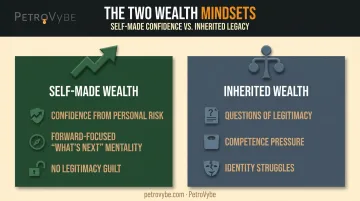
Tax treatment isn't the only place these two paths diverge: the psychology behind each differs just as sharply. Self-made wealth builders tend to operate from a "what do I do next" mentality. Conviction earned through personal risk shapes how boldly they invest and spend.
Inheritors often carry a different internal script. Practitioner research on inheritor psychology describes recurring struggles with legitimacy, competence, and identity. Heirs frequently feel pressure to prove they deserve what they received, producing hesitation rather than confidence.
What is Self-Made Wealth?
Self-made wealth is money built through your own effort — not something that showed up in a will. It's the business started from a garage, the career maximized over two decades, the investment portfolio built one contribution at a time.
What actually drives it? Ramsey's National Study of Millionaires surveyed more than 10,000 American millionaires and found the top two self-reported factors behind their net worth weren't salary size or family money. They were financial discipline and consistent saving over time.
That independence carries a psychological edge too. Self-made wealth builders don't carry the "did I earn this?" question that can slow down inheritors. There's no legitimacy guilt weighing on decisions — just the next opportunity to evaluate.
Use Cases of Self-Made Wealth
Self-made wealth tends to show up in a few recognizable patterns:
- First-generation entrepreneurs who build a company from nothing and reinvest profits instead of cashing out early
- High-income W-2 professionals (doctors, engineers, executives) who invest aggressively instead of just saving
- Founders who exit a business and redeploy the proceeds into new ventures or passive assets
Analysis of Forbes billionaire scores suggests a strong majority of U.S. billionaires are self-made, reflecting how entrepreneurial economies tend to mint more founders than heirs. What's clearer: Ramsey's data shows 79% of American millionaires received no inheritance whatsoever. Most people who reach millionaire status get there through paychecks, budgets, and index funds — not family money.
What is Inherited Wealth?
Inherited wealth is money, property, or a business transferred to you through a will, trust, or family gift, not something you built or earned directly. The transfer might be immediate, like a lump-sum trust distribution, or gradual, like years of informal family support.
Inheritance rarely arrives in isolation. Brookings researchers describe a "glass floor" effect: children raised in affluent families gain protection from downward mobility through school quality, social networks, and family connections, even when their own measured skills are modest.
That head start can accelerate wealth-building, but it doesn't guarantee smooth stewardship. Heirs often wrestle with governance challenges researchers describe as over-control (micromanaging every dollar out of fear), over-distance (avoiding financial involvement entirely), or over-performance (working obsessively to prove they didn't just get lucky).
Use Cases of Inherited Wealth
Inherited wealth typically shows up as:
- Family business succession — passing operational control and equity to the next generation
- Dynastic wealth in countries with strong old-money traditions
- Next-generation stewardship of family trusts and investment funds
Old-money traditions still dominate in parts of Europe and Latin America. Billionaire data shows inherited fortunes make up a far larger share of wealth there than in the U.S. Countries like Germany, Belgium, and Mexico show significantly lower self-made shares than entrepreneurial hubs like the U.S. or China.
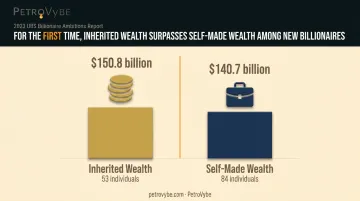
The risk side of the ledger is real too. UBS's 2023 Billionaire Ambitions Report found that for the first time in the report's history, new billionaires inherited more wealth than they created that year. Heirs received $150.8 billion across 53 individuals, compared with $140.7 billion earned by 84 self-made entrepreneurs.
Receiving wealth isn't the same as keeping it. Ohio State research found that 34.9% of inheritors saw their wealth stay flat or decline after the transfer. Roughly half of inherited money gets spent or lost rather than saved and grown.
Self-Made vs. Inherited Wealth: Which Builds Lasting Wealth?
There's no universal winner here. The real question is which factors matter for your specific situation.
Weigh these before deciding how to build, or steward, wealth:
- Origin of capital: do you have existing assets or are you starting from zero?
- Risk tolerance: self-made builders often take on more risk, while inheritors may be more cautious with money they didn't create
- Tax exposure: active income faces different rules than inherited assets
- Family dynamics: governance and communication matter more with inherited capital
- Long-term discipline: habits, not origin, determine whether wealth grows or shrinks
If You're Starting From Scratch
Prioritize disciplined saving paired with tax-efficient active investing. The habits behind Ramsey's millionaires, like consistent contributions and avoiding lifestyle inflation, work regardless of starting income.
High-income earners can also offset active income directly. Vehicles like direct oil and gas development partnerships offer intangible drilling cost deductions against W2 earnings and capital gains, something inherited capital rarely provides.
If You're Receiving or Expecting an Inheritance
Don't assume the money manages itself. Financial education, professional guidance, and a clear purpose for the capital matter more than the size of the transfer.
UBS's billionaire research found that first-generation billionaires are roughly twice as likely as their heirs to name philanthropy as a top legacy goal: 68% versus 32%. Values shift across generations even when the balance sheet doesn't.
Building Your Own Legacy Wealth: The Self-Made Path Forward
Whether your wealth came from a business exit or a family trust, sustaining it requires the same playbook: reduce your tax burden, generate passive income, and hold assets that appreciate in real terms, not just on paper.
For accredited investors carrying a heavy active-income tax bill, one underused lever is direct participation in energy development.
Oil and gas investments carry a tax provision most other asset classes don't offer: Intangible Drilling Cost (IDC) deductions can offset active income, including W-2 wages and capital gains, not just passive income. Real estate deductions, by contrast, are typically restricted to offsetting passive income unless you qualify as a full-time real estate professional.
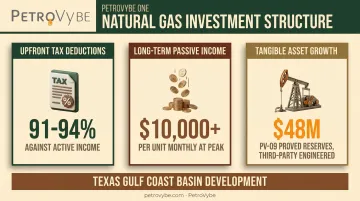
This is where PetroVybe fits into the picture. PetroVybe is a Texas-based natural gas development company operating in Lavaca County and the Gulf Coast Basin, offering accredited investors direct equity participation in upstream energy projects. The structure centers on three things:
- Upfront tax deductions: partners have historically received deductions in the 91-94% range against active income in recent program years
- Long-term passive income: monthly distributions are projected to peak above $10,000 per unit once the multi-year development phase reaches production
- Tangible asset growth: proved reserves independently valued at $48 million (PV-09) by a third-party engineering firm, not self-reported
Participation requires accredited investor status and a $100,000 minimum. This reflects a long-hold, illiquid strategy built for multi-decade compounding rather than quick trades. It works whether you're a self-made builder in a high-earning window or an inheritor redeploying family capital into something with independent third-party validation.
Lasting wealth, whichever path brought you to the starting line, depends on deliberate structure: tax efficiency, compounding assets, and consistent stewardship applied over years, not the luck of origin.
Frequently Asked Questions
Is it better to earn wealth or inherit it?
Self-made wealth tends to build stronger financial discipline, while inherited wealth offers a head start but requires deliberate stewardship to avoid decline. Neither path is inherently better; outcomes depend on how the wealth is managed.
What percentage of wealth is inherited versus earned?
Brookings estimates that 35-45% of wealth is inherited rather than self-made, based on economist Wojciech Kopczuk's research. Separately, analysis of billionaire data suggests roughly two-thirds of the world's billionaires built their fortunes independently.
What are the four types of wealth?
Financial, social, time, and physical/health wealth are commonly cited as core categories people build over a lifetime. Self-made and inherited paths primarily affect financial wealth. The other three depend more on personal choices than money's origin.
Can inherited wealth be lost or squandered?
Yes. Ohio State research found that 34.9% of inheritors saw no wealth growth or an outright decline after receiving an inheritance, with roughly half of inherited money eventually spent or lost rather than saved.
Do most millionaires actually inherit their wealth?
No. Ramsey's National Study of Millionaires found that 79% of American millionaires received no inheritance at all, with only 21% receiving any inheritance, however small.
What tax strategies help build self-made wealth faster?
Tax-advantaged investments, like direct participation in natural gas development, offer deductions against active income rather than just passive income. This structure can accelerate wealth building for high-income earners compared to standard taxable accounts.