
Accounting statements are built to classify, not to capture true worth. A commercial building purchased in 2005 might sit on the books at its original cost, decades below what it would fetch today. Meanwhile, a software company's most valuable asset, its brand or customer data, may not appear on the balance sheet at all.
This isn't sloppiness. It's how GAAP works. Asset valuation and income measurement are two sides of the same coin: how you value an asset directly determines how much income it reports in any given year. This guide breaks down the accounting principles behind asset measurement, the three primary valuation approaches, and how these ideas play out in a real asset class: natural gas development.
Key Takeaways
- Valuation and income measurement aren't separate exercises; one drives the other
- GAAP defaults to historical cost and conservative estimates, not market value
- The income, market, and cost approaches cover nearly every valuation scenario
- Depreciation and depletion method choice changes the timing of reported income, not just its size
- Independent, third-party reserve valuations add credibility to hard-to-value assets like producing gas wells
What Is Asset Valuation and Income Measurement in Accounting?
Asset valuation is the process of assigning a dollar figure to something a company owns, whether that's a building, a patent, or a producing oil well, for financial reporting purposes. Income measurement is the process of quantifying how much that asset, or the business as a whole, earned over a specific period.
These two exercises aren't independent. The valuation method chosen for an asset flows directly into the income statement. Depreciation schedules, depletion calculations, and impairment write-downs all originate from a valuation decision, then reduce or delay reported profit.
Balance sheets sort assets into four broad buckets, each treated differently under GAAP:
- Fixed/tangible assets: buildings, equipment, wells; typically held at historical cost less accumulated depreciation or depletion
- Current assets: cash, receivables, inventory; often valued at cost or market, whichever is lower
- Investments/securities: frequently marked to fair value, with gains or losses flowing through earnings
- Intangible assets: patents, trademarks, goodwill; often understated or missing entirely unless acquired in a transaction
This distinction matters for anyone comparing alternative assets, real estate, private equity, natural gas development, against traditional stocks and bonds. A public company's book value might bear little relationship to what the business is actually worth.
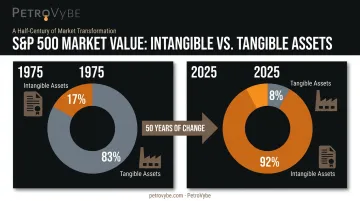
Consider the scale of that gap. Ocean Tomo's 2025 Intangible Asset Market Value study estimates intangible assets now make up roughly 92% of S&P 500 market capitalization, up from just 17% in 1975. That gap isn't a literal book-to-market comparison, but it shows how far historical-cost accounting can drift from what markets believe an asset is worth.
The reverse often holds true for income-producing, asset-heavy investments like natural gas wells. Reserves can be worth more than a simple cost-based number suggests. That's exactly why independent, income-based valuations carry so much weight in this industry.
Core Accounting Principles Underlying Asset Measurement
Four ideas anchor how U.S. GAAP treats asset value. Understanding them explains why a company's books rarely match its market price.
Historical Cost and the Primacy of Book Value
GAAP treats historical cost, the original purchase price adjusted for improvements, as the default measure of asset value. This is what accountants call book value. Historical cost doesn't always reflect current worth, but it offers something more valuable: verifiability. The figure comes from an actual transaction, not an estimate.
That reliability comes at a cost. A warehouse bought for $2 million in 2010 might carry a book value well below its current market price, and GAAP won't automatically restate it upward.
Conservatism: Preferring to Underestimate Value
When more than one valuation approach is available, accountants have traditionally leaned toward the lower, more cautious figure. This is the conservatism principle: better to understate an asset than overstate it.
But FASB's current conceptual framework pushes back on treating this as a formal rule. The 2024 FASB Conceptual Framework notes that systematically understating assets or overstating liabilities conflicts with neutrality and can distort future-period performance. Conservatism survives as a practical convention, not a codified qualitative characteristic.
Distrust of Market and Estimated Values
GAAP treats market-based or cash-flow-estimated values with real skepticism. Fair value can swing with sentiment or illiquidity in ways historical cost doesn't. That's why fair value measurement, used for certain investments and securities, comes wrapped in disclosure requirements meant to flag its subjectivity.
GAAP isn't purely historical-cost accounting, nor purely fair-value accounting. It's a mixed model, and different asset types call for different measurement bases.
Depreciation and Depletion's Role in Income Measurement
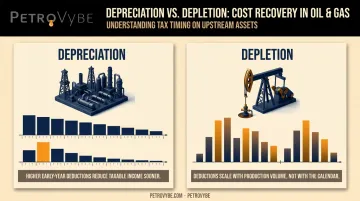
The method used to allocate an asset's cost over time changes when income shows up, not just how much.
| Method | Pattern | Effect on early-year income |
|---|---|---|
| Straight-line | Equal expense each period | Smoother, more predictable net income |
| Accelerated (declining balance) | Larger charges early, smaller later | Lower income early, higher later |
In capital-intensive, resource-based industries like oil and gas, depletion plays the role depreciation plays elsewhere, except it's tied to units of reserves produced rather than time. Get the reserve estimate wrong, and both the depletion expense and reported income shift. That sensitivity is exactly why independent, third-party reserve reports carry so much weight in this industry, a theme worth returning to below.
The Three Primary Approaches to Asset Valuation
Professional appraisers and financial experts generally rely on three approaches to determine what something is worth. Each starts from a different question.
Income Approach
The income approach converts an asset's expected future economic benefits into one present-value figure. Two techniques dominate:
- Discounted Cash Flow (DCF): forecasts cash flow period by period, then discounts each to today's dollars; suited to variable, multi-stage cash flows
- Capitalized Cash Flow (CCF): applies a single capitalization rate to one stabilized benefit stream; suited to steady, perpetual income
This approach fits income-producing assets with predictable, ongoing cash flow best: operating companies, producing wells, rental properties. Oil and gas reserve valuations, for example, often use a PV-9 analysis, a discounted cash flow method that projects reserve revenue year by year and discounts it at a standard 9% rate to estimate proved reserve value.
Market Approach
The market approach values an asset by comparing it to similar assets that recently sold or traded, such as comparable company multiples or precedent transactions. It works well when there's an active market with genuinely comparable data.
Its limitation shows up fast with illiquid, unique, or early-stage assets. A niche private company, or a newly drilled well with no production history, simply doesn't have enough comparable sales data for this approach to stand alone.
Asset (Cost) Approach
The asset approach sums the value of a business's tangible and intangible assets, net of liabilities, to arrive at net asset value. It rests on the principle of substitution: a rational buyer won't pay more than it would cost to acquire a comparable substitute.
This approach suits capital-intensive businesses, real estate holding companies, and investment holding entities best. It often produces something closer to a liquidation value than a going-concern value, since it doesn't directly capture earning power.
In practice, valuation experts rarely rely on just one approach. They blend all three, weighting each based on asset type and data quality, then reconcile the results into a final conclusion of value.

Asset Valuation vs. Income Measurement: What's the Real Difference?
It's easy to conflate these two ideas since they're so tightly linked. They aren't the same thing.
| Aspect | Valuation | Income Measurement |
|---|---|---|
| Type | Point-in-time worth estimate | Ongoing performance tracking |
| Timing | Snapshot as of a specific date | Period-over-period record |
A chosen valuation method, such as accelerated depreciation instead of straight-line, doesn't just change the balance sheet. It also changes how much income gets reported in a given year, even though the underlying asset itself hasn't changed.
Overvaluing an asset's future benefits, for instance, by assuming an overly optimistic production decline curve, can inflate projected income figures in ways that mislead investors or lenders. The asset hasn't changed; only the assumptions have.
That's why serious operators pair internal projections with independent, third-party valuations:
- Internal projections: rely on assumptions the company controls, like decline curves
- Third-party valuations: come from outside engineering firms, such as the one behind PetroVybe's $48MM PV-09 reserves report
- Credibility: an independently confirmed number carries far more weight with investors than one a company produces itself
The 4 Core Principles of Valuation
Four foundational principles from appraisal theory support every valuation approach. They explain why professionals choose one method over another for a given asset.
- Substitution: A rational buyer won't pay more for an asset than it would cost to acquire an equally desirable substitute; this reasoning underlies comparable-sales and replacement-cost approaches.
- Anticipation: Value reflects expected future benefits, not just historical performance. This principle underlies income capitalization and DCF models: what matters is what the asset will produce, not what it has produced.
- Highest and best use: An asset's value reflects its most profitable, legally permissible use, one that's physically possible, financially feasible, and maximally productive.
- Supply and demand: Price moves with the balance between availability and desire. More buyers chasing fewer comparable assets pushes value up, and vice versa.
Appraisers lean on these principles to decide which method fits a given asset.
| Asset Characteristic | Best-Fit Approach |
|---|---|
| Strong anticipated cash flow | Income approach |
| Reproducible asset, no unique earning power | Cost approach |
| Trades in a liquid, active market | Market approach |
Applying These Principles to Natural Gas Development Assets
Oil and gas reserves are a textbook case of the income approach in action, and one of the clearest illustrations of why independent verification matters.
How Proved Reserves Get Valued
Companies value proved reserves using PV-10 methodology (or a comparable discount-rate variant), an income-approach technique that discounts future net revenue from those reserves back to present value. The SEC defines PV-10 as the present value of estimated future net revenues from proved reserves, discounted at 10% per year before income taxes.
It's a disclosure convention rather than a fair-value measurement. Independent third-party engineering firms typically validate the figure rather than calculating it in-house.
A Real-World Example
PetroVybe's own reserve portfolio illustrates this principle. The company's proved reserves have been valued at $48 million on a PV-9 basis, independently determined by a licensed third-party engineering firm rather than an internal estimate. That distinction, outside verification instead of self-reported figures, is exactly the kind of rigor the income approach depends on to be credible.
Getting the reserve estimate right starts upstream, with location selection. PetroVybe's Chief Geophysicist, Michael Stamatedes, has picked well locations at a 75.2% success rate over a 48-year career, well above the industry peer average of under 40%. Since the decline curve behind any reserve estimate depends heavily on where wells get placed, that track record feeds directly into the confidence behind the numbers themselves.

From Valuation to Investor Metrics
This is where income measurement re-enters the picture. Metrics like EBITDAX (earnings before interest, taxes, depreciation, amortization, and exploration expense) and depletion accounting translate verified reserve value into the ongoing income story investors actually see.
PetroVybe reports its lead project at 33% EBITDAX-positive operations, and structures its natural gas development partnerships across South Texas and the Gulf Coast Basin around two investor-facing metrics:
- MOIC (Multiple on Invested Capital): projected in the 2.2x to 5.8x range over a 10-year hold
- IRR (Internal Rate of Return): projected around 26% over the same period
Both figures are forward-looking projections tied to production, pricing, and reinvestment assumptions, not guarantees. But they trace the throughline this guide has been following: a verified reserve valuation feeds a depletion schedule, which feeds reported income, which ultimately determines what a partner actually earns.
Frequently Asked Questions
What is the income approach to asset valuation?
It converts an asset's expected future cash flows into a single present-value figure. Analysts use discounted cash flow (DCF) for variable, multi-period earnings, or capitalized cash flow for stable, ongoing income.
What are the three methods of asset valuation?
The income, market, and asset (cost) approaches. Income works best for cash-flow-generating assets, market for assets with comparable sales data, and cost for reproducible or capital-intensive assets.
What is the difference between valuation and measurement?
Valuation is a point-in-time estimate of what something is worth. Income measurement is the ongoing accounting process that tracks financial performance period over period under GAAP rules.
What are the 4 principles of valuation?
Substitution, anticipation, highest and best use, and supply and demand. Together, they explain why buyers won't overpay for an asset and why value depends on future benefit, not past cost.
How does depreciation affect income measurement?
The depreciation method chosen, straight-line versus accelerated, changes the timing and size of the expense recognized each period. This directly raises or lowers reported net income year to year.
Why does asset valuation matter for investors?
Accurate valuation reveals whether an asset is fairly priced, undervalued, or overvalued. For income-producing assets like natural gas wells, an independently verified valuation gives investors a credible basis for evaluating projected returns.