
For long-payback ventures like natural gas development, where capital goes into the ground years before it comes back out, the stakes are even higher. This article isn't about theoretical finance frameworks. It's about what cash flow modeling actually does for operators and accredited investors trying to meet obligations, fund growth, and hit return targets.
Key Takeaways
- Cash flow modeling forecasts future cash movement, not accounting profit
- It flags shortfalls and surpluses before they become emergencies
- Disciplined modeling improves capital allocation, financing, and investor trust
- Skipping it leads to reactive decisions and missed growth windows
- Value comes from consistent use, not a one-time spreadsheet
What Is Cash Flow Modeling?
A cash flow model is a forward projection of a business's expected cash inflows and outflows over a defined period. It's built from assumptions about revenue, expenses, capital expenditures, financing, and taxes.
It differs from a historical cash flow statement by looking ahead instead of back, and from accrual-based profit by tracking actual cash movement rather than revenue recognition timing.
You'll typically find cash flow modeling applied in:
- Corporate budgeting: planning spend against expected inflows
- M&A and acquisition valuation: projecting post-close cash generation
- Credit and lender negotiations: proving repayment capacity
- Capital-intensive project evaluation: clarifying payback timing and distribution schedules for long-cycle assets like oil and gas developments
A cash flow model works as a decision-making tool. Its real value shows up when leadership and investors know exactly what to do next.
Key Advantages of Cash Flow Modeling
The advantages below aren't abstract. They tie directly to metrics businesses and investors already track: liquidity, capital efficiency, and access to financing. Here's how each one plays out in practice.
Improved Liquidity Planning and Risk Mitigation
This advantage is about spotting a cash shortfall or surplus before it happens, not reacting once it's already a problem. Driver-based inputs, paired with scenario and sensitivity testing, surface risk points weeks or months in advance.
The scale of the problem is real. In the 2024 Small Business Credit Survey of 7,653 employer firms, 51% reported uneven cash flows as a financial challenge, and 56% reported difficulty paying operating expenses, according to the Federal Reserve Banks' 2025 report. Early visibility into these gaps lets a business delay discretionary spend or line up financing before a shortfall turns into a crisis.
KPIs impacted:
- Cash runway
- Days cash on hand
- Working capital ratio
- Covenant compliance
This matters most for capital-intensive, long-payback businesses with lumpy revenue timing or leveraged financing. Natural gas development is a textbook example, since production ramps unevenly, drilling costs hit early, and revenue depends on commodity pricing that swings month to month.
Hedging a portion of production and diversifying across oil, gas, and NGLs are two ways operators smooth that volatility out on paper before it hits the bank account.
Smarter Capital Allocation and Reinvestment Decisions
This advantage comes down to knowing precisely when surplus cash exists to redeploy into growth, and when it should be conserved instead. Modeling multiple reinvestment scenarios, such as funding new development versus building reserves, mirrors how growth-stage operators actually compound returns.
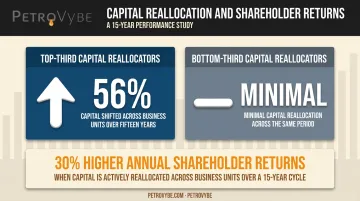
The data backs this up. McKinsey's analysis of 1,616 U.S.-listed companies from 1990 to 2005 found that companies in the top third for capital reallocation shifted an average of 56% of capital across business units over 15 years. Those same companies earned 30% higher annual shareholder returns than the bottom third, relative to peers (McKinsey, 2012).
Timed correctly, capital deployment directly improves return metrics like MOIC and IRR rather than just chasing whatever opportunity appears next.
KPIs impacted:
- Free cash flow
- MOIC and IRR
- Reinvestment rate
- Capital efficiency
The clearest use case is multi-project portfolios that require prioritizing between competing capex opportunities. PetroVybe's dual-strategy approach illustrates this well. One track (PROTECT) directs cash flow toward acquiring and optimizing legacy production, while the other (SCALE) reinvests operating cash flow into new well development across its Lavaca County acreage.
Which track gets funding in a given quarter depends on the model, not a gut call.
Stronger Investor and Lender Confidence
A transparent, well-built cash flow model signals financial discipline to anyone providing capital. Independent, third-party-validated projections carry weight that internal assumptions alone can't match.
Lenders lean on this heavily. Debt-service coverage ratio, calculated as net operating income divided by total debt service, is a standard underwriting metric.
Regulatory guidance for income-property lending generally calls for a stabilized DSCR of 1.20x or higher, though the exact threshold shifts based on collateral quality and structure. Credible projections that clear this bar tend to improve financing terms and speed up deal close rates.
KPIs impacted:
- Investor retention rate
- Cost of capital
- Financing terms
- Time-to-close on deals
Credibility like this matters most when raising capital from accredited investors, negotiating credit lines, or going through M&A due diligence. PetroVybe pairs in-house financial modeling, led by CFO Clayton Riddle, with independent engineering validation.
That combination is how the company arrived at its $48MM proved reserves valuation (PV-09), a figure verified by a licensed third-party engineering firm rather than generated internally. Investors reviewing the PetroVybe ONE offering see both the internal ProForma P&L and the outside engineering report side by side, not just one or the other.
What Happens When Cash Flow Modeling Is Missing or Ignored
Skipping disciplined cash flow modeling doesn't usually blow up immediately. It shows up gradually, and then all at once.
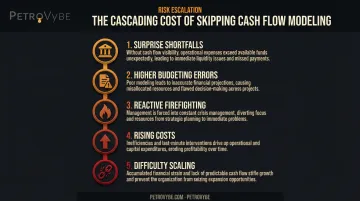
- Surprise shortfalls despite reported profitability: accrual profit looks fine while the bank account tells a different story
- Higher error rates in budgeting: decisions get made on incomplete forward visibility
- Reactive firefighting: leadership spends time reacting to cash crunches instead of planning around them
- Rising costs over time: emergency financing, missed early-payment discounts, and rushed decisions all cost more than planned ones
- Difficulty scaling: as a business or portfolio grows, financial oversight can't be delegated without a model to guide it
None of this is theoretical. It's the predictable outcome of running a business or a portfolio of assets on hope instead of a forecast.
How to Get the Most Value from Cash Flow Modeling
A cash flow model only delivers value when it stays in active use well past the raise, revisited every reporting period and updated as new information comes in.
- Apply it consistently across every reporting period, not once at launch
- Review outcomes against actuals through regular variance analysis, catching drift before it compounds
- Act on what the model tells you — adjusting financing, spend, or reinvestment timing rather than just noting the gap
PetroVybe's AI-based iterative underwriting is a version of this in practice: every well result feeds back into the model, tightening assumptions instead of letting a static projection go stale. That feedback loop keeps the model driving real decisions, from financing terms to reinvestment timing, long after the raise closes.
Conclusion
Cash flow modeling comes down to control and clarity in how financial decisions get made, built through consistent, disciplined forecasting. Its advantages compound over time, especially for capital-intensive ventures like natural gas development, where the timing of cash matters nearly as much as the returns themselves.
Treat it as an ongoing discipline rather than a one-time forecasting exercise. For PetroVybe, that discipline drives how monthly distributions and tax advantages reach accredited investors throughout a well's production life.
Frequently Asked Questions
What is a cash flow model?
A cash flow model is a forward-looking projection of a business's expected cash inflows and outflows, built from assumptions about revenue, expenses, financing, and taxes. It's distinct from a historical cash flow statement.
What are DCF and LBO models?
A DCF (discounted cash flow) model values a business or asset based on projected future cash flows discounted to present value. An LBO (leveraged buyout) model projects cash flows to assess debt repayment capacity in a heavily debt-financed acquisition.
What is the 3-way cash flow model?
A 3-way, or 3-statement, model links the income statement, balance sheet, and cash flow statement together. Changes to one assumption automatically flow through the other two, giving a complete financial picture.
How is cash flow modeling different from cash flow forecasting?
Forecasting is typically shorter-term and tactical, predicting the most likely outcome. Modeling builds the full structural framework, including the drivers, assumptions, and scenarios, that forecasts are generated from.
How often should a cash flow model be updated?
Monthly updates are typical, with revisions whenever a material assumption changes, such as a new contract, a cost spike, or a financing event.
Why does cash flow modeling matter for oil and gas investments specifically?
Development projects carry long payback timelines, variable production curves, and tax-driven cash timing from mechanisms like IDC deductions. Disciplined modeling helps investors understand distribution schedules and whether return targets like MOIC and IRR, such as PetroVybe's projected 10-year MOIC of 2.2-5.8x, are realistic.