

Same income. Wildly different outcomes.
Research backs up what that story suggests. A National Bureau of Economic Research study following households into retirement found that within the same lifetime-earnings bracket, wealth at retirement varied by as much as 35-fold between the top and bottom of the group. Income explained surprisingly little. Saving behavior explained a lot more.
That's wealth thinking in action — the beliefs and decision patterns that shape what you do with money, regardless of how much of it you make. This article breaks down the five mindset patterns behind serious wealth builders, what actually creates most millionaires, the traps that keep people stuck, and concrete steps to start shifting today.
Key Takeaways
- Saving behavior and asset ownership predict wealth better than income size
- Five learnable thought patterns set wealth builders apart from everyone else
- Income-producing assets outperform salary alone in building real wealth
- Small, repeated mindset shifts compound into major financial outcomes over time
The 5 Types of Wealth Mindset You Need to Develop
Behavioral finance research keeps circling back to the same five thought patterns among people who build lasting wealth. None of them require a six-figure salary to start practicing.
Long-Term, Delayed-Gratification Thinking
Wealth builders judge a decision by where it leaves them in five or ten years, not how it feels this Friday.
A study following more than 1,000 people from childhood into adulthood found that those with lower self-control at age 10 were far more likely to struggle financially later: 32% of the lowest self-control group earned under NZ$20,000 as adults, compared to just 10% of the highest group.
The practical version: financing a depreciating car versus investing that same monthly payment. One feels better today. The other builds something.
Abundance Over Scarcity Thinking
Scarcity thinking says, "there's never enough, so hold on tight." Abundance thinking says, "opportunities can be created, so go find one." The shift shows up in language first: instead of "I can't afford this," the wealth-minded ask "how could I afford this?"
This is a practical problem-solving reflex, not feel-good thinking for its own sake. Research on financial scarcity shows it narrows attention toward whatever feels urgent right now, often at the expense of longer-term decisions, which is exactly the trap abundance thinking is designed to interrupt.
Ownership and Asset-Acquisition Mentality
This is the biggest lever in the entire list. Employee thinking says: work more hours, ask for a raise, income is capped by the clock. Owner thinking says: acquire things that produce income whether or not you show up.
Federal Reserve data illustrates the gap starkly. Among U.S. families in 2022:
- Families with no business ownership: median net worth of $155,700
- Families owning a business with 2-5 employees: $575,900
- Families owning a business with more than 5 employees: $1,250,700
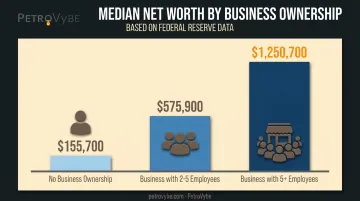
Business ownership alone doesn't guarantee this outcome; owners differ in age, education, and other factors too. But the gradient explains why wealth-minded investors increasingly look past a paycheck toward direct ownership stakes, whether in a small business or a producing energy asset.
Financial Education and Educated Risk-Taking
Wealth thinkers study how assets, taxes, and cash flow actually work instead of avoiding the subject or gambling blindly. Across nearly 69,000 adults surveyed in 39 countries, only 34% met the OECD's minimum financial literacy target, and those who did scored measurably higher on financial resilience.
Education doesn't guarantee returns. But it's the difference between calculated risk and reckless risk.
Radical Responsibility and Action
Wealth builders stop blaming the economy, their employer, or bad luck, and start asking what they control. Research on locus of control found that people with a more internal sense of control over their finances consistently saved more, in both absolute terms and as a share of their income.
Mindset without action is just a nice thought. The pattern only matters once it turns into a budget, an automated contribution, or a new skill.
What Creates 90% of Millionaires? The Truth About Asset Ownership
You've probably seen the quote floating around social media: "90% of millionaires became so through owning real estate," often attributed to Andrew Carnegie. It's a compelling line. It's also not something any credible, current dataset actually verifies.
Here's what the real research shows instead. Ramsey Solutions surveyed 10,000 U.S. millionaires and found:
- 79% received no inheritance at all, building their wealth from scratch
- 8 in 10 invested through an employer retirement plan
- Only 31% averaged $100,000 a year across their entire career
Translation: most millionaires weren't high earners who got lucky. They were disciplined savers and investors who consistently directed money toward appreciating assets, year after year.
Why Earned Income Alone Rarely Builds Wealth
W-2 income comes with built-in friction. It's automatically withheld before you ever see it, subject to ordinary federal tax brackets up to 37%, plus Social Security and Medicare taxes on top. It's also linear: trading hours for dollars means income stops the moment you do.
Compare that to qualifying long-term capital gains, which are often taxed at 0%, 15%, or 20%, frequently a lower rate than wages, especially for high earners.
That's not a universal rule for every type of investment income. But it illustrates why "save what's left of my paycheck" and "acquire assets that produce cash flow" lead to very different outcomes over a decade.
Beyond Stocks and Real Estate
Ownership thinking doesn't stop at a 401(k) or a rental duplex.
A growing number of accredited investors are looking at alternative, tangible assets: private equity, natural resources, direct business equity. They're drawn by the same forces that made real estate popular, including appreciation potential, cash flow, and tax efficiency, particularly as inflation eats into cash savings.
This is where PetroVybe fits the pattern. PetroVybe is a private Texas natural gas development company that gives accredited investors direct equity ownership in early-stage producing gas assets in Lavaca County and the Gulf Coast Basin. It's the underlying asset itself, not a stock or a fund.
What makes this ownership approach distinct:
- Tangible asset appreciation through proved reserves (PetroVybe's current portfolio carries a third-party engineered valuation of $48 million)
- Passive monthly cash flow once production ramps up, projected to peak above $10,000/month per unit at scale
- Substantial upfront tax deductions against active income: PetroVybe partners received a 94% deduction in 2024 and 91% in 2025 against W-2 and capital gains income, through the Intangible Drilling Cost deduction
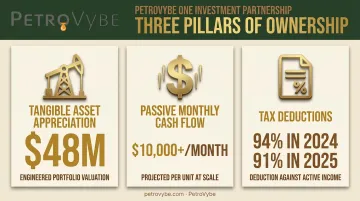
That last point matters because it's structurally different from most real estate deductions, which typically only offset passive income unless you qualify as a real estate professional. IDC deductions can offset active income directly, rewarding the same asset-ownership mindset in a different asset class.
Minimum investment sits at $100,000 and is restricted to verified accredited investors, reflecting the early-stage, higher-risk nature of the projects. It's not for everyone. But it's a clear illustration of what "thinking like an owner" looks like once you move past savings accounts and index funds.
Common Wealth Mindset Traps That Keep You Stuck
Even people who understand these principles get stuck repeating a handful of predictable mental traps.
- "I'm just not good with money." Nobody's born understanding compound interest or tax brackets, and thirty minutes a week reading about how money works closes the gap fast.
- "I'll start investing once I earn more." Spending tends to rise right alongside income — a pattern researchers call lifestyle inflation. Someone who can't save 10% of $50,000 usually can't save 10% of $150,000 either, because the habit was never built.
- Emotional "I deserve this" spending. A rough week doesn't need to end in an impulse purchase; the momentary relief doesn't help your bottom line. Celebrate wins for free: a day off, a call with a friend, a long walk.
How to Start Shifting Your Wealth Mindset Today
Mindset change doesn't happen through one motivational read. It happens through small, repeated actions.
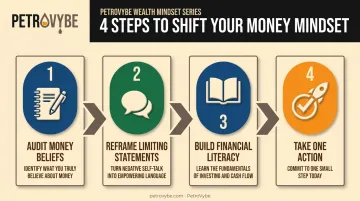
Audit your current money beliefs. For one week, write down every financial thought and decision: what you told yourself before a purchase, a bill, or an investment choice. Scarcity patterns usually surface fast once they're on paper.
Practice reframing limiting statements. Every time "I can't afford it" comes up, follow it immediately with "how could I afford it?" That single question turns a dead end into a problem to solve.
Build baseline financial literacy. Learn the difference between assets and liabilities, passive and earned income, and how tax-advantaged structures like retirement accounts or intangible drilling cost (IDC) deductions actually work. You don't need a finance degree. You need the basics well enough to make informed decisions.
Take one concrete action this month. Open an investment account. Automate a contribution. Research accredited investor requirements if you're getting close to qualifying. Progress compounds, but only once you start moving.
Frequently Asked Questions
What are the 5 types of wealth mindset?
The five patterns are delayed gratification, abundance over scarcity thinking, asset ownership, financial education paired with calculated risk-taking, and radical responsibility. Research links all five to stronger financial outcomes over time.
What creates 90% of millionaires?
There's no verified study confirming that exact 90% figure. What credible research does show is that most millionaires build wealth through consistent saving, employer retirement plans, and long-term asset ownership — not high salaries or inheritance.
Is a wealth mindset something you're born with, or can it be learned?
Money beliefs typically form early in life through family and environment, but they aren't fixed. Awareness, deliberate practice, and consistent small actions can reshape these patterns at any age.
What is the difference between a scarcity mindset and an abundance mindset?
Scarcity thinking focuses on fear and holding onto what you have. Abundance thinking focuses on identifying and creating new opportunities. The practical difference shows up in language: "I can't afford it" versus "how could I afford it?"
How long does it take to shift your money mindset?
There's no fixed timeline. Tracking your financial beliefs, practicing reframes, and taking one concrete step each month typically builds noticeable momentum within a few months of consistent effort.
Can accredited investors apply this asset-ownership mindset to alternative investments like natural gas development?
Yes. Accredited investors increasingly diversify into tangible, income-producing assets like natural gas development for tax efficiency and passive cash flow. PetroVybe's projects apply that same ownership approach, giving partners direct equity in producing wells rather than paper assets.