Across 190 Gulf of Mexico assets, production efficiency benchmarking by SPE found operators achieved just 88% efficiency, with 8% of potential output lost to unplanned downtime alone. That's revenue left on the table, not because reserves ran dry, but because equipment didn't hold up.
Many people treat "asset integrity" as a synonym for maintenance. It isn't. It's a lifecycle-long discipline that starts at design and doesn't end until decommissioning. This article breaks down what asset integrity actually means, why it matters to operators and investors alike, how it differs from asset management, and why well integrity deserves its own spotlight.
Key Takeaways
- Asset integrity spans an asset's entire life cycle, not a single inspection event
- Five stages define asset integrity: design, installation, operation, inspection/maintenance, and decommissioning
- Engineering-focused, asset integrity feeds the broader financial strategy of asset management
- Well integrity specifically targets preventing uncontrolled release of subsurface fluids
- For investors, weak asset integrity directly threatens capital protection and return targets
What Is Asset Integrity in Oil and Gas Operations?
According to IOGP Report 415, asset integrity is the ability of an asset to perform its required function effectively and safely while protecting people, the environment, and operations. That guidance applies the concept to new and existing assets at every lifecycle stage, not just the ones already in the ground.
This matters because integrity isn't a checkbox exercise. It's a continuous process that begins the moment engineers choose materials for a wellhead and doesn't stop until that asset is safely retired.
The Lifecycle Approach to Asset Integrity
Five stages define the full lifecycle:
- Design and material selection - engineers choose corrosion-resistant alloys and build in redundancy before anything touches the ground
- Installation and commissioning - equipment is verified to meet design specifications before it goes into service
- Operation and monitoring - sensors and inspectors track pressure, temperature, and vibration in real time
- Inspection and maintenance - scheduled and risk-based checks catch degradation before it becomes failure
- Decommissioning - assets are retired and plugged in a way that prevents future leaks or contamination
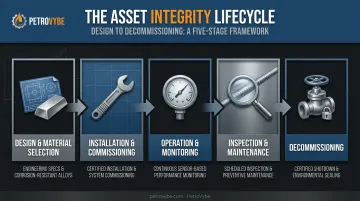
Skipping any one of these stages raises the risk of failure, which is exactly why certain equipment types demand closer scrutiny than others.
Critical Asset Types Requiring Oversight
Not every piece of equipment carries equal risk. The assets that demand the most rigorous integrity oversight include:
- Wellheads
- Pipelines
- Storage tanks
- Pressure vessels
- Flare stacks
Each of these represents a point where contained pressure, hydrocarbons, or both could escape if the physical barrier fails.
Why Asset Integrity Matters in Oil and Gas Operations
Skipping asset integrity doesn't just risk equipment. It risks people, ecosystems, and balance sheets.
Safety. Field workers operate near high-pressure systems and flammable materials daily. Between 2014 and 2019, NIOSH's Fatalities in Oil and Gas Extraction database recorded 470 worker deaths in US oil and gas extraction. Fire and explosion incidents alone accounted for 68 of those deaths, roughly 14.5% of the total.
Environmental. A failed seal or corroded tank can trigger spills and long-term regulatory penalties that follow an operator for years, well beyond the cost of the repair itself.
Financial. Unplanned shutdowns mean lost production and emergency repair costs stacked on top of each other. McKinsey's research on oil and gas technology found that condition-based maintenance can cut unplanned downtime by 20% to 30% for offshore surface equipment. That's a meaningful swing in output for any operator running tight margins.
Regulatory. Operators in Texas answer to the Railroad Commission, which requires a current Form P-5 Organization Report and proof of financial assurance before drilling or producing a single well.
Technical standards add another layer of oversight, with API 510, 570, and 653 governing inspection of pressure vessels, piping, and storage tanks. These standards become enforceable the moment they're written into a permit, and losing compliance can mean losing the license to operate.
Key Pillars of an Effective Asset Integrity Management Program
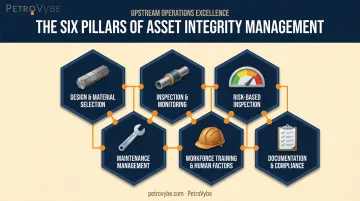
A functioning program rests on six interlocking practices. Skip one, and the whole system weakens.
- Design and material selection - Corrosion-resistant metals and fatigue-resistant engineering prevent decades of downstream degradation, while built-in redundancy gives operators a margin for error.
- Inspection and monitoring - Ultrasonic testing, corrosion mapping, and continuous monitoring give inspectors real-time, spatial data on wall thickness, pressure, and vibration. Drones now inspect flare stacks and other hard-to-reach structures.
- Risk-based inspection (RBI) - Rather than following a fixed calendar, RBI ranks equipment by probability and consequence of failure. API RP 580 sets the framework; API RP 581 supplies the quantitative risk-scoring method.
- Maintenance management - Preventive maintenance follows a schedule; corrective maintenance reacts after failure. Condition-based approaches reduce unplanned downtime by 20% to 30% in offshore surface equipment.
- Workforce training and human factors - An IOGP review of 1,484 fatal industry incidents over 20 years linked basic safety-rule violations to over 70% of fatalities in one studied year. Procedure and culture matter as much as hardware.
- Documentation and regulatory compliance - Tracking inspection history against standards like API 510/570/653 and ISO 55001 gives operators an audit trail and protects long-term accountability.
Asset Integrity vs. Asset Management: What's the Difference?
These terms get used interchangeably, but they answer different questions.
| Aspect | Asset Management | Asset Integrity |
|---|---|---|
| Scope | Portfolio-wide business strategy | A single asset's technical condition |
| Definition | Balances cost, risk, and performance across the organization (ISO 55000) | Confirms whether a pressure vessel, wellhead, or pipeline can safely operate now and years from now |
| Core Question | "Is this asset worth funding?" | "Can this asset do its job safely?" |
Here's how they connect: integrity data (inspection results, corrosion rates, risk scores) feeds directly into asset management decisions. A CFO deciding whether to fund a workover or divest an asset relies on integrity reports to make that call.
Without solid integrity data, asset management decisions become guesswork.
Well Integrity: A Critical Piece of Oil and Gas Asset Integrity
Well integrity deserves its own category because a well isn't just equipment. It's the direct interface between a subsurface reservoir and the surface, and that interface has to hold for decades.
The Society of Petroleum Engineers (SPE) defines well integrity as the application of technical, operational, and organizational solutions to reduce the risk of uncontrolled release of formation fluids across a well's entire lifecycle.
Primary Well Barriers
Containment relies on multiple layers working together:
- Casing and cement - set during construction to isolate formations and prevent flow between zones
- Wellhead components - provide surface pressure containment
- Packers and seal rings - create mechanical barriers within the annulus, the space between casing and tubing
These layers form what engineers call containment envelopes. If one barrier degrades, the others are designed to hold until repairs happen.
Why Well Integrity Carries Unique Weight
Unlike a pipeline or storage tank, a well connects directly to a pressurized reservoir that can't simply be shut off at a valve on the surface. A breach here risks uncontrolled flow, not just a contained leak.
For project stakeholders, well integrity translates straight into production consistency. A well that maintains its barriers produces predictably over its projected decline curve. One that doesn't risks premature abandonment, unrecovered reserves, and a permanently smaller return on the capital that funded it.
How PetroVybe Applies Asset Integrity Principles to Protect Investor Capital
For accredited investors, asset integrity directly affects whether a project hits its targeted return or falls short.
At PetroVybe, that discipline starts before drilling begins and continues long after the rig leaves the site.
Where Integrity Checks Happen
PetroVybe builds integrity checks into three stages of a project's life:
- Prospect selection: Chief Geophysicist Michael Stamatedes brings a 75.2% career hit rate on profitable well locations, built over 48 years — well above the industry peer average of under 40%.
- Ongoing performance monitoring: VP of Asset Intelligence & Performance Luke McIntosh translates operational and production data into intelligence that supports decisions across PetroVybe's South Texas and Gulf Coast Basin assets.
- Independent validation: PetroVybe's proved reserves valuation of $48MM (PV-09) was determined by a licensed third-party engineering firm, not an internal estimate.
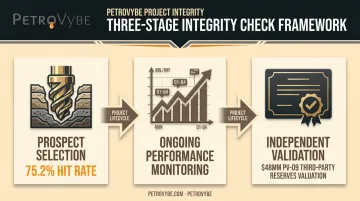
This structure spreads integrity checks across the full project lifecycle, from geology to daily operations to outside verification.
For any accredited investor evaluating an oil and gas sponsor, asking direct questions about these practices, not just projected returns, is one of the more useful due diligence steps available. Sponsors who protect their physical assets tend to protect investor capital as well.
Frequently Asked Questions
What is asset integrity in the oil and gas industry?
Asset integrity is the ability of oil and gas equipment to perform its required function safely and effectively across its full lifecycle, from design through decommissioning. It's an ongoing engineering discipline that continues throughout the asset's entire operating life.
What is the difference between asset management and asset integrity?
Asset management is the broader business strategy for maximizing value across a portfolio of assets. Asset integrity is the narrower, technical discipline focused on whether a specific piece of equipment remains physically sound and safe to operate.
What is well integrity in the oil and gas industry?
Well integrity refers to the technical, operational, and organizational measures used to prevent uncontrolled release of subsurface fluids throughout a well's life. It relies on barriers like casing, cement, packers, and wellhead components.
What are the main causes of asset integrity failures in oil and gas?
Corrosion, material fatigue, aging infrastructure, and human error top the list. Rule noncompliance and organizational lapses also drive a significant share of industry incidents, making training just as critical as hardware.
How often should oil and gas assets be inspected?
There's no universal fixed schedule. Frequency depends on a risk-based inspection score, calculated under frameworks like API RP 580/581, along with whatever regulatory standards apply to that specific asset type.
Why should investors care about asset integrity?
Strong asset integrity practices protect the physical assets that generate returns. Poor integrity risks unplanned downtime, regulatory penalties, and lost production, all of which directly threaten capital protection and projected investor returns.