
Get it wrong, and a buyer can inherit undisclosed environmental claims, lose a valuable depreciation deduction, or pay a goodwill premium that never shows up in cash flow. In a sample of 123 private-target M&A agreements tracked by the American Bar Association from 2020 through Q1 2021, only 18.7% were structured as asset deals — meaning most buyers chose stock purchases, often for continuity, not because it was universally the smarter tax move.
This guide breaks down both structures so you can match the deal to the goal.
TL;DR
- Asset deals let buyers cherry-pick assets and liabilities; share deals transfer the whole entity, warts and all.
- Tax basis differs sharply: asset purchases get a stepped-up basis under IRS rules, while stock deals inherit the seller's basis.
- Undisclosed liabilities default to the buyer in stock deals; asset buyers can exclude them contractually, with exceptions.
- Distressed sales and asset-heavy sectors like oil & gas favor asset deals; contract- and IP-heavy businesses lean toward share deals.
Asset Acquisition vs Share Purchase: Quick Comparison
Here's the side-by-side breakdown buyers and their counsel reference most often when structuring a deal:
| Factor | Asset Acquisition | Share Purchase |
|---|---|---|
| Pricing | Priced per asset using fair value allocation (residual method); no blanket premium for unwanted parts | Priced on total equity value, often including a goodwill premium |
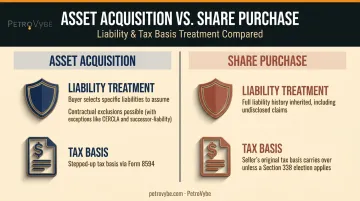
| Liability | Buyer selects specific liabilities; lower risk of inheriting unknown obligations | Buyer takes on the target's full liability history, including undisclosed claims |
| Tax basis | Allocated via IRS residual method (Form 8594); can create a depreciable/amortizable step-up | Buyer generally inherits the seller's existing basis unless a Section 338 election applies |
| Closing speed | Slower — requires itemizing and retitling each asset and contract | Typically faster — transfers the entity as one transaction |
| Contracts & licenses | May require third-party consent to assign | Generally remain intact since the legal entity doesn't change |
The Liability Nuance Most Buyers Miss
Stock deal liabilities don't literally "transfer" to the buyer. They stay put — inside the same corporation the buyer now owns. That distinction carries real consequences. The buyer inherits economic exposure simply by owning the entity that holds those liabilities.
Asset buyers, meanwhile, can contractually exclude unwanted liabilities. But that protection isn't absolute. Successor-liability doctrines, fraudulent-transfer rules, and environmental statutes like CERCLA can still attach regardless of what the purchase agreement says.
The Tax Basis Nuance
A conventional stock purchase leaves the target's inside asset basis untouched. Buyers who want a step-up anyway can pursue a Section 338(g) or 338(h)(10) election, which treats the deal as a deemed asset sale for tax purposes. This election can trigger additional seller-side tax costs that need modeling before signing.
What Is Asset Acquisition?
An asset acquisition is exactly what it sounds like: the buyer purchases specific assets, and sometimes select liabilities, instead of buying the company's stock. The seller's legal entity remains intact (or gets wound down separately) while the buyer walks away with only the pieces it wants.
This structure is common in asset-heavy sectors like oil & gas, real estate, and distressed retail, where the value sits in tangible property rather than in the corporate wrapper around it.
Two core benefits drive buyers toward this structure:
- Selective control. Buyers pick only the assets that create value, avoiding integration waste and operational risk tied to the seller's broader business.
- Tax efficiency. A stepped-up basis on acquired assets, allocated under the IRS residual method via Form 8594, can mean higher depreciation and amortization deductions. Section 197 intangibles like goodwill are generally amortized over 15 years, improving after-tax cash flow well beyond closing.
Asset deals also come in several flavors: full asset purchases, partial carve-outs, and distressed or bankruptcy sales. Most notably, Section 363 sales let a bankruptcy court authorize a sale free and clear of qualifying claims.
Use Cases of Asset Acquisition
Buyers reach for this structure when they want to build a portfolio piece by piece rather than swallow an entire company:
- Upstream oil & gas: Acquiring producing wells, mineral or working interests, and leasehold acreage rather than an operator's full corporate entity.
- Bankruptcy liquidations pick up equipment, real estate, or producing assets out of Chapter 11 free of certain successor claims.
- Gradual control plays involve buying a target's most critical assets first before considering a fuller acquisition later.
This bankruptcy liquidation dynamic played out directly in the Catalina Sea Ranch case, where a Section 363 sale order transferred assets free and clear of asserted successor-liability claims, according to Jones Day's analysis of the case. It's a useful illustration, but the protection depends entirely on the sale order's wording and proper notice, not blanket immunity from every future claim.
What Is Share Purchase?
A share purchase, or stock acquisition, means buying the target's equity to gain control of the entire legal entity: assets, liabilities, contracts, and licenses included. Nothing gets itemized or retitled because the entity itself doesn't change hands; only its ownership does.
The appeal here comes down to continuity and speed:
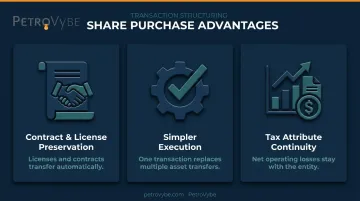
- Contract and license preservation. Government licenses, permits, and long-term customer contracts transfer automatically since the legal entity stays the same, minimizing disruption.
- Simpler execution. One transaction closes the deal rather than dozens of individual asset transfers and consent requests.
- Tax attribute continuity. Net operating losses and other tax attributes stay with the entity, preserving benefits an asset sale would otherwise forfeit.
Subtypes range from a full 100% buyout to majority or controlling-stake purchases, plus the distinction between public company tender offers and privately negotiated stock deals.
Use Cases of Share Purchase
This structure wins out when a target's real value lives in things that are expensive or impossible to renegotiate individually:
- Technology and SaaS companies, where customer contracts and IP licensing agreements are the business
- Healthcare providers, since regulatory licensure like Knox-Keene Act approvals can take months to reissue
- Franchise operations carrying territory agreements with significant embedded value
Molina Healthcare's 2023 acquisition of Bright Health's California Medicare Advantage business illustrates this well. Molina structured the deal as a purchase of 100% of the stock of Universal Care, Inc. and Central Health Plan of California, according to the stock purchase agreement filed with the SEC.
Keeping the licensed entities intact meant provider contracts and Knox-Keene approvals stayed in place rather than requiring fresh applications.
Asset Acquisition vs Share Purchase: Which Structure Wins?
There's no default answer. Buyers weigh risk tolerance for unknown liabilities, tax priorities, deal size, and how much the target's value depends on intact contracts versus physical assets.
As a rule of thumb:
- Choose asset acquisition when tax efficiency and liability control matter most — common in oil & gas and distressed deals.
- Choose share purchase when preserving licenses, contracts, or regulatory approvals is the priority.
PetroVybe's growth strategy in South Texas and the Gulf Coast Basin reflects the asset-acquisition side of that equation. Rather than pursuing corporate stock deals, the company sources off-market working interests, leasehold acreage, and producing wells directly.
Entity-level stock deals in oil & gas can carry hidden plugging obligations, environmental exposure, or title defects buried in decades of ownership history.
Direct asset acquisitions let PetroVybe's leadership control exactly which risks come with a deal, while passing direct tax benefits like intangible drilling cost (IDC) deductions through to investors. President & COO Blaine Yeary, for instance, scaled a $5 billion asset from zero to 35,000 BOEPD over eight years.
That approach has produced real numbers:
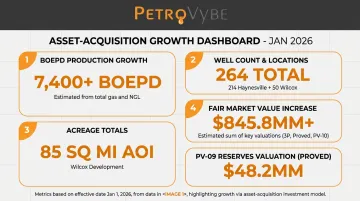
- Growth to ~1,300 BOEPD across roughly 400 wells and 58,000 acres
- A 21x fair market value increase on one project
- A $48 million proved reserves valuation (PV-09), verified by an independent third-party engineering firm
For accredited investors, PetroVybe ONE offers direct participation in this asset-acquisition model starting at $100,000. Partners have received 91–94% tax deductions against active income in recent years, alongside a targeted 10-year MOIC of 2.2x to 5.8x and ~26% IRR.
If tax efficiency and long-term MOIC growth matter more to you than owning a corporate shell, schedule a discovery call with PetroVybe's team to see whether this asset-based structure fits your portfolio.
Conclusion
Neither structure wins outright. The right call depends on your risk appetite, your tax goals, and whether the target's value lives in physical assets or in contracts and licenses that would be costly to replace.
Asset acquisitions protect buyers from legacy liabilities and unlock tax-advantaged growth — the model PetroVybe has built its oil & gas portfolio around. Share purchases preserve continuity for buyers acquiring an ongoing, contract-dependent business where disruption is the bigger risk. Match the structure to the risk that threatens your deal most, whether that's inherited liability or business disruption, and the right choice becomes clear.
Frequently Asked Questions
What do you mean by asset acquisition?
An asset acquisition is the purchase of specific assets (and sometimes liabilities) instead of company stock. It doesn't meet the accounting definition of a business combination under ASC 805 if it fails the standard's screen test for concentrated fair value.
What are the 4 types of acquisitions?
The four common structures are asset acquisition (buying specific assets), stock/share acquisition (buying equity), merger (one entity absorbed into a survivor), and consolidation (constituent entities combine into a new successor entity).
What is an example of asset acquisition?
A company buying a bankrupt competitor's equipment and real estate out of Chapter 11 is a classic example. In oil & gas, this also looks like acquiring specific producing wells and leasehold acreage rather than the seller's entire corporate entity.
Do you have goodwill in an asset acquisition?
Generally, no. Under GAAP, goodwill is only recognized in a business combination. Asset acquisitions instead allocate any excess purchase price across the acquired assets based on relative fair value.
What is the main difference between an asset acquisition and a share purchase?
Asset deals let buyers select specific assets and liabilities while avoiding unknown risk. Share deals transfer the entire legal entity, including all its liabilities, contracts, and licenses, whether disclosed or not.
Which is better for a buyer: asset purchase or stock purchase?
Neither is universally better. Asset purchases suit buyers prioritizing tax efficiency and liability control, while stock purchases suit buyers who need existing contracts and licenses to stay intact without renegotiation.