

That's a mistake. When equipment gets sold, working capital gets released, or decommissioning bills come due, real money changes hands. Skip that calculation and your NPV or IRR analysis can misread a project's actual profitability, sometimes badly enough to flip an accept decision into a reject (or vice versa).
This article breaks down what terminal cash flow actually means, walks through the formula component by component, and works a full numerical example. We'll also clear up the confusion between terminal cash flow and "terminal value," two terms that get mixed up constantly despite meaning very different things.
Key Takeaways
- Terminal cash flow (TCF) is the net cash recovered at a project's end of life.
- The formula combines after-tax salvage proceeds with recovered net working capital.
- This total flows into the final year's operating cash flow before running NPV/IRR analysis.
- TCF is not the same as terminal value, a separate DCF concept for ongoing businesses.
- Ignoring TCF distorts a project's calculated return, particularly in asset-heavy industries like oil and gas.
What Is Terminal Cash Flow?
Terminal cash flow is the net cash inflow or outflow that occurs when a project shuts down. It captures three things happening at once: equipment gets sold or scrapped, working capital tied up in inventory and receivables gets released, and taxes get settled on whatever gain or loss the disposal created.
Unlike operating cash flows, which repeat every year the project runs, TCF is a one-time event. It shows up exactly once, in the final period of the project's life.
Why this matters for accept/reject decisions: Capital budgeting frameworks consistently model project cash flows in three stages: initial investment, operating period, and terminal closure. The terminal stage is treated as a distinct, required input, not an optional add-on.
Leave it out, and you've effectively told your model the project generates zero cash at wind-down. For a business with substantial salvageable equipment or recoverable working capital, that's rarely true.
Where this shows up most often:
- Manufacturing — machinery gets sold at the end of a production run
- Construction — heavy equipment gets liquidated once a project wraps
- Resource extraction — oil and gas wells reach their economic limit and get decommissioned
Across these industries, TCF isn't always a positive number. If an asset's salvage value falls short of its remaining book value, or if decommissioning obligations pile up, the terminal cash flow can turn negative. That's a critical detail for any asset with meaningful teardown costs.
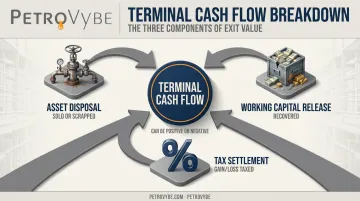
Terminal Cash Flow Formula & Key Components
The core formula is straightforward:
TCF = After-Tax Proceeds from Asset Disposal + Net Change in Working Capital
Some models add a third term for closure costs. Let's break down each piece.
After-Tax Disposal Proceeds
This component answers one question: how much cash actually lands in the company's account after taxes are applied? The formula is:
After-tax proceeds = S − t(S − BV)
Where S is the sale or salvage price, BV is the asset's book value at disposal, and t is the applicable tax rate. For example, a $500,000 sale against a $200,000 book value at a 21% tax rate yields after-tax proceeds of $437,000.
- If S > BV, you've got a taxable gain, which reduces the cash you keep.
- If S < BV, you've got a loss, which can create a tax benefit that increases TCF.
- If S = BV, there's no disposal tax at all.
Net Working Capital Recovery
Every project ties up cash in inventory, receivables, and similar accounts during its life. Once the project ends, that capital gets freed up and flows back to the company. This recovery gets added directly into the TCF calculation, no tax adjustment needed since it's simply the return of capital already invested.
Additional Line Items
More advanced models sometimes tack on decommissioning or site-restoration costs as a separate outflow. This is especially relevant for oil and gas operators managing plugging and abandonment (P&A) obligations, where the cost of properly closing a well can meaningfully offset salvage proceeds. Developers like PetroVybe, which operates natural gas projects in Texas's Lavaca County, build these P&A costs into project economics from day one rather than treating them as a late-stage surprise.
Formula at a glance:
| Variable | Meaning |
|---|---|
| S | Sale or salvage proceeds |
| BV | Book value at disposal |
| t | Applicable tax rate |
| NWC | Net working capital recovered |
| Closure costs | Decommissioning/site restoration (if applicable) |
How to Calculate Terminal Cash Flow: Step-by-Step Example
Picture a company evaluating a project that requires a piece of equipment. At the end of the project's life, that equipment can be sold, and the working capital invested throughout the project gets released.
- Identify salvage value. The company expects to sell the equipment for $25,000 at project completion.
- Calculate the tax effect on disposal. The equipment's remaining book value is $0, and the applicable tax rate is 40%.
- Taxable gain: $25,000 − $0 = $25,000
- Tax owed: 40% × $25,000 = $10,000
- After-tax proceeds: $25,000 − $10,000 = $15,000
- Determine working capital recovery. The project tied up $20,000 in working capital, all of which gets recovered at closure.
- Sum the components. $15,000 (after-tax proceeds) + $20,000 (working capital) = $35,000 terminal cash flow
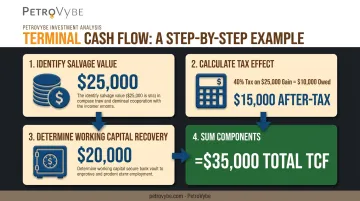
This academic example, drawn from Rose-Hulman's capital budgeting course materials, then adds that $35,000 to the final year's operating cash flow of $54,700, producing a total final-year cash flow of $89,700.
That combined figure, not the $35,000 alone, is what gets entered into the NPV and IRR calculation for the last period.
Notice the discipline here: terminal cash flow stays a distinct line item until the very last step. Blending it into operating cash flow too early makes it easy to miscalculate or double-count.
Terminal Cash Flow vs. Related Concepts
These two ideas get confused constantly, largely because they share the word "terminal." They measure completely different things.
Terminal Cash Flow vs. Terminal Value
Terminal cash flow is a capital budgeting figure. It represents actual cash a company recovers when a specific, finite project ends, equipment gets sold, working capital comes back, taxes get paid.
Terminal value is a valuation concept used in discounted cash flow (DCF) models. It estimates what a business is worth beyond an explicit forecast period, under the assumption that the business keeps operating indefinitely.
As Aswath Damodaran's foundational research on terminal value explains, the stable-growth version of the formula is Terminal Value = Cash Flow(n+1) / (r − g). This assumes perpetual, going-concern operations rather than a project winding down.
| Terminal Cash Flow | Terminal Value | |
|---|---|---|
| Assumes | Finite project life ending in disposal | Perpetual, ongoing operations |
| Used for | Individual project/investment decisions | Whole-company or equity valuation |
| Core inputs | Salvage proceeds, working capital, taxes | Growth rate, discount rate |
With that distinction in mind, terminal cash flow fits into a larger framework: the full cash flow timeline of a capital project.
The Three Types of Cash Flows in Capital Budgeting
Every capital project's cash flow timeline breaks into three categories:
- Initial investment — the upfront outflow for equipment, installation, and initial working capital
- Operating cash flows — the recurring, annual cash generated while the project runs
- Terminal cash flow — the one-time cash event when the project ends
These three stages combine into the full cash flow stream used to calculate NPV and IRR. Miss any one of them, and the resulting return figure won't reflect the project's true economics.
Why Terminal Cash Flow Matters in Oil & Gas Project Evaluation
Oil and gas wells don't produce forever. Every well has a finite economic life, and once production drops below the point of profitability, operators face plugging and abandonment (P&A) obligations. In Texas, that means compliance with Statewide Rule 14. The actual cost varies by well depth and Railroad Commission district, not a flat, one-size-fits-all number.
The Texas Railroad Commission's cost calculation methodology confirms this: plugging cost estimates use the average actual state-funded cost per foot, by district, multiplied against well depth. That's a project-specific number, not a generic industry average.
For anyone evaluating natural gas development opportunities, full project economics, not just operating cash flow, determine the real MOIC and IRR investors should expect. A well can look strong on paper during its production years and still see its terminal cash flow turn negative if closure costs outpace whatever salvage value remains.
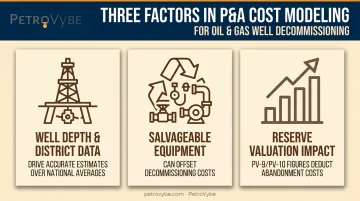
A few things to weigh when modeling this:
- Well-specific depth and district data, not national averages, drive accurate P&A estimates
- Salvageable equipment value at end-of-life can partially offset decommissioning costs
- Reserve valuations (like PV-9 or PV-10 figures) typically deduct abandonment costs from future net revenue as standard industry practice
At PetroVybe, this kind of full-cycle thinking sits at the intersection of engineering and finance. CFO Clayton Riddle brings both a petroleum engineering background and a financial strategist's eye to project evaluation. He previously built corporate financial models across more than 70 upstream and midstream acquisition opportunities at Odyssey Energy.
That dual perspective matters for accredited investors evaluating natural gas development opportunities across South Texas and the Gulf Coast Basin. Knowing the full lifecycle economics of a well, not just its peak production years, shapes a realistic return picture.
Frequently Asked Questions
What is terminal cash flow?
Terminal cash flow is the net cash a company recovers at project termination after disposing of assets, recovering working capital, and settling related taxes. It's a one-time cash event, distinct from the recurring operating cash flows generated during the project's life.
What is the formula for finding the terminal cash flow?
TCF = After-Tax Disposal Proceeds + Net Working Capital Recovery. The disposal proceeds get adjusted for tax using S − t(S − BV), where S is sale price, BV is book value, and t is the tax rate.
Is terminal value the same as NPV?
No. Terminal value is an endpoint figure estimating a business's worth beyond a forecast period. NPV is the total discounted value of all project cash flows, including any terminal value, minus the initial investment.
What are three types of cash flows?
Capital budgeting tracks initial investment, operating cash flows during the project's life, and terminal cash flow at project completion. Together, they form the full cash flow timeline used for NPV and IRR calculations.
Why is terminal cash flow important in capital budgeting?
Omitting terminal cash flow understates a project's true return, which can lead to bad accept/reject decisions. This is especially significant for asset-heavy industries where salvage value and working capital recovery are substantial.
Can terminal cash flow be negative?
Yes. If disposal or decommissioning costs exceed after-tax salvage proceeds and recoverable working capital, TCF turns negative. Oil and gas projects often face this scenario, given the sizable plugging and abandonment obligations involved.