
According to the Federal Reserve's 2025 report on the 2024 Small Business Credit Survey, 51% of employer firms cited uneven cash flow as a financial challenge, and 56% struggled just to cover operating expenses.
That volatility is exactly why recurring revenue has become one of the most sought-after financial structures for business owners and individual investors alike. Predictable, scheduled cash inflows let you budget with confidence instead of guessing.
This guide covers what recurring cash flow actually means, the formula behind it, how it differs from one-time income, and the proven models, both business-based and investment-based, that can help you build it.
Key Takeaways
- Recurring cash flow reoccurs predictably on a set schedule, unlike one-time revenue
- Formula: Recurring Cash Flow = Recurring Revenue − Recurring Operating Expenses, adjusted for non-cash items
- SaaS firms with 120%+ net revenue retention command a 21x valuation multiple, versus 9x below that mark
- Individuals can build recurring cash flow through dividends, rental income, or assets like natural gas royalties
What Is Recurring Cash Flow?
Recurring cash flow is money that flows into a business or personal account on a predictable, repeating schedule, cash you can reasonably forecast months or years in advance. Think subscription fees, retainer payments, or lease royalties rather than a one-off equipment sale.
The formula:
Recurring Cash Flow = Recurring Revenue − Recurring Operating Expenses (adjusted for interest, depreciation, and amortization add-backs, with one-time items stripped out)
Here's a simple example. A natural gas producer collects $50,000 in monthly royalty and lease revenue and pays $30,000 in recurring field operations, royalty processing, and payroll costs. Add back $2,000 in depreciation and strip out a $5,000 one-time legal fee already buried in expenses. Recurring cash flow lands at $22,000 a month, a number you can actually plan around.
Predictable cash flow matters because it:
- Enables accurate budgeting and payroll planning
- Reduces dependence on constantly chasing new customers or investors
- Builds resilience when the market softens
The financial upside is measurable, too. McKinsey found that public B2B SaaS companies with net revenue retention of 120% or higher carried a median enterprise-value-to-revenue multiple of 21x, compared to just 9x for companies below that threshold. Recurring revenue quality also shapes how the market prices your business.
Common Recurring Revenue Models in Business
Not all recurring revenue behaves the same way. The billing model you choose directly shapes how predictable your cash flow actually is:
- Flat-rate: One fixed fee, same amount every cycle, easiest to forecast
- Tiered: Pricing that steps up based on usage bands
- Freemium: Free basic access, paid upgrades for added features
- Usage-based: Charges tied to actual consumption, which can swing month to month
- Hybrid: A base subscription fee plus variable usage charges
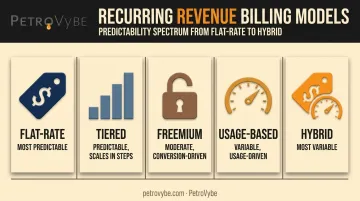
Usage-based and hybrid models still repeat on a schedule, but the dollar amount can vary considerably, making them less predictable than flat-rate billing.
Recurring vs. Non-Recurring Cash Flow: What's the Difference?
Non-recurring cash flow is money that shows up once, or so rarely you can't count on it again: a lawsuit settlement, the sale of old equipment, a one-time grant. It's real money, just not a foundation to budget on.
Why the distinction matters on your financial statements: recurring items typically flow through operating activities, the section reflecting your core, ongoing business. Non-recurring items can land in operating, investing, or financing activities depending on their source, which makes them easy to misclassify as reliable income.
GAAP eliminated the formal "extraordinary item" category back in 2015, but the practical need to separate recurring from non-recurring performance never went away.
Consider two small businesses:
| Business | Cash Source | Recurring? |
|---|---|---|
| Company A | 40 clients on monthly landscaping contracts | Yes, steady and forecastable |
| Company B | Sold an old delivery truck for $15,000 | No, a one-time inflow |
If Company B's owner starts budgeting as though that $15,000 will recur, they're setting themselves up for a shortfall the moment bills come due without a truck sale to cover them.
This is where conflating the two categories creates a false sense of security. A business can look flush with cash one quarter and scramble the next, simply because a one-time inflow got lumped in with the predictable stuff.
Investors and lenders don't make this mistake. When evaluating a company for a loan or acquisition, they strip out non-recurring items and focus on the recurring cash flow baseline. It's the single best predictor of whether a business can service debt and grow without needing a lucky windfall every few months.
How Businesses Build Recurring Revenue: Proven Models
Building recurring revenue means choosing a model that fits your business, then running the forecasting discipline that turns booked revenue into actual cash in the bank.
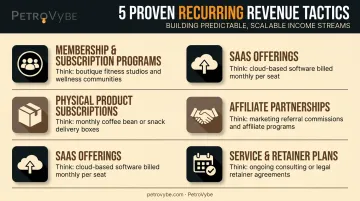
Five proven tactics:
- Membership and subscription programs - a recurring fee for ongoing access, content, or community, common in fitness, media, and education
- Physical product subscriptions - replenishable goods shipped on a schedule (coffee, razors, supplements) so customers never reorder manually
- SaaS offerings - monthly or annual license fees, often the gold standard for recurring revenue multiples
- Affiliate partnerships - recurring commissions from referred customers who keep paying the partner company over time
- Service and retainer plans - a fixed monthly fee for ongoing services like accounting, marketing, or legal counsel instead of one-off projects
Zuora's 2025 Subscription Economy Index found that its cohort of more than 600 subscription companies grew revenue 11% faster than the S&P 500 between 2022 and 2024, evidence that recurring models can outpace broader market growth when executed well.
But the model alone isn't enough. Disciplined forecasting is what actually converts recurring revenue into reliable cash flow:
- Separate revenue recognition (when you record the sale) from actual cash receipt timing (when money hits your account)
- Define which inflows and outflows count as recurring versus one-time
- Monitor performance monthly, not quarterly, so declines get caught early
Even a strong subscription base doesn't guarantee cash flow. Churn eats into recurring revenue every month. Customers pay late. Markets shift. Recurring revenue reduces uncertainty, but it doesn't eliminate it.
Diversifying Your Cash Flow: Building Recurring Income Through Natural Gas Development Investments
Recurring cash flow principles don't stop at running a business. Accredited investors and high-income earners can build a personal recurring cash flow stream through income-generating alternative assets, and natural gas development is one of the more overlooked options.
How it works: as producing wells generate natural gas and NGLs (natural gas liquids), development companies distribute a share of production revenue to investors on a recurring basis. It functions much like a subscription's recurring revenue, except it's backed by a tangible, depleting physical asset instead of a customer relationship.
One company applying this model is PetroVybe, a Texas-based natural gas development company that gives accredited investors direct access to early-stage development projects in South Texas and the Gulf Coast Basin. The structure targets:
- A 10-year MOIC of roughly 2.2x to 5.8x
- A target IRR near 26%
- Monthly distributions projected to peak above $10,000 per unit during the production phase
- A minimum investment of $100,000 per unit
SEC rules require accredited investor status to participate, generally net worth over $1 million excluding a primary residence, or income over $200,000 individually ($300,000 with a spouse) in each of the past two years.
The tax layer most passive income streams don't have:
Natural gas development carries a distinct advantage: Intangible Drilling Cost (IDC) deductions. Unlike most passive recurring income, qualifying IDCs can offset active income, including W-2 wages and capital gains, not just passive gains.
PetroVybe partners have seen this play out directly. The company reports a 94% tax deduction against active income for 2024 partners and 91% for 2025, on top of a projected ~70% first-year deduction tied to IDC costs alone.
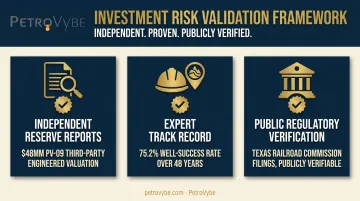
Reducing risk through third-party validation:
- Independent engineering firms produce reserve reports, including third-party PV-09 valuations
- Chief Geophysicist Michael Stamatedes brings a 75.2% well-success track record over a 48-year career, well above typical industry averages
- Public regulatory records, like Texas Railroad Commission filings, let investors independently verify operator licenses
For investors already running a business built on recurring revenue, adding a natural gas development position diversifies where that recurring cash flow comes from entirely, uncorrelated with customer churn or software pricing pressure. Learn more about how these projects are structured at petrovybe.com.
Tips to Protect and Maximize Your Recurring Cash Flow
Recurring revenue on paper isn't the same as recurring cash in your account. A few habits keep the two aligned:
- Track recurring cash flow separately from total revenue or valuation. Lumping in one-time inflows overstates what's actually available to spend, and that gap shows up fast when bills come due.
- Monitor performance continuously, whether that's subscription retention or well production data. Catching a decline early gives you time to react before it compounds.
- Diversify your recurring income sources. Relying on one asset class exposes you to a single point of failure, so pair operating revenue with passive investments, like dividend stocks, rental property, or natural gas development royalties, to hedge against inflation and sector-specific downturns.
None of this eliminates risk entirely. But businesses and investors who actively manage their recurring cash flow, rather than assuming it takes care of itself, are the ones who see it compound over time.
Frequently Asked Questions
What does recurring cash flow mean?
Recurring cash flow is money that repeats predictably on a set schedule, whether monthly, quarterly, or annually, giving businesses and investors a reliable basis for forecasting. It excludes one-time windfalls like asset sales or settlements.
What's the difference between recurring and non-recurring cash flow?
Recurring cash flow comes from ongoing, predictable sources like contracts or subscriptions. Non-recurring cash flow comes from one-time or infrequent events, and mixing the two distorts both forecasting and valuation.
What is the formula for recurring cash flow?
Recurring Cash Flow = Recurring Revenue − Recurring Operating Expenses, adjusted for non-cash add-backs and one-time items. For example, $50,000 in monthly subscription revenue minus $30,000 in recurring costs nets $20,000 in monthly recurring cash flow.
What are some examples of recurring revenue streams?
Common examples include subscriptions, membership fees, service retainers, SaaS licensing fees, and royalty or distribution payments from investments like natural gas development projects.
How can I add recurring cash flow to my personal investment portfolio?
Dividend-paying stocks, rental real estate, and alternative assets such as natural gas development royalties all generate recurring distributions. Diversifying across these categories helps smooth out sector-specific volatility.
Is passive income from oil and gas royalties considered recurring cash flow?
Yes, royalty and distribution payments from producing wells function as recurring cash flow. That said, the amount can fluctuate with production output and commodity prices, so it's variable rather than fixed.