
Introduction
More money is about to change hands than at any point in modern history. UBS's Global Wealth Report puts the figure at more than $83 trillion moving over the next 20 to 25 years, as Baby Boomers pass assets to spouses, children, and grandchildren.
Here's the problem: most people receiving this money aren't ready for it. Heirs and widows alike get blindsided by taxes and unfamiliar estate documents, then freeze when it's time to invest a lump sum larger than anything they've handled before.
This article breaks down who stands to inherit, how much, why so many feel unprepared, and what to actually do with a sudden inheritance so it grows instead of disappearing.
Key Takeaways
- UBS projects over $83 trillion will transfer globally over the next two to three decades
- New wealth holders are trending younger, more female, and more openly queer
- Nearly one-third of women inheriting from parents never had a prior conversation about the plan
- 83% of widows report difficulty taking sole control of household finances after a spouse dies
- Tax-efficient, diversified strategies, including alternative assets like oil and gas, are essential for preserving inherited wealth
What Is the Great Wealth Transfer?
The Great Wealth Transfer refers to the decades-long shift of assets from Baby Boomers into the hands of Gen X, Millennials, Gen Z, and surviving spouses. This shift is already underway, moving gradually rather than all at once, and it will accelerate through the 2030s and 2040s.
According to UBS's Global Wealth Report research, the total sits at more than $83.5 trillion over 20 to 25 years. That figure includes both spousal transfers and the eventual downward movement to children and grandchildren.
Separately, US-focused research from Cerulli Associates projects $124 trillion through 2048 in the American market alone. The methodology and geography differ, but the conclusion holds: an enormous concentration of wealth is about to move.
Why Boomers Hold So Much, So Long
Boomers control a disproportionate share of global assets for a simple reason: they built careers, bought real estate, and invested during multiple decades of market growth. Rising life expectancy has stretched the timeline further.
- The average person transferring wealth is now about 84 years old
- The average recipient is around 59
- That means many heirs are receiving inheritances in their late-career years, not their twenties
Expect that recipient age to drift younger over the next decade as transfers accelerate and life expectancy trends shift.
How Much Money Will Be Transferred in the Great Wealth Transfer?
The headline number, more than $83 trillion globally over 20 to 25 years, breaks down into two distinct movements that matter for planning purposes.
Vertical transfers (parent to child) account for the bulk of it, estimated at more than $74 trillion. But before that downward shift happens, there's a horizontal step most people overlook.
The $9 Trillion Spousal Handoff
Roughly $9 trillion is expected to move horizontally between spouses first, typically from a deceased husband to his surviving wife, before eventually passing to the next generation. This matters because:
- Puts control of significant household wealth into surviving spouses' hands, often with little warning
- Leaves many spouses without prior experience managing investments, tax filings, or estate paperwork
- Delays transfer to children or grandchildren until after this spousal step completes
This sequencing is why widow preparedness has become its own distinct planning category, separate from the broader generational conversation.

The Changing Face of Wealth: Who's Inheriting?
UBS chief economist Paul Donovan has described the incoming wave of wealth holders as "younger, more female — and more openly queer" than any previous generation of wealth owners. This demographic shift reshapes how advisors, banks, and investment platforms need to think about their client base.
The LGBTQ+ Identification Shift
The generational gap here is stark. According to Gallup's 2025 research on LGBTQ+ identification:
| Generation | LGBTQ+ Identification |
|---|---|
| Baby Boomers | 3.0% |
| Gen X | 5.1% |
| Millennials | 14.2% |
| Gen Z | 23.1% |
UBS estimates roughly 20% of the inheriting generation is either openly queer or has openly queer children. Gen X drives much of this figure, since this cohort is currently receiving the bulk of inheritances from Boomer parents.
Why Women Inherit More
Women are statistically positioned to control more of this wealth for two compounding reasons:
- Longevity gap: Women in the US live roughly five years longer than men on average
- Marriage-age gap: Women often marry older partners, so they outlive spouses by an even wider margin in practice
Combined with the $9 trillion horizontal transfer mentioned earlier, this puts women at the center of the wealth transfer story.
How Much Will the Average Millennial Inherit From Their Parents?
There's no single, universally agreed-upon dollar figure for "the average Millennial inheritance," and anyone quoting one precise number should be viewed skeptically. What the data does show:
- Cerulli projects Millennials will inherit $46 trillion collectively over 25 years
- A combined Millennial/Gen Z survey found respondents who'd received or expected an inheritance averaged nearly $320,000, reflecting expectations across two cohorts rather than a confirmed individual median
- Knight Frank's research suggests affluent Millennials specifically could become the wealthiest generation in history, though aggregate cohort wealth isn't the same as a typical individual's inheritance
A Shift in Investment Values
This incoming wealth changes both who holds capital and how it gets invested. Morgan Stanley's Sustainable Signals research found 80% of LGBTQ+ investors and 69% of Millennials express strong interest in values-aligned or impact investing. That's a meaningful signal for anyone building products or portfolios aimed at this generation. Traditional index-fund defaults may not hold the same appeal they did for Boomer investors.
Why Many Heirs Feel Unprepared
Here's the uncomfortable truth: a massive dollar figure moving between generations means very little if the people receiving it don't know it's coming, or what to do once it arrives.
UBS's Own Your Worth research found that nearly a third of women inheriting from parents had no prior conversation about the transfer before it happened. The same research found 83% of widows encountered real difficulty taking sole control of household finances after their spouse passed away.
The pattern shows up across every group studied:
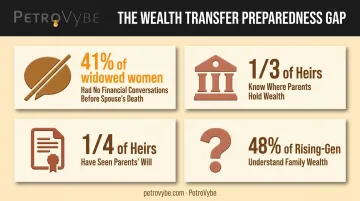
- 41% of widowed women report having no financial conversations or plans in place before their spouse died
- Only about one-third of heirs know where their parents actually hold their wealth
- Roughly one-quarter have ever seen their parents' will
- UBS's Next Generation research found only 48% of rising-gen respondents feel they understand all aspects of their family's wealth
Communication, not money, is the real issue here. Families that start these conversations early close this gap entirely.
Smart Strategies to Preserve and Grow Your Inheritance
Receiving a sudden inheritance creates opportunity and risk in equal measure. Here's how to handle it well.
Start the Conversation Before the Transfer
The single biggest predictor of a smooth transition is communication that happens years, not weeks, before it's needed:
- Ask parents directly about estate plans, asset locations, and will contents
- Widowed or soon-to-be-widowed spouses should get a full inventory of household assets now
- Document everything : account numbers, advisor contacts, insurance policies
Avoid Over-Concentration in Traditional Assets
Many heirs simply drop inherited funds into the same stocks, bonds, and real estate their parents held. That's not automatically wrong, but it does concentrate risk in assets that are highly correlated with each other and with the broader market cycle. Diversifying into less-correlated alternative asset classes can reduce that exposure.
Tax Efficiency Matters From Day One
A lump sum inheritance often lands on top of an existing high income: W2 earnings, capital gains, or both. Without planning, that combination can push someone into a materially higher tax bracket the same year the money arrives.
This is where a specific alternative asset class becomes relevant: oil and gas development investment, structured around Intangible Drilling Cost (IDC) deductions.
Here's how it works. Under IRS rules, qualifying IDCs (labor, fuel, site prep, and other drilling-related costs) can be deducted in the year they're incurred rather than capitalized over time.
Working interests in oil and gas development are also often treated as nonpassive, meaning the deduction can offset active income, including W2 wages and capital gains. Real estate depreciation generally cannot do this unless you qualify as a full-time real estate professional.
PetroVybe, a Texas-based natural gas development company, is one example of a platform structured around this benefit for accredited investors:
- Partners who joined PetroVybe's flagship project in 2024 received a 94% deduction against active income; 2025 partners received 91%
- The project holds a $48 million third-party-engineered proved reserves valuation
- Distributions are projected to peak above $10,000 per month per unit during production, with a targeted 10-year MOIC of roughly 2.2x to 5.8x and an IRR near 26%

Deductions like these aren't automatic or one-size-fits-all: basis, at-risk rules, and alternative minimum tax calculations all apply, and ownership structure matters. That's why the practical recommendation is simple: talk to a tax and wealth advisor experienced in alternative assets before deploying inherited capital anywhere new.
Done thoughtfully, combining an upfront deduction with inflation-hedged passive income can turn a one-time inheritance into a compounding, multi-generational asset rather than a windfall that gets spent down within a decade.
Frequently Asked Questions
How much will the average Millennial inherit from their parents?
There's no single confirmed average. Cerulli projects Millennials will collectively inherit $46 trillion over 25 years, while a combined Millennial/Gen Z survey found expected inheritances averaging nearly $320,000.
How much money will be transferred in the Great Wealth Transfer?
UBS estimates more than $83 trillion globally over 20 to 25 years, including roughly $9 trillion in spousal transfers and $74 trillion moving to the next generation.
When will most of the Great Wealth Transfer take place?
The average person transferring wealth is now about 84, meaning a substantial share is expected to move within the next decade as more Boomers reach average life expectancy.
Why are women expected to control more wealth after the transfer?
Women live roughly five years longer than men on average and often marry older partners, making them more likely to inherit through the $9 trillion spousal transfer before assets pass to children.
What is the biggest mistake heirs make with inherited wealth?
Heirs often fail to plan ahead and get blindsided by taxes. Many also dump the entire inheritance into the same stocks, bonds, and real estate their parents held instead of diversifying.
How can I reduce taxes on a large inheritance?
Alternative investments like oil and gas development can offer IDC deductions against active income, but the details depend on your situation — consult a tax advisor before making any moves.